Pieters Bartijn C H, Arntz Onno J, Bennink Miranda B, Broeren Mathijs G A, van Caam Arjan P M, Koenders Marije I, van Lent Peter L E M, van den Berg Wim B, de Vries Marieke, van der Kraan Peter M, van de Loo Fons A J
Experimental Rheumatology, Radboud university medical center, Nijmegen, the Netherlands.
PLoS One. 2015 Mar 30;10(3):e0121123. doi: 10.1371/journal.pone.0121123. eCollection 2015.
Extracellular vesicles, including exosomes, have been identified in all biological fluids and rediscovered as an important part of the intercellular communication. Breast milk also contains extracellular vesicles and the proposed biological function is to enhance the antimicrobial defense in newborns. It is, however, unknown whether extracellular vesicles are still present in commercial milk and, more importantly, whether they retained their bioactivity. Here, we characterize the extracellular vesicles present in semi-skimmed cow milk available for consumers and study their effect on T cells.
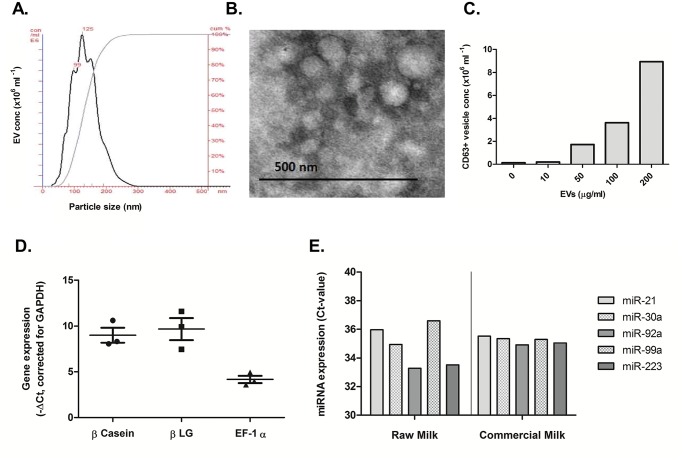
Extracellular vesicles from commercial milk were isolated and characterized. Milk-derived extracellular vesicles contained several immunomodulating miRNAs and membrane protein CD63, characteristics of exosomes. In contrast to RAW 267.4 derived extracellular vesicles the milk-derived extracellular vesicles were extremely stable under degrading conditions, including low pH, boiling and freezing. Milk-derived extracellular vesicles were easily taken up by murine macrophages in vitro. Furthermore, we found that they can facilitate T cell differentiation towards the pathogenic Th17 lineage. Using a (CAGA)12-luc reporter assay we showed that these extracellular vesicles carried bioactive TGF-β, and that anti-TGF-β antibodies blocked Th17 differentiation.
Our findings show that commercial milk contains stable extracellular vesicles, including exosomes, and carry immunoregulatory cargo. These data suggest that the extracellular vesicles present in commercial cow milk remains intact in the gastrointestinal tract and exert an immunoregulatory effect.
细胞外囊泡,包括外泌体,已在所有生物体液中被鉴定出来,并被重新发现是细胞间通讯的重要组成部分。母乳中也含有细胞外囊泡,其推测的生物学功能是增强新生儿的抗菌防御能力。然而,尚不清楚市售牛奶中是否仍存在细胞外囊泡,更重要的是,它们是否保留了生物活性。在此,我们对市售半脱脂牛奶中存在的细胞外囊泡进行了表征,并研究了它们对T细胞的影响。
分离并表征了市售牛奶中的细胞外囊泡。牛奶来源的细胞外囊泡含有几种免疫调节性微小RNA和膜蛋白CD63,这些都是外泌体的特征。与RAW 267.4来源的细胞外囊泡不同,牛奶来源的细胞外囊泡在包括低pH、煮沸和冷冻在内的降解条件下极其稳定。牛奶来源的细胞外囊泡在体外很容易被小鼠巨噬细胞摄取。此外,我们发现它们可以促进T细胞向致病性Th17谱系分化。使用(CAGA)12荧光素酶报告基因检测,我们表明这些细胞外囊泡携带生物活性转化生长因子-β(TGF-β),并且抗TGF-β抗体可阻断Th17分化。
我们的研究结果表明,市售牛奶含有稳定的细胞外囊泡,包括外泌体,并携带免疫调节物质。这些数据表明,市售牛奶中存在的细胞外囊泡在胃肠道中保持完整并发挥免疫调节作用。