Zhong Xiaoyong, Lin Jiumao, Zhou Jianheng, Xu Wei, Hong Zhenfeng
Department of Rehabilitation Medicine, Fujian University of Traditional Chinese Medicine, Fuzhou, Fujian 350108, P.R. China.
Academy of Integrative Medicine Biomedical Research Center, Fujian University of Traditional Chinese Medicine, Fuzhou, Fujian 350108, P.R. China.
Mol Med Rep. 2015 Aug;12(2):1699-708. doi: 10.3892/mmr.2015.3566. Epub 2015 Mar 27.
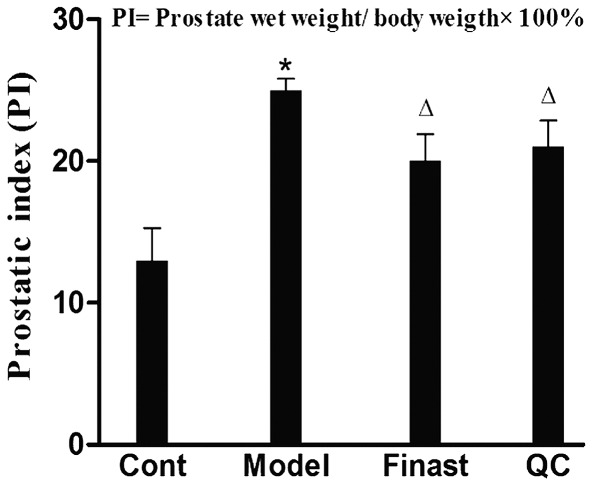
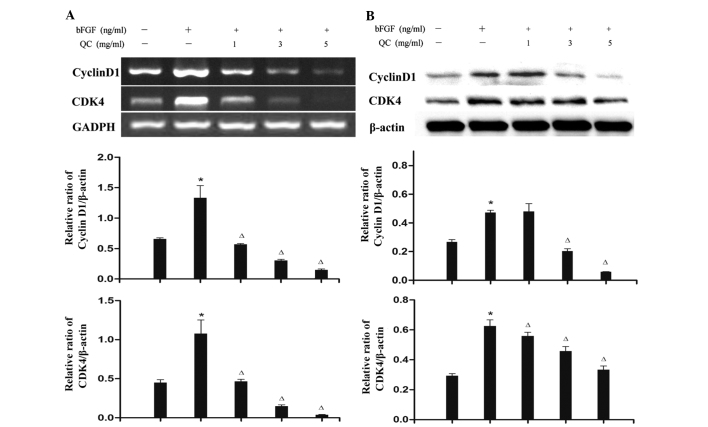
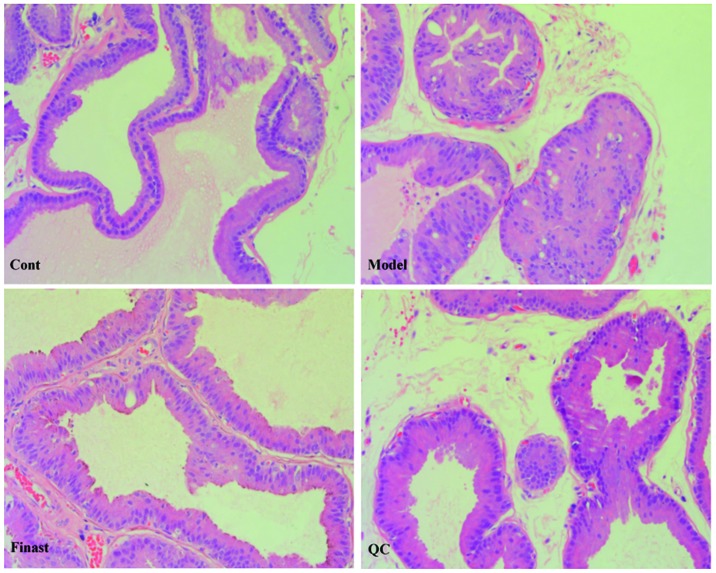
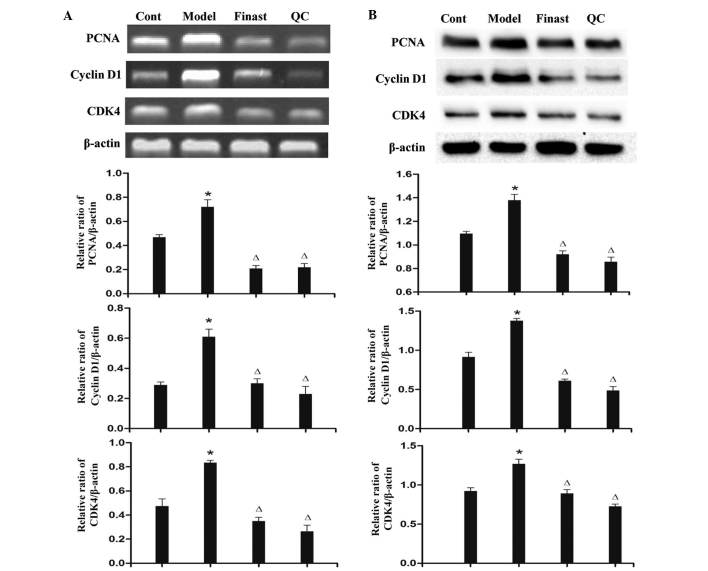
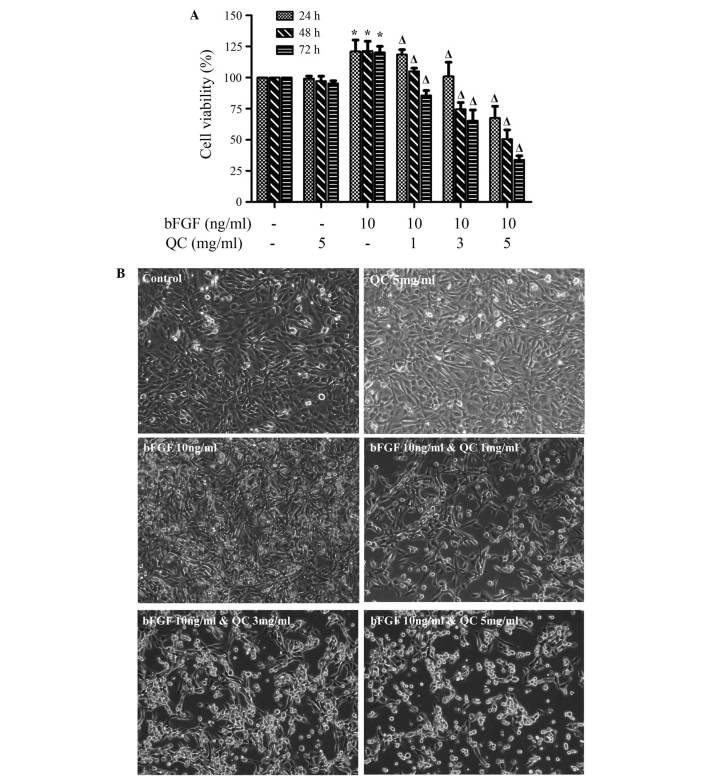
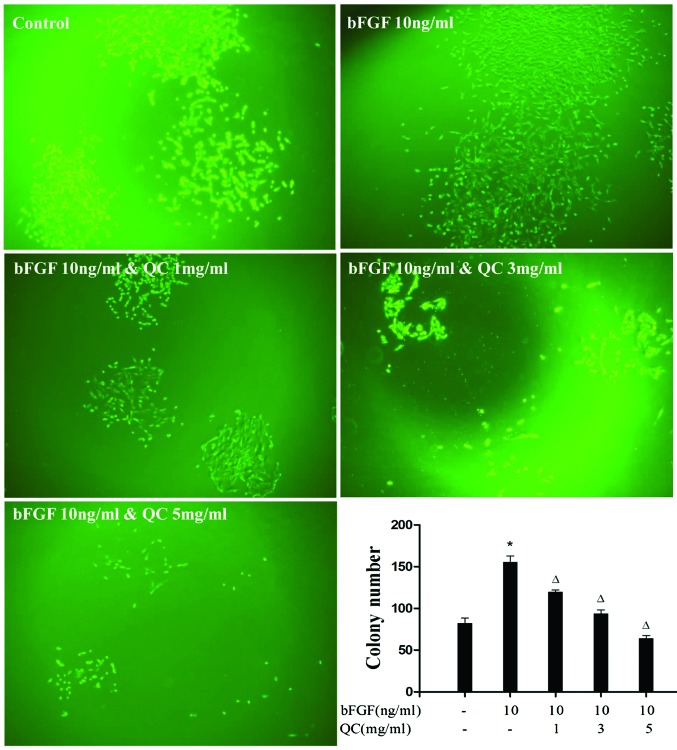
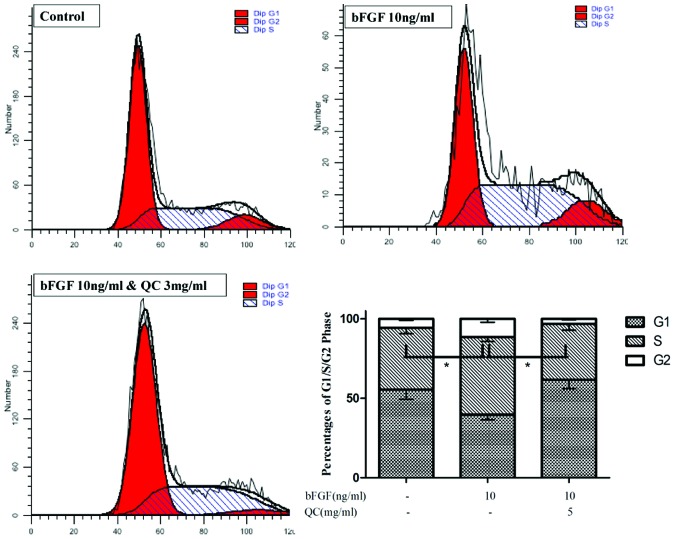
Previous studies by our group showed that Qianliening capsules (QC), a clinically proven effective traditional Chinese formulation that has long been used in the treatment of benign prostatic hyperplasia (BPH), is capable of inhibiting BPH in vivo and in vitro via the promotion of apoptosis, suppression of the EGFR/STAT3 signaling pathway and regulating the expression of sex hormones as well as their receptors. However, the mechanism of its anti-BPH activity has remained to be fully elucidated. The present study aimed to investigate the mechanism underlying the anti-proliferative effect of QC in vivo and in vitro. Castrated male Sprage-Dawley (SD) rats where subcutaneously injected with testosterone propionate and the WPMY-1 cell line was stimulated with basic fibroblast growth factor in order to generate BPH in vivo and in vitro separately, both of which were then subjected to QC treatment. Finasteride was used as a positive control drug for the in vivo study. In the present study, it was found that treatment with QC or finasteride significantly reduced the prostatic index (PI=prostate wet weight/body weight x 100) in a rat model of BPH (P<0.05). In addition, reverse transcription quantitative polymerase chain reaction (RT-PCR) and western blot analyses showed that QC or finasteride treatment significantly inhibited model construction-induced upregulation of expression of proliferating cell nuclear antigen, cyclin D1 and cyclin-dependent kinase 4 in prostatic tissues of rats with BPH (P<0.05). The in vitro study further proved that QC exhibited anti-proliferative properties via G1/S cell cycle arrest in the WPMY-1 cell line, as evidenced by colony formation, flow cytometric cell cycle, immunoblot and RT-PCR analyses. In conclusion, the present study demonstrated that inhibition of cell proliferation via G1/S cell cycle arrest may be one of the underlying mechanisms of the effect of QC on BPH.
我们团队之前的研究表明,前列宁胶囊(QC)是一种临床验证有效的传统中药制剂,长期用于治疗良性前列腺增生(BPH),它能够通过促进细胞凋亡、抑制表皮生长因子受体(EGFR)/信号转导和转录激活因子3(STAT3)信号通路以及调节性激素及其受体的表达,在体内和体外抑制BPH。然而,其抗BPH活性的机制仍有待充分阐明。本研究旨在探讨QC在体内和体外抗增殖作用的潜在机制。分别对去势雄性Sprague-Dawley(SD)大鼠皮下注射丙酸睾酮,并用碱性成纤维细胞生长因子刺激WPMY-1细胞系,以便在体内和体外分别诱导BPH,然后对二者均进行QC治疗。非那雄胺用作体内研究的阳性对照药物。在本研究中,发现用QC或非那雄胺治疗可显著降低BPH大鼠模型中的前列腺指数(PI =前列腺湿重/体重×100)(P<0.05)。此外,逆转录定量聚合酶链反应(RT-PCR)和蛋白质免疫印迹分析表明,QC或非那雄胺治疗可显著抑制模型构建诱导的BPH大鼠前列腺组织中增殖细胞核抗原、细胞周期蛋白D1和细胞周期蛋白依赖性激酶4表达的上调(P<0.05)。体外研究进一步证明,QC通过使WPMY-1细胞系中的细胞周期停滞于G1/S期而表现出抗增殖特性,集落形成、流式细胞术细胞周期分析、免疫印迹和RT-PCR分析均证实了这一点。总之,本研究表明,通过使细胞周期停滞于G1/S期来抑制细胞增殖可能是QC对BPH作用的潜在机制之一。