Department for Anaesthesiology, Centre for Anaesthesiology, Emergency and Intensive Care Medicine, University Medical Centre, University of Göttingen, Robert-Koch-Straße 40, 37075 Göttingen, Germany.
Leibniz-Insitut für Analytische Wissenschaften - ISAS - e. V, Bunsen-Kirchhoff-Straße 11, 44139 Dortmund, Germany.
J Occup Med Toxicol. 2015 Mar 27;10:12. doi: 10.1186/s12995-015-0056-7. eCollection 2015.
Occupational exposure to sevoflurane has the potential to cause health damage in hospital personnel. Workplace contamination with the substance mostly is assessed by using photoacoustic infrared spectrometry with detection limits of 10 ppbv. Multi-capillary column-ion mobility spectrometry (MCC-IMS) could be an alternative technology for the quantification of sevoflurane in the room air and could be even more accurate because of potentially lower detection limits. The aim of this study was to test the hypothesis that MCC-IMS is able to detect and monitor very low concentrations of sevoflurane (<10 ppbv) and to evaluate the exposure of hospital personnel to sevoflurane during paediatric anaesthesia and in the post anaesthesia care unit (PACU).
A MCC-IMS device was calibrated to several concentrations of sevoflurane and limits of detection (LOD) and quantification (LOQ) were calculated. Sevoflurane exposure of hospital personnel was measured at two anaesthesia workplaces and time-weighted average (TWA) values were calculated.
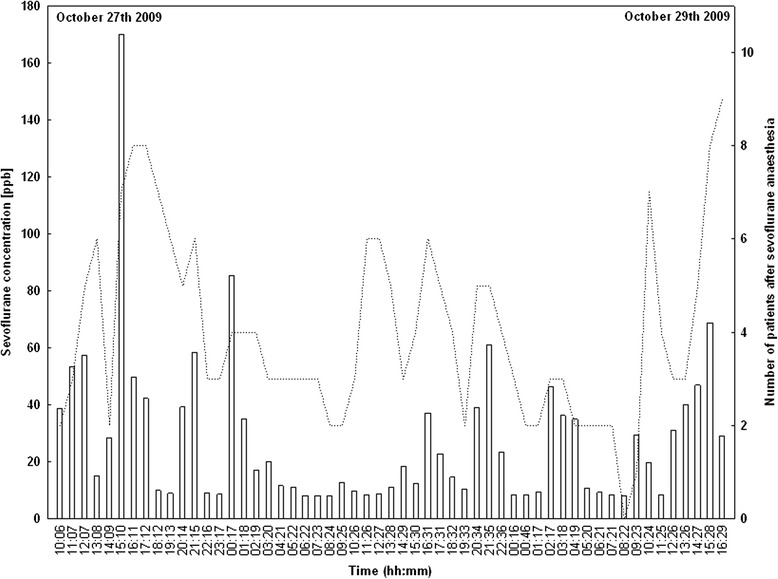
The LOD was 0.0068 ppbv and the LOQ was 0.0189 ppbv. During paediatric anaesthesia the mean sevoflurane concentration was 46.9 ppbv (8.0 - 314.7 ppbv) with TWA values between 5.8 and 45.7 ppbv. In the PACU the mean sevoflurane concentration was 27.9 ppbv (8.0 - 170.2 ppbv) and TWA values reached from 8.3 to 45.1 ppbv.
MCC-IMS shows a significantly lower LOD and LOQ than comparable methods. It is a reliable technology for monitoring sevoflurane concentrations at anaesthesia workplaces and has a particular strength in quantifying low-level contaminations of sevoflurane. The exposure of the personnel working in these areas did not exceed recommended limits and therefore adverse health effects are unlikely.
七氟醚职业接触有可能对医院工作人员造成健康损害。该物质的工作场所污染主要通过使用光声红外光谱法进行评估,检测限为 10ppbv。多毛细管柱-离子迁移谱(MCC-IMS)可能是一种替代技术,用于定量空气中的七氟醚,并且由于潜在的更低检测限,它可能更准确。本研究旨在检验以下假设,即 MCC-IMS 能够检测和监测非常低浓度的七氟醚(<10ppbv),并评估医院工作人员在小儿麻醉和麻醉后护理单元(PACU)期间接触七氟醚的情况。
对 MCC-IMS 设备进行了几种七氟醚浓度的校准,并计算了检测限(LOD)和定量限(LOQ)。在两个麻醉工作场所测量了医院工作人员的七氟醚暴露情况,并计算了时间加权平均值(TWA)。
LOD 为 0.0068ppbv,LOQ 为 0.0189ppbv。在小儿麻醉期间,七氟醚的平均浓度为 46.9ppbv(8.0-314.7ppbv),TWA 值在 5.8 和 45.7ppbv 之间。在 PACU 中,七氟醚的平均浓度为 27.9ppbv(8.0-170.2ppbv),TWA 值达到 8.3-45.1ppbv。
MCC-IMS 显示出比类似方法显著更低的 LOD 和 LOQ。它是监测麻醉工作场所七氟醚浓度的可靠技术,在量化七氟醚的低水平污染方面具有特别的优势。在这些区域工作的人员的暴露量没有超过推荐的限值,因此不太可能产生不良健康影响。