Toperoff Gidon, Kark Jeremy D, Aran Dvir, Nassar Hisham, Ahmad Wiessam Abu, Sinnreich Ronit, Azaiza Dima, Glaser Benjamin, Hellman Asaf
Department of Developmental Biology and Cancer Research, Institute for Medical Research Israel-Canada, Hebrew University-Hadassah Medical School, Jerusalem, 91120 Israel.
Epidemiology Unit, Braun School of Public Health and Community Medicine, Hebrew University and Hadassah Medical Organization, Jerusalem, Israel.
Clin Epigenetics. 2015 Mar 28;7(1):35. doi: 10.1186/s13148-015-0069-1. eCollection 2015.
Type 2 diabetes mellitus (T2D) is highly prevalent in Middle-Eastern and North African Arab populations, but the molecular basis for this susceptibility is unknown. Altered DNA methylation levels were reported in insulin-secreting and responding tissues, but whether methylation in accessible tissues such as peripheral blood is associated with T2D risk remains an open question. Age-related alteration of DNA methylation level was reported in certain methylation sites, but no association with T2D has been shown. Here we report on a population-based study of 929 men and women representing the East Jerusalem Palestinian (EJP) Arab population and compare with the findings among Israeli Ashkenazi Jews. This is the first reported epigenetic study of an Arab population with a characteristic high prevalence of T2D.
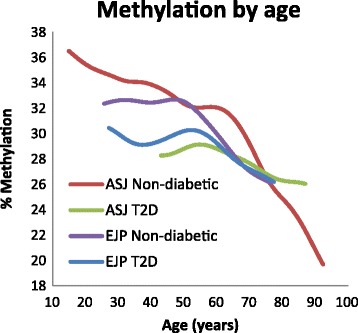
We found that DNA methylation of a prespecified regulatory site in peripheral blood leukocytes (PBLs) is associated with impaired glucose metabolism and T2D independent of sex, body mass index, and white blood cell composition. This CpG site (Chr16: 53,809,231-2; hg19) is located in a region within an intron of the FTO gene, suspected to serve as a tissue-specific enhancer. The association between PBL hypomethylation and T2D varied by age, revealing differential patterns of methylation aging in healthy and diabetic individuals and between ethnic groups: T2D patients displayed prematurely low methylation levels, and this hypomethylation was greater and occurred earlier in life among Palestinian Arabs than Ashkenazi Jews.
Our study suggests that premature DNA methylation aging is associated with increased risk of T2D. These findings should stimulate the search for more such sites and may pave the way to improved T2D risk prediction within and between human populations.
2型糖尿病(T2D)在中东和北非阿拉伯人群中高度流行,但其易感性的分子基础尚不清楚。胰岛素分泌和反应组织中报道了DNA甲基化水平的改变,但外周血等易获取组织中的甲基化是否与T2D风险相关仍是一个悬而未决的问题。某些甲基化位点报道了与年龄相关的DNA甲基化水平改变,但未显示与T2D有关联。在此,我们报告了一项基于人群的研究,该研究对929名代表东耶路撒冷巴勒斯坦(EJP)阿拉伯人群的男性和女性进行了研究,并与以色列阿什肯纳兹犹太人的研究结果进行了比较。这是首次报道的对具有T2D特征性高患病率的阿拉伯人群的表观遗传学研究。
我们发现外周血白细胞(PBLs)中一个预先指定的调控位点的DNA甲基化与葡萄糖代谢受损和T2D相关,且独立于性别、体重指数和白细胞组成。这个CpG位点(Chr16: 53,809,231-2;hg19)位于FTO基因内含子内的一个区域,怀疑其作为组织特异性增强子。PBL低甲基化与T2D之间的关联因年龄而异,揭示了健康个体和糖尿病个体以及不同种族群体之间甲基化衰老的差异模式:T2D患者表现出过早的低甲基化水平,且这种低甲基化在巴勒斯坦阿拉伯人中比阿什肯纳兹犹太人更大且发生得更早。
我们的研究表明,DNA甲基化过早衰老与T2D风险增加有关。这些发现应促使人们寻找更多此类位点,并可能为改善人群内部和人群之间的T2D风险预测铺平道路。