Lin Yung-Chang, Björkman Torbjörn, Komsa Hannu-Pekka, Teng Po-Yuan, Yeh Chao-Hui, Huang Fei-Sheng, Lin Kuan-Hung, Jadczak Joanna, Huang Ying-Sheng, Chiu Po-Wen, Krasheninnikov Arkady V, Suenaga Kazu
National Institute of Advanced Industrial Science and Technology (AIST), Tsukuba 305-8565, Japan.
COMP/Department of Applied Physics, Aalto University, P.O. Box 11100, FI-00076 Aalto, Finland.
Nat Commun. 2015 Apr 2;6:6736. doi: 10.1038/ncomms7736.
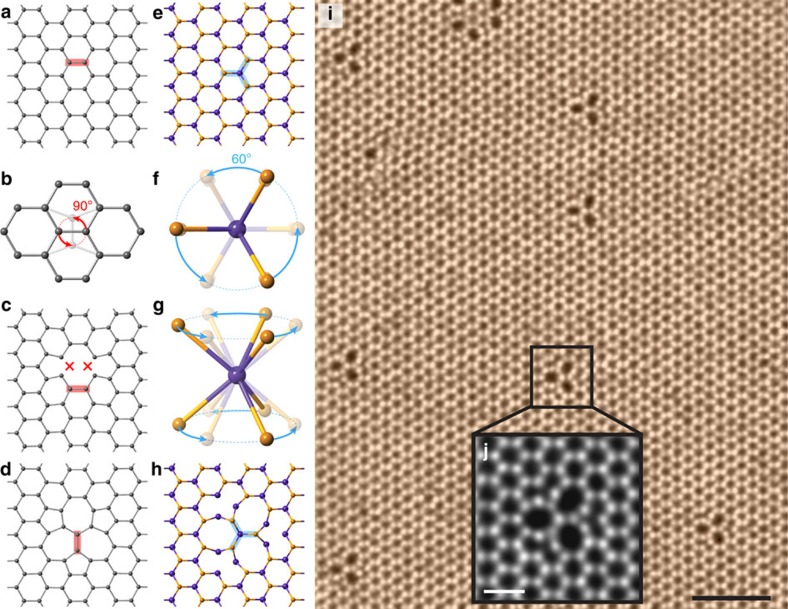
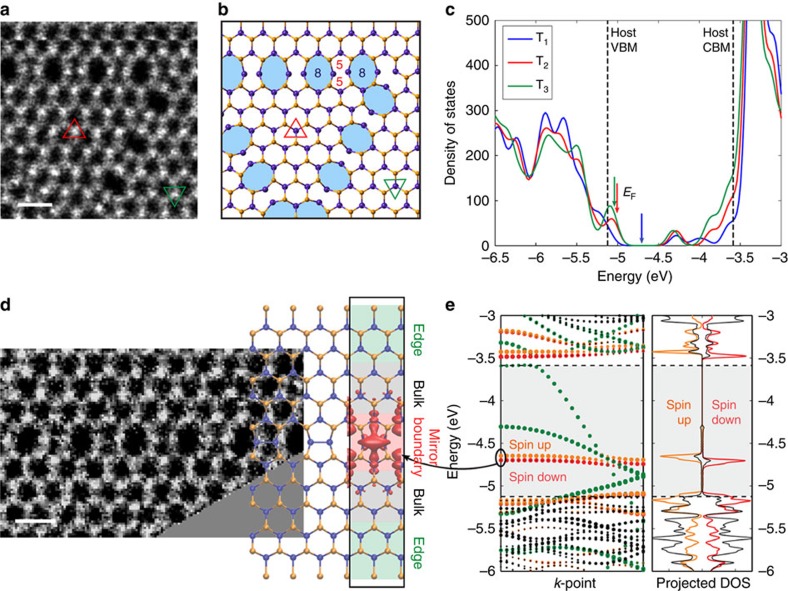
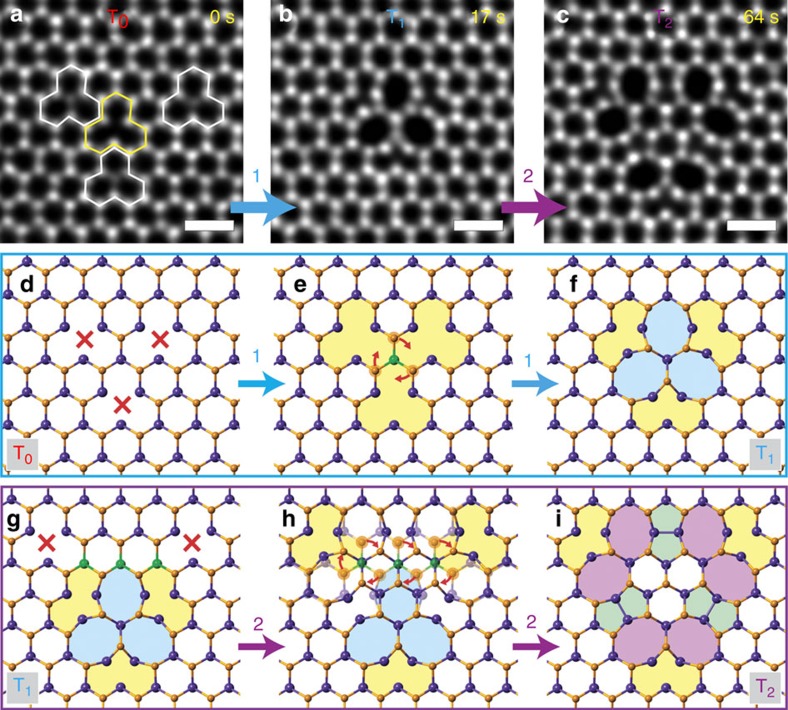
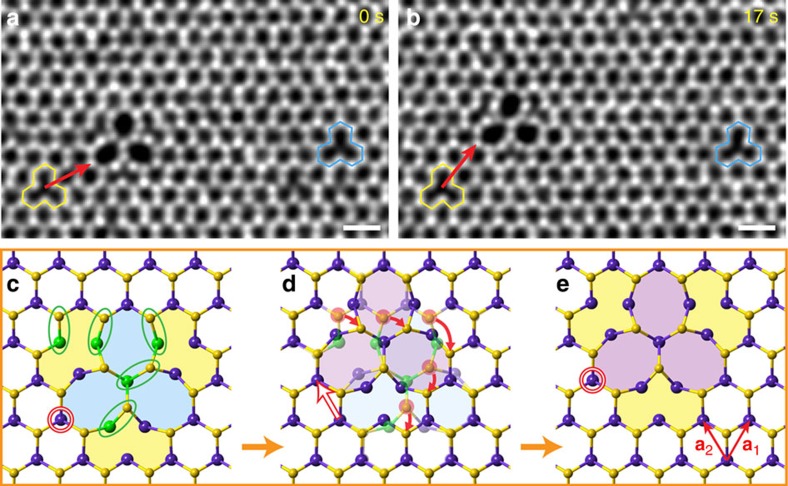
As defects frequently govern the properties of crystalline solids, the precise microscopic knowledge of defect atomic structure is of fundamental importance. We report a new class of point defects in single-layer transition metal dichalcogenides that can be created through 60° rotations of metal-chalcogen bonds in the trigonal prismatic lattice, with the simplest among them being a three-fold symmetric trefoil-like defect. The defects, which are inherently related to the crystal symmetry of transition metal dichalcogenides, can expand through sequential bond rotations, as evident from in situ scanning transmission electron microscopy experiments, and eventually form larger linear defects consisting of aligned 8-5-5-8 membered rings. First-principles calculations provide insights into the evolution of rotational defects and show that they give rise to p-type doping and local magnetic moments, but weakly affect mechanical characteristics of transition metal dichalcogenides. Thus, controllable introduction of rotational defects can be used to engineer the properties of these materials.
由于缺陷常常决定晶体固体的性质,因此对缺陷原子结构的精确微观认识至关重要。我们报告了一类新型的单层过渡金属二硫属化物中的点缺陷,这些缺陷可通过三角棱柱晶格中金属 - 硫属键的60°旋转产生,其中最简单的是三重对称的三叶形缺陷。这些缺陷与过渡金属二硫属化物的晶体对称性内在相关,可通过连续的键旋转扩展,原位扫描透射电子显微镜实验表明了这一点,最终形成由对齐的8 - 5 - 5 - 8元环组成的更大线性缺陷。第一性原理计算为旋转缺陷的演化提供了见解,并表明它们会导致p型掺杂和局部磁矩,但对过渡金属二硫属化物的力学特性影响较弱。因此,可控引入旋转缺陷可用于调控这些材料的性质。