Nussey Daniel H, Baird Duncan, Barrett Emma, Boner Winnie, Fairlie Jennifer, Gemmell Neil, Hartmann Nils, Horn Thorsten, Haussmann Mark, Olsson Mats, Turbill Chris, Verhulst Simon, Zahn Sandrine, Monaghan Pat
Institute of Evolutionary Biology and Centre for Immunity, Infection & Evolution, University of Edinburgh Edinburgh, EH9 3JT, UK.
Institute of Cancer and Genetics, School of Medicine, Cardiff University Cardiff, CF14 4XN, UK.
Methods Ecol Evol. 2014 Apr;5(4):299-310. doi: 10.1111/2041-210X.12161. Epub 2014 Mar 2.
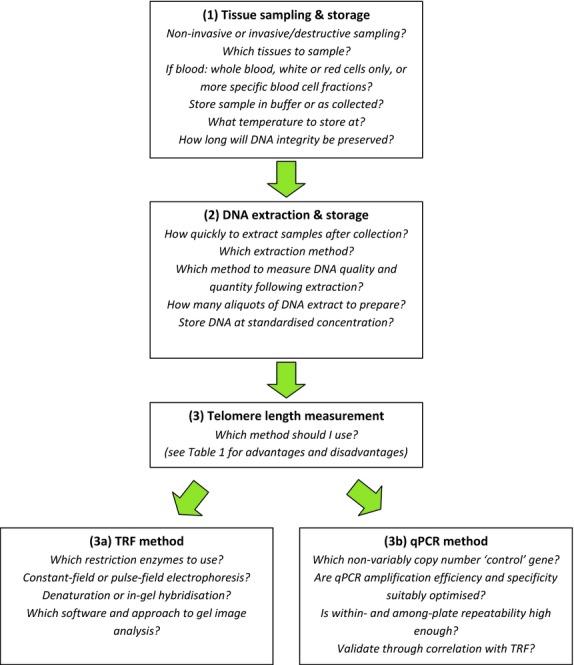
Telomeres play a fundamental role in the protection of chromosomal DNA and in the regulation of cellular senescence. Recent work in human epidemiology and evolutionary ecology suggests adult telomere length (TL) may reflect past physiological stress and predict subsequent morbidity and mortality, independent of chronological age.Several different methods have been developed to measure TL, each offering its own technical challenges. The aim of this review is to provide an overview of the advantages and drawbacks of each method for researchers, with a particular focus on issues that are likely to face ecologists and evolutionary biologists collecting samples in the field or in organisms that may never have been studied in this context before.We discuss the key issues to consider and wherever possible try to provide current consensus view regarding best practice with regard to sample collection and storage, DNA extraction and storage, and the five main methods currently available to measure TL.Decisions regarding which tissues to sample, how to store them, how to extract DNA, and which TL measurement method to use cannot be prescribed, and are dependent on the biological question addressed and the constraints imposed by the study system. What is essential for future studies of telomere dynamics in evolution and ecology is that researchers publish full details of their methods and the quality control thresholds they employ.
端粒在保护染色体DNA以及调节细胞衰老过程中发挥着重要作用。近期人类流行病学和进化生态学领域的研究表明,成人端粒长度(TL)可能反映过去的生理压力,并能预测后续的发病率和死亡率,且不受实际年龄的影响。目前已开发出几种不同的方法来测量端粒长度,每种方法都有其自身的技术挑战。本综述的目的是为研究人员概述每种方法的优缺点,特别关注生态学家和进化生物学家在野外或此前从未在此背景下研究过的生物体中采集样本时可能面临的问题。我们讨论了需要考虑的关键问题,并尽可能就样本采集与储存、DNA提取与储存以及目前可用于测量端粒长度的五种主要方法的最佳实践提供当前的共识观点。关于采集哪些组织样本、如何储存样本、如何提取DNA以及使用哪种端粒长度测量方法的决策无法一概而论,这取决于所研究的生物学问题以及研究系统所带来的限制。对于未来进化和生态学中端粒动态的研究而言,至关重要的是研究人员要公布其方法的完整细节以及所采用的质量控制阈值。