Baker James O, Tyther Raymond, Liebetrau Christoph, Clark James, Howarth Robert, Patterson Tiffany, Möllmann Helge, Nef Holger, Sicard Pierre, Kailey Balrik, Devaraj Renuka, Redwood Simon R, Kunst Gudrun, Weber Ekkehard, Marber Michael S
King's College London BHF Centre, The Rayne Institute, St Thomas' Hospital, 4th Floor Lambeth Wing, Westminster Bridge Road, London, SE1 7EH, UK.
Basic Res Cardiol. 2015 May;110(3):23. doi: 10.1007/s00395-015-0478-5. Epub 2015 Apr 3.
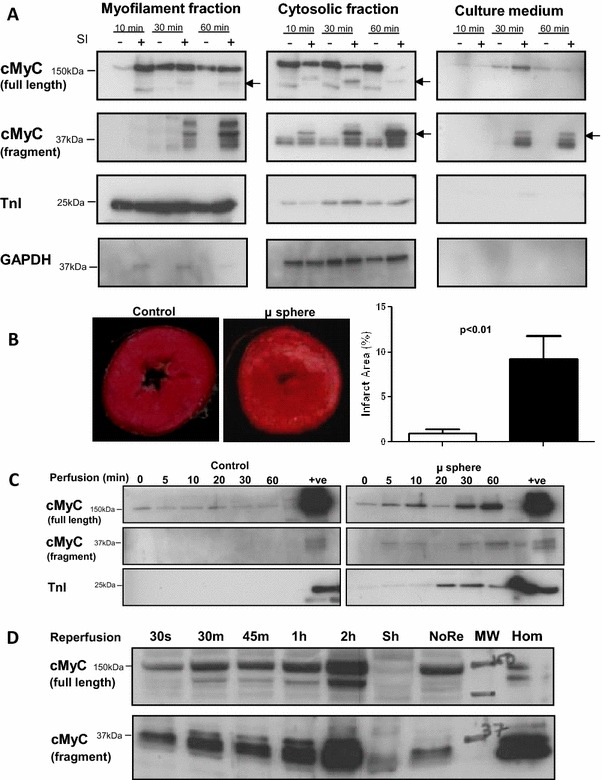
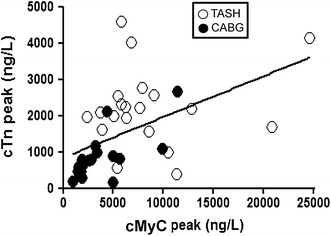
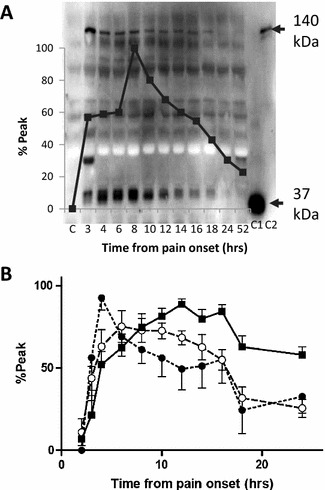
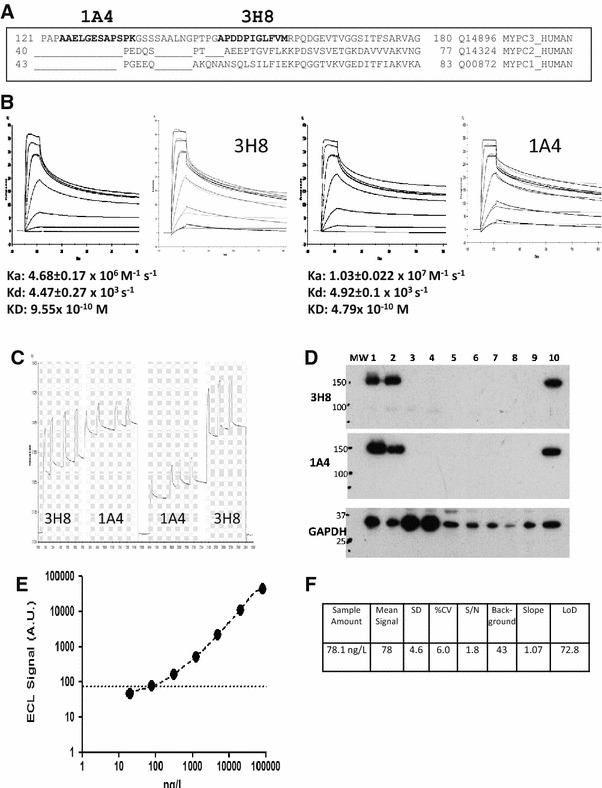
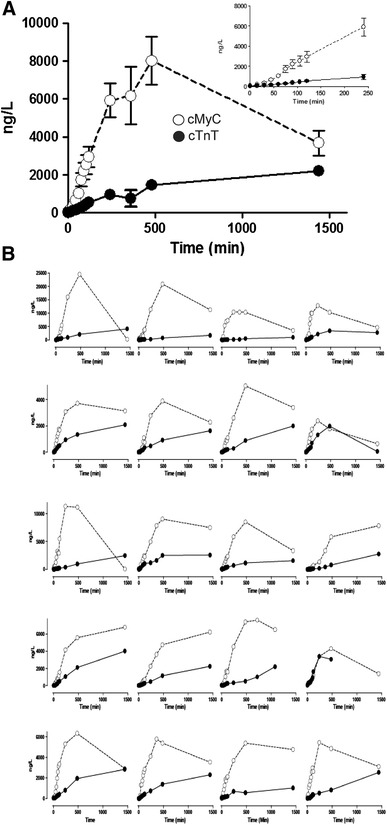
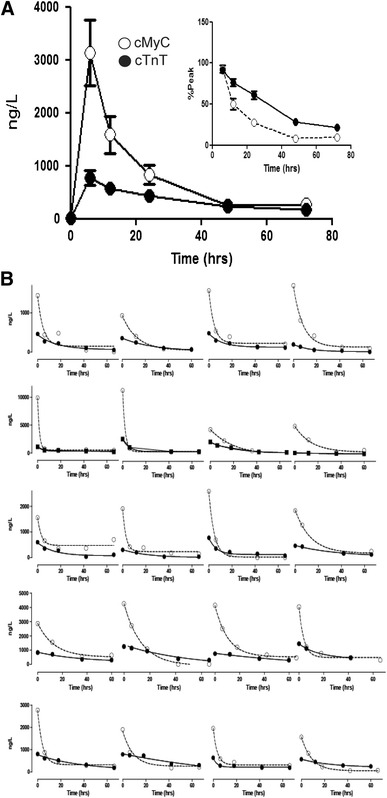
Cardiac troponins are released and cleared slowly after myocardial injury, complicating the diagnosis of early, and recurrent, acute myocardial infarction. Cardiac myosin-binding protein C (cMyC) is a similarly cardiac-restricted protein that may have different release/clearance kinetics. Using novel antibodies raised against the cardiac-specific N-terminus of cMyC, we used confocal microscopy, immunoblotting and immunoassay to document its location and release. In rodents, we demonstrate rapid release of cMyC using in vitro and in vivo models of acute myocardial infarction. In patients, with ST elevation myocardial infarction (STEMI, n = 20), undergoing therapeutic ablation of septal hypertrophy (TASH, n = 20) or having coronary artery bypass surgery (CABG, n = 20), serum was collected prospectively and frequently. cMyC appears in the serum as full-length and fragmented protein. Compared to cTnT measured using a contemporary high-sensitivity commercial assay, cMyC peaks earlier (STEMI, 9.3 ± 3.1 vs 11.8 ± 3.4 h, P < 0.007; TASH, 9.7 ± 1.4 vs 21.6 ± 1.4 h, P < 0.0001), accumulates more rapidly (during first 4 h after TASH, 25.8 ± 1.9 vs 4.0 ± 0.4 ng/L/min, P < 0.0001) and disappears more rapidly (post-CABG, decay half-time 5.5 ± 0.8 vs 22 ± 5 h, P < 0.0001). Our results demonstrate that following defined myocardial injury, the rise and fall in the serum of cMyC is more rapid than that of cTnT. We speculate that these characteristics could enable earlier diagnosis of myocardial infarction and reinfarction in suspected non-STEMI, a population not included in this early translational study.
心肌损伤后,心肌肌钙蛋白释放和清除缓慢,这使得早期及复发性急性心肌梗死的诊断变得复杂。心肌肌球蛋白结合蛋白C(cMyC)是一种同样在心脏中特异性表达的蛋白,其释放/清除动力学可能有所不同。我们利用针对cMyC心脏特异性N端产生的新型抗体,通过共聚焦显微镜、免疫印迹和免疫测定来记录其定位和释放情况。在啮齿动物中,我们利用急性心肌梗死的体外和体内模型证明了cMyC的快速释放。在接受肥厚性室间隔消融治疗(TASH,n = 20)或冠状动脉搭桥手术(CABG,n = 20)的ST段抬高型心肌梗死(STEMI,n = 20)患者中,前瞻性地频繁采集血清。cMyC以全长和片段化蛋白的形式出现在血清中。与使用当代高灵敏度商业检测方法测得的cTnT相比,cMyC峰值出现更早(STEMI,9.3±3.1小时对11.8±3.4小时,P<0.007;TASH,9.7±1.4小时对21.6±1.4小时,P<0.0001),积累速度更快(TASH后最初4小时内,25.8±1.9对4.0±0.4 ng/L/分钟,P<0.0001),消失速度也更快(CABG后,衰减半衰期5.5±0.8对22±5小时,P<0.0001)。我们的结果表明,在明确的心肌损伤后,血清中cMyC的升降比cTnT更快。我们推测,这些特性可能有助于在疑似非STEMI患者中更早地诊断心肌梗死和再梗死,本早期转化研究未纳入这一人群。