Phaiboun Andy, Zhang Yiming, Park Boryung, Kim Minsu
Department of Physics, Emory University, Atlanta, Georgia, United States of America.
Department of Physics, Emory University, Atlanta, Georgia, United States of America; Graduate Division of Biological and Biomedical Sciences, Emory University, Atlanta, Georgia, United States of America.
PLoS Comput Biol. 2015 Apr 2;11(4):e1004198. doi: 10.1371/journal.pcbi.1004198. eCollection 2015 Apr.
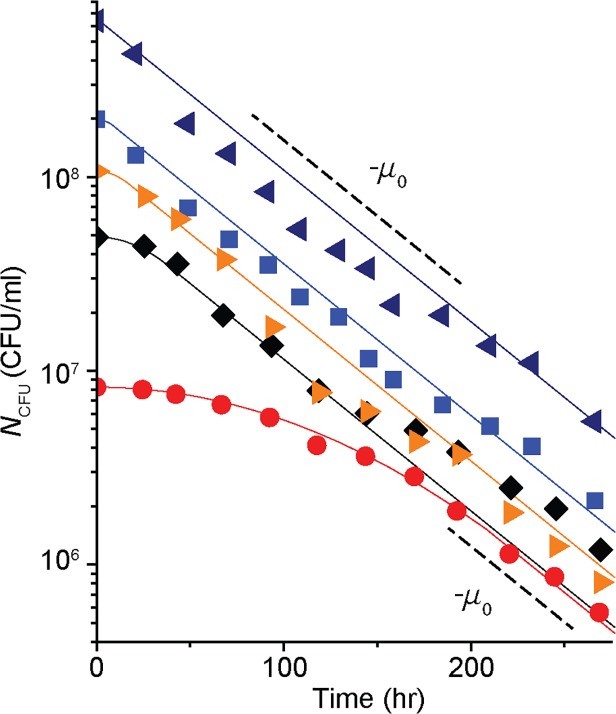
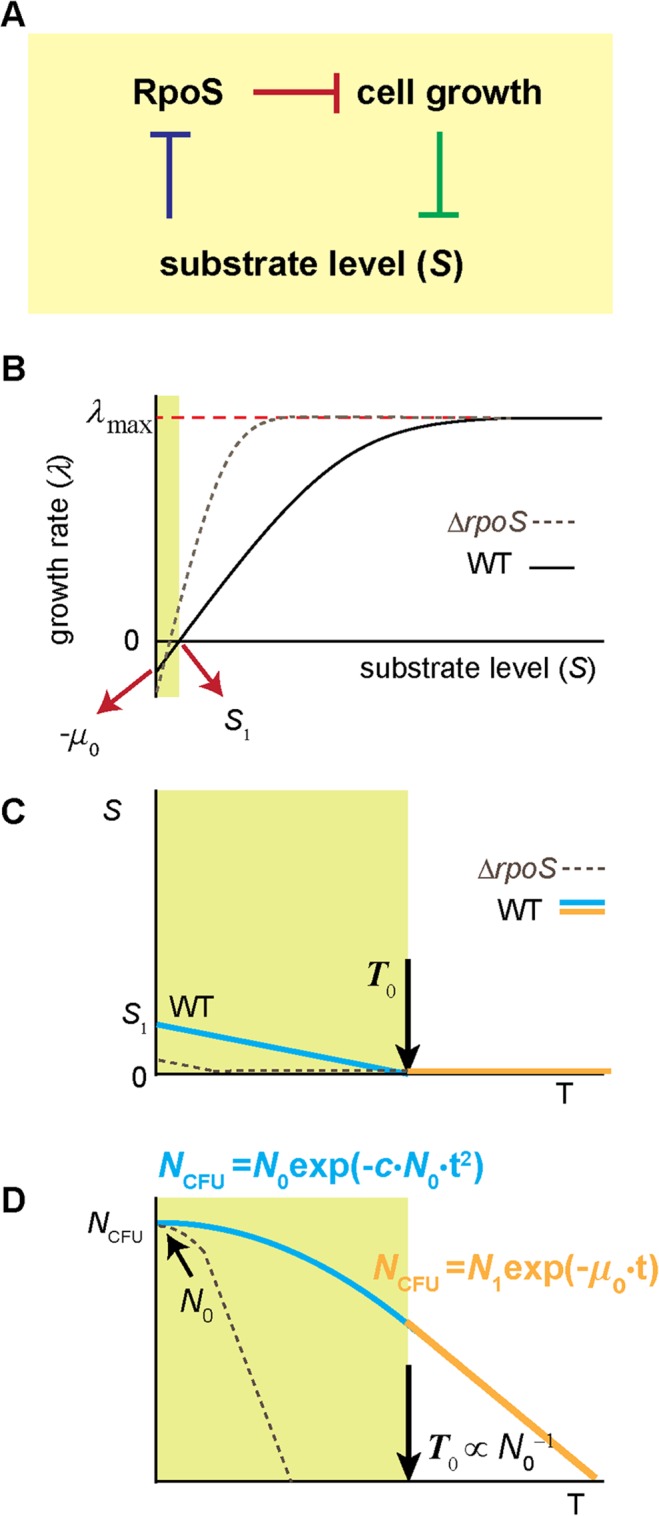
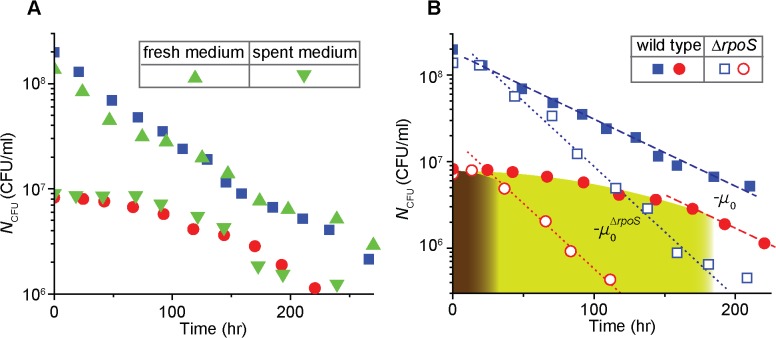
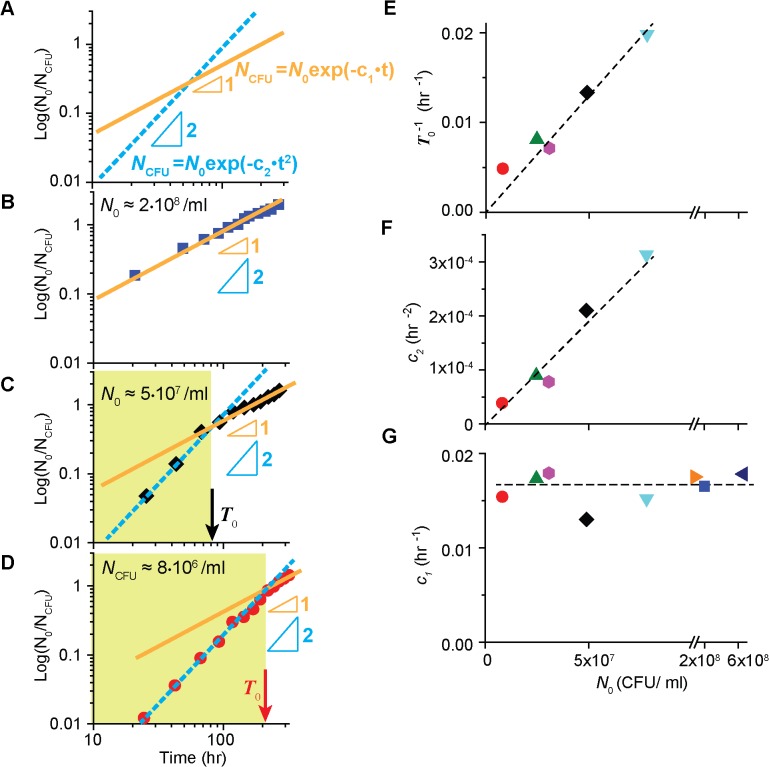
In the lifecycle of microorganisms, prolonged starvation is prevalent and sustaining life during starvation periods is a vital task. In the literature, it is commonly assumed that survival kinetics of starving microbes follows exponential decay. This assumption, however, has not been rigorously tested. Currently, it is not clear under what circumstances this assumption is true. Also, it is not known when such survival kinetics deviates from exponential decay and if it deviates, what underlying mechanisms for the deviation are. Here, to address these issues, we quantitatively characterized dynamics of survival and death of starving E. coli cells. The results show that the assumption--starving cells die exponentially--is true only at high cell density. At low density, starving cells persevere for extended periods of time, before dying rapidly exponentially. Detailed analyses show intriguing quantitative characteristics of the density-dependent and biphasic survival kinetics, including that the period of the perseverance is inversely proportional to cell density. These characteristics further lead us to identification of key underlying processes relevant for the perseverance of starving cells. Then, using mathematical modeling, we show how these processes contribute to the density-dependent and biphasic survival kinetics observed. Importantly, our model reveals a thrifty strategy employed by bacteria, by which upon sensing impending depletion of a substrate, the limiting substrate is conserved and utilized later during starvation to delay cell death. These findings advance quantitative understanding of survival of microbes in oligotrophic environments and facilitate quantitative analysis and prediction of microbial dynamics in nature. Furthermore, they prompt revision of previous models used to analyze and predict population dynamics of microbes.
在微生物的生命周期中,长期饥饿很常见,在饥饿期间维持生命是一项至关重要的任务。在文献中,通常认为饥饿微生物的存活动力学遵循指数衰减。然而,这一假设尚未经过严格验证。目前,尚不清楚在何种情况下这一假设成立。此外,也不清楚这种存活动力学何时会偏离指数衰减,如果发生偏离,其潜在的偏离机制是什么。在此,为了解决这些问题,我们对饥饿大肠杆菌细胞的存活和死亡动态进行了定量表征。结果表明,饥饿细胞呈指数死亡这一假设仅在高细胞密度时成立。在低密度时,饥饿细胞会持续较长时间,然后迅速呈指数死亡。详细分析揭示了密度依赖性和双相存活动力学的有趣定量特征,包括持续时间与细胞密度成反比。这些特征进一步引导我们确定了与饥饿细胞持续存活相关的关键潜在过程。然后,通过数学建模,我们展示了这些过程如何导致观察到的密度依赖性和双相存活动力学。重要的是,我们的模型揭示了细菌采用的一种节俭策略,即一旦感知到底物即将耗尽,就会保存有限的底物,并在饥饿后期利用它来延迟细胞死亡。这些发现推进了对贫营养环境中微生物存活的定量理解,并有助于对自然界中微生物动态进行定量分析和预测。此外,它们促使人们对以前用于分析和预测微生物种群动态的模型进行修订。