Koehler Niklas K U, Stransky Elke, Meyer Mirjam, Gaertner Susanne, Shing Mona, Schnaidt Martina, Celej Maria S, Jovin Thomas M, Leyhe Thomas, Laske Christoph, Batra Anil, Buchkremer Gerhard, Fallgatter Andreas J, Wernet Dorothee, Richartz-Salzburger Elke
Department of Psychiatry and Psychotherapy, Eberhard-Karls-University Tübingen, Calwerstr. 14, 72076 Tübingen, Germany; German Center for Neurodegenerative Diseases (DZNE), Otfried-Müller-Strasse 27, 72076 Tübingen, Germany.
Department of Psychiatry and Psychotherapy, Eberhard-Karls-University Tübingen, Calwerstr. 14, 72076 Tübingen, Germany.
PLoS One. 2015 Apr 6;10(4):e0123444. doi: 10.1371/journal.pone.0123444. eCollection 2015.
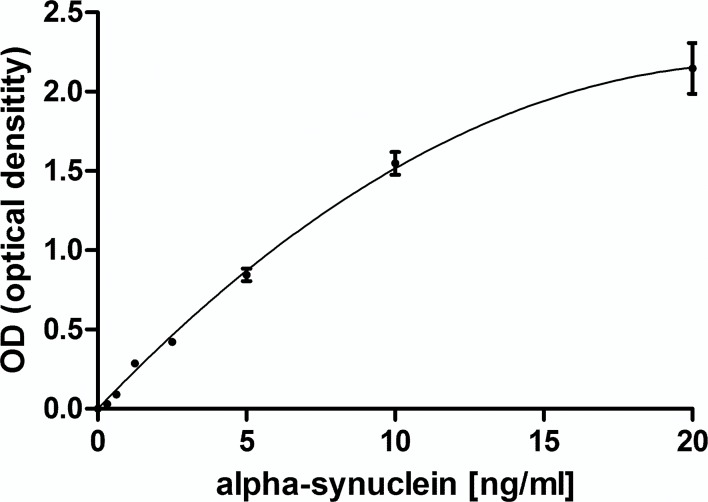
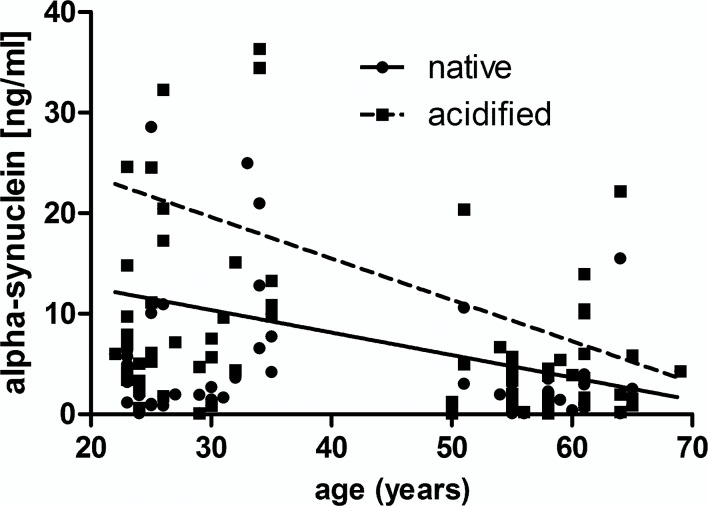
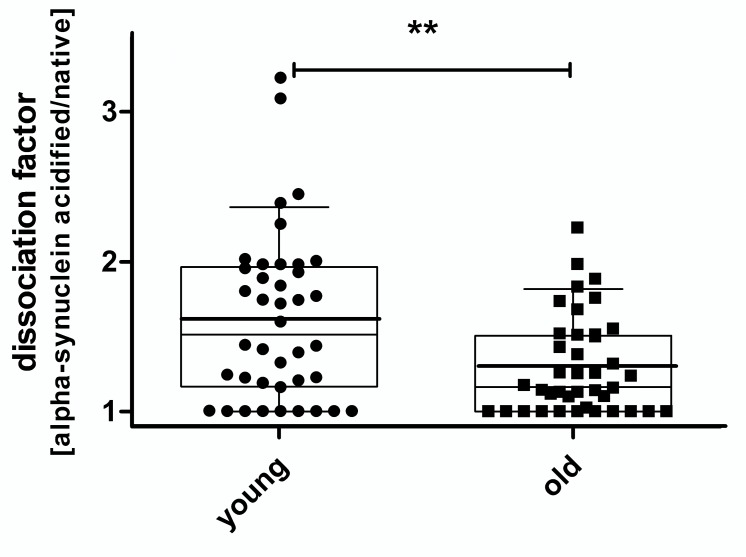
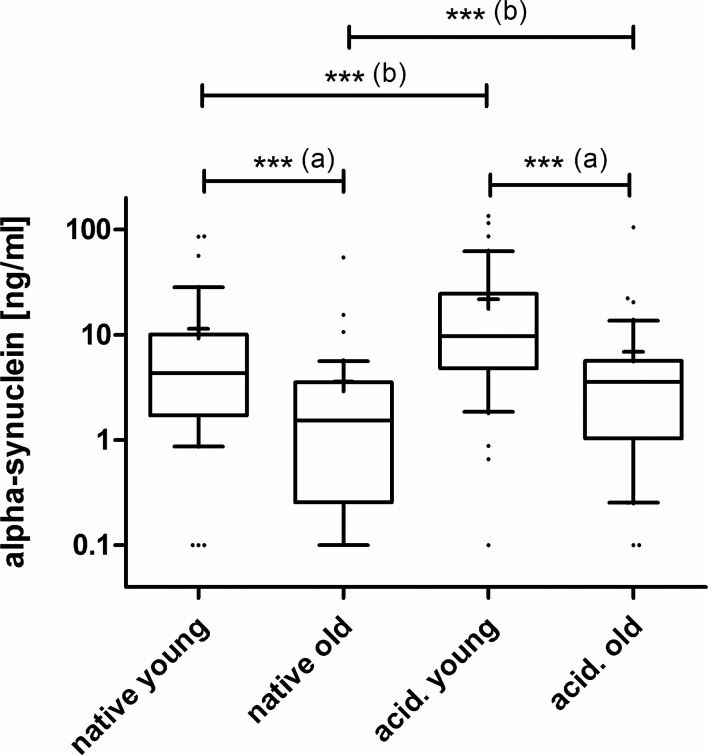
There is unequivocal evidence that alpha-synuclein plays a pivotal pathophysiological role in neurodegenerative diseases, and in particular in synucleinopathies. These disorders present with a variable extent of cognitive impairment and alpha-synuclein is being explored as a biomarker in CSF, blood serum and plasma. Considering key events of aging that include proteostasis, alpha-synuclein may not only be useful as a marker for differential diagnosis but also for aging per se. To explore this hypothesis, we developed a highly specific ELISA to measure alpha-synuclein. In healthy males plasma alpha-synuclein levels correlated strongly with age, revealing much lower concentrations in older (avg. 58.1 years) compared to younger (avg. 27.6 years) individuals. This difference between the age groups was enhanced after acidification of the plasmas (p<0.0001), possibly reflecting a decrease of alpha-synuclein-antibody complexes or chaperone activity in older individuals. Our results support the concept that alpha-synuclein homeostasis may be impaired early on, possibly due to disturbance of the proteostasis network, a key component of healthy aging. Thus, alpha-synuclein may be a novel biomarker of aging, a factor that should be considered when analyzing its presence in biological specimens.
有明确证据表明,α-突触核蛋白在神经退行性疾病,尤其是突触核蛋白病中发挥着关键的病理生理作用。这些疾病表现出不同程度的认知障碍,并且α-突触核蛋白正作为脑脊液、血清和血浆中的一种生物标志物进行研究。考虑到包括蛋白质稳态在内的衰老关键事件,α-突触核蛋白不仅可能作为鉴别诊断的标志物有用,而且对衰老本身也有用。为了探索这一假设,我们开发了一种高度特异性的酶联免疫吸附测定法(ELISA)来测量α-突触核蛋白。在健康男性中,血浆α-突触核蛋白水平与年龄密切相关,与年轻个体(平均27.6岁)相比,老年个体(平均58.1岁)的浓度要低得多。血浆酸化后,年龄组之间的这种差异更加明显(p<0.0001),这可能反映了老年个体中α-突触核蛋白-抗体复合物或伴侣活性的降低。我们的结果支持这样一种概念,即α-突触核蛋白的稳态可能在早期就受到损害,这可能是由于蛋白质稳态网络(健康衰老的关键组成部分)受到干扰所致。因此,α-突触核蛋白可能是一种新型的衰老生物标志物,在分析其在生物标本中的存在时应考虑这一因素。