Conti Heather R, Whibley Natasha, Coleman Bianca M, Garg Abhishek V, Jaycox Jillian R, Gaffen Sarah L
University of Pittsburgh, Department of Medicine, Division of Rheumatology & Clinical Immunology, Pittsburgh, PA, United States of America.
Carnegie Mellon University, Dept. of Biological Sciences, Pittsburgh, PA, United States of America.
PLoS One. 2015 Apr 7;10(4):e0122807. doi: 10.1371/journal.pone.0122807. eCollection 2015.
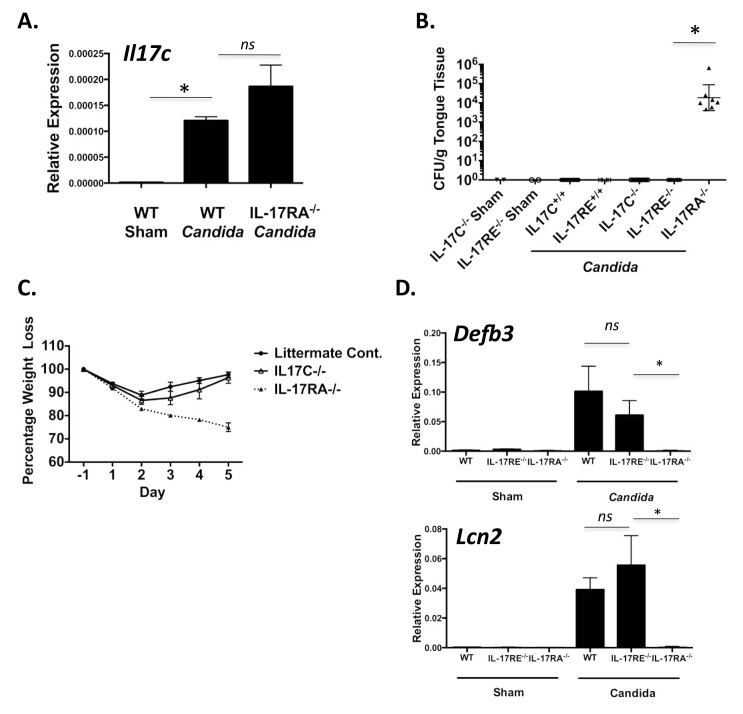
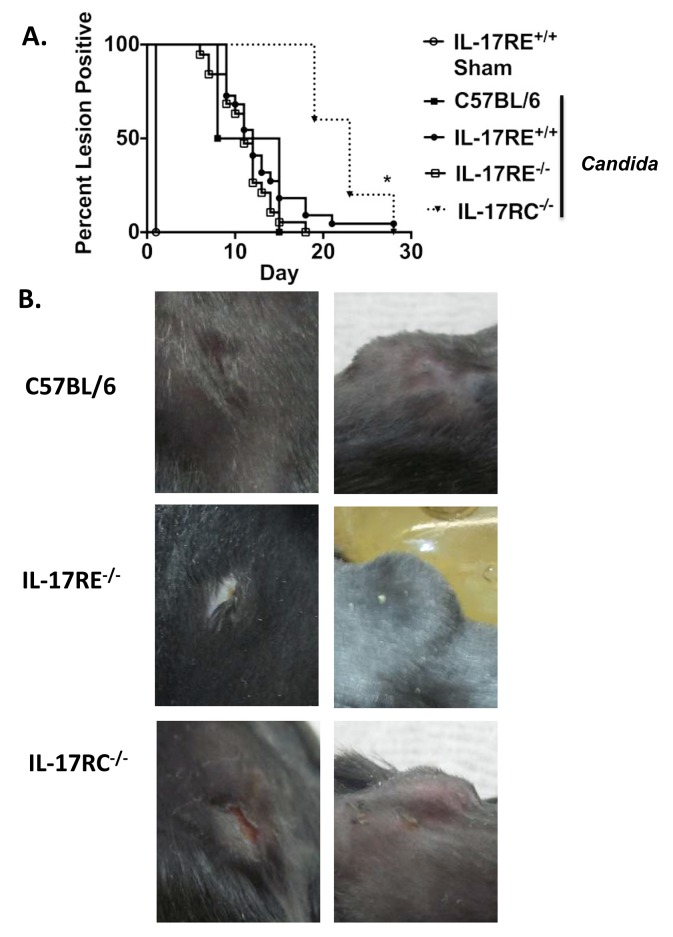
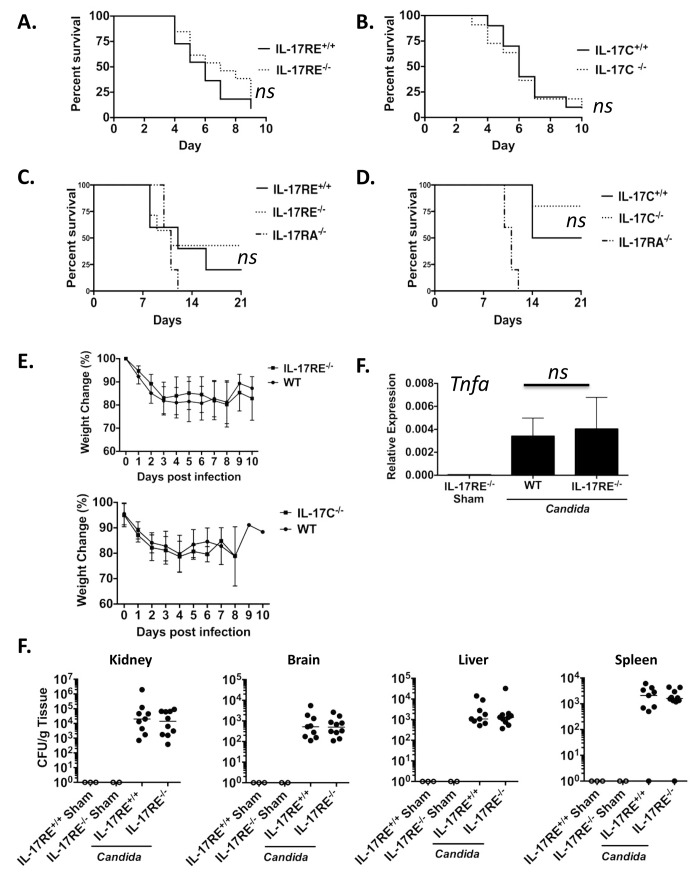
Candida albicans is a commensal fungal microbe of the human orogastrointestinal tract and skin. C. albicans causes multiple forms of disease in immunocompromised patients, including oral, vaginal, dermal and disseminated candidiasis. The cytokine IL-17 (IL-17A) and its receptor subunits, IL-17RA and IL-17RC, are required for protection to most forms of candidiasis. The importance of the IL-17R pathway has been observed not only in knockout mouse models, but also in humans with rare genetic mutations that impact generation of Th17 cells or the IL-17 signaling pathway, including Hyper-IgE Syndrome (STAT3 or TYK2 mutations) or IL17RA or ACT1 gene deficiency. The IL-17 family of cytokines is a distinct subclass of cytokines with unique structural and signaling properties. IL-17A is the best-characterized member of the IL-17 family to date, but far less is known about other IL-17-related cytokines. In this study, we sought to determine the role of a related IL-17 cytokine, IL-17C, in protection against oral, dermal and disseminated forms of C. albicans infection. IL-17C signals through a heterodimeric receptor composed of the IL-17RA and IL-17RE subunits. We observed that IL-17C mRNA was induced following oral C. albicans infection. However, mice lacking IL-17C or IL-17RE cleared C. albicans infections in the oral mucosa, skin and bloodstream at rates similar to WT littermate controls. Moreover, these mice demonstrated similar gene transcription profiles and recovery kinetics as WT animals. These findings indicate that IL-17C and IL-17RE are dispensable for immunity to the forms of candidiasis evaluated, and illustrate a surprisingly limited specificity of the IL-17 family of cytokines with respect to systemic, oral and cutaneous Candida infections.
白色念珠菌是人类口腔胃肠道和皮肤的共生真菌微生物。白色念珠菌在免疫功能低下的患者中会引发多种疾病,包括口腔、阴道、皮肤和播散性念珠菌病。细胞因子IL-17(IL-17A)及其受体亚基IL-17RA和IL-17RC是抵御大多数念珠菌病形式所必需的。不仅在基因敲除小鼠模型中,而且在患有影响Th17细胞生成或IL-17信号通路的罕见基因突变的人类中,包括高IgE综合征(STAT3或TYK2突变)或IL17RA或ACT1基因缺陷,都观察到了IL-17R途径的重要性。细胞因子IL-17家族是具有独特结构和信号特性的细胞因子的一个独特亚类。IL-17A是迄今为止IL-17家族中特征最明确的成员,但对其他与IL-17相关的细胞因子了解要少得多。在本研究中,我们试图确定相关的IL-17细胞因子IL-17C在抵御白色念珠菌口腔、皮肤和播散性感染形式中的作用。IL-17C通过由IL-17RA和IL-17RE亚基组成的异二聚体受体发出信号。我们观察到,在白色念珠菌口腔感染后,IL-17C mRNA被诱导。然而,缺乏IL-17C或IL-17RE的小鼠在口腔黏膜、皮肤和血液中清除白色念珠菌感染的速度与野生型同窝对照相似。此外,这些小鼠表现出与野生型动物相似的基因转录谱和恢复动力学。这些发现表明,IL-17C和IL-17RE对于所评估的念珠菌病形式的免疫是可有可无的,并说明了IL-17细胞因子家族在系统性、口腔和皮肤念珠菌感染方面令人惊讶的有限特异性。