Lalia Antigoni Z, Johnson Matthew L, Jensen Michael D, Hames Kazanna C, Port John D, Lanza Ian R
Division of Endocrinology and Metabolism, Mayo Clinic College of Medicine, Rochester, MN.
Division of Radiology, Mayo Clinic College of Medicine, Rochester, MN.
Diabetes Care. 2015 Jul;38(7):1228-37. doi: 10.2337/dc14-3101. Epub 2015 Apr 7.
Dietary n-3 polyunsaturated fatty acids, including eicosapentaenoic acid (EPA) and docosahexaenoic acid (DHA), prevent insulin resistance and stimulate mitochondrial biogenesis in rodents, but the findings of translational studies in humans are thus far ambiguous. The aim of this study was to evaluate the influence of EPA and DHA on insulin sensitivity, insulin secretion, and muscle mitochondrial function in insulin-resistant, nondiabetic humans using a robust study design and gold-standard measurements.
Thirty-one insulin-resistant adults received 3.9 g/day EPA+DHA or placebo for 6 months in a randomized double-blind study. Hyperinsulinemic-euglycemic clamp with somatostatin was used to assess hepatic and peripheral insulin sensitivity. Postprandial glucose disposal and insulin secretion were measured after a meal. Measurements were performed at baseline and after 6 months of treatment. Abdominal fat distribution was evaluated by MRI. Muscle oxidative capacity was measured in isolated mitochondria using high-resolution respirometry and noninvasively by magnetic resonance spectroscopy.
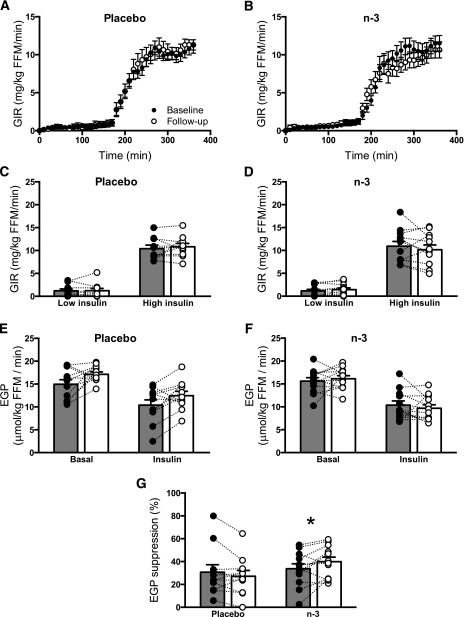
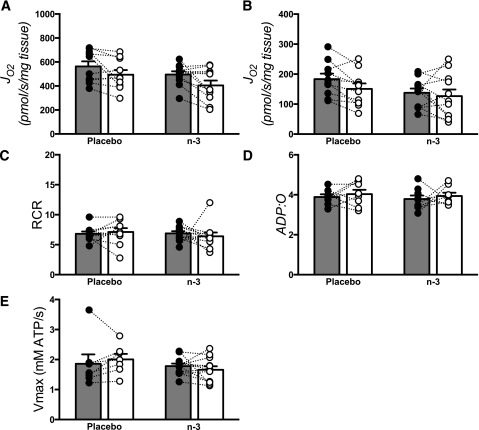
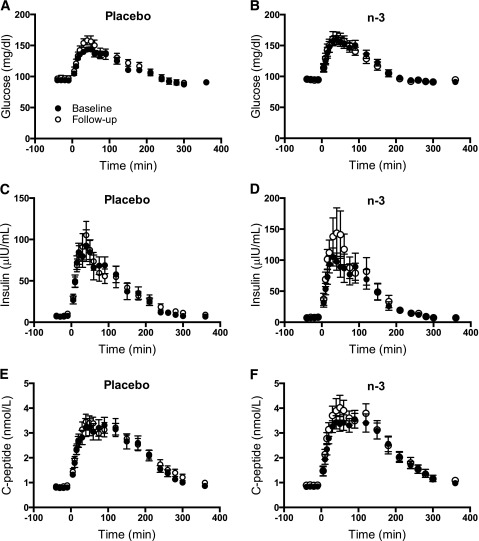
Compared with placebo, EPA+DHA did not alter peripheral insulin sensitivity, postprandial glucose disposal, or insulin secretion. Hepatic insulin sensitivity, determined from the suppression of endogenous glucose production by insulin, exhibited a small but significant improvement with EPA+DHA compared with placebo. Muscle mitochondrial function was unchanged by EPA+DHA or placebo.
This study demonstrates that dietary EPA+DHA does not improve peripheral glucose disposal, insulin secretion, or skeletal muscle mitochondrial function in insulin-resistant nondiabetic humans. There was a modest improvement in hepatic insulin sensitivity with EPA+DHA, but this was not associated with any improvements in clinically meaningful outcomes.
膳食中的n-3多不饱和脂肪酸,包括二十碳五烯酸(EPA)和二十二碳六烯酸(DHA),可预防啮齿动物的胰岛素抵抗并刺激线粒体生物合成,但迄今为止,人类转化研究的结果尚不明确。本研究的目的是采用可靠的研究设计和金标准测量方法,评估EPA和DHA对胰岛素抵抗的非糖尿病患者胰岛素敏感性、胰岛素分泌和肌肉线粒体功能的影响。
在一项随机双盲研究中,31名胰岛素抵抗的成年人接受了6个月的3.9克/天EPA+DHA或安慰剂治疗。采用生长抑素的高胰岛素-正常血糖钳夹技术评估肝脏和外周胰岛素敏感性。餐后测量餐后血糖处置和胰岛素分泌。在基线和治疗6个月后进行测量。通过MRI评估腹部脂肪分布。使用高分辨率呼吸测定法在分离的线粒体中测量肌肉氧化能力,并通过磁共振波谱法进行无创测量。
与安慰剂相比,EPA+DHA未改变外周胰岛素敏感性、餐后血糖处置或胰岛素分泌。与安慰剂相比,通过胰岛素对内源性葡萄糖生成的抑制作用确定的肝脏胰岛素敏感性,在使用EPA+DHA时虽有小幅但显著的改善。EPA+DHA或安慰剂对肌肉线粒体功能无影响。
本研究表明,膳食中的EPA+DHA并不能改善胰岛素抵抗的非糖尿病患者的外周葡萄糖处置、胰岛素分泌或骨骼肌线粒体功能。EPA+DHA使肝脏胰岛素敏感性有适度改善,但这与任何有临床意义的结果改善均无关联。