Eötvös Loránd University, Institute of Psychology, Budapest, Hungary.
PLoS One. 2012;7(5):e36417. doi: 10.1371/journal.pone.0036417. Epub 2012 May 10.
Online gaming has become increasingly popular. However, this has led to concerns that these games might induce serious problems and/or lead to dependence for a minority of players.
The aim of this study was to uncover and operationalize the components of problematic online gaming.
A total of 3415 gamers (90% males; mean age 21 years), were recruited through online gaming websites. A combined method of exploratory factor analysis (EFA) and confirmatory factor analysis (CFA) was applied. Latent profile analysis was applied to identify persons at-risk.
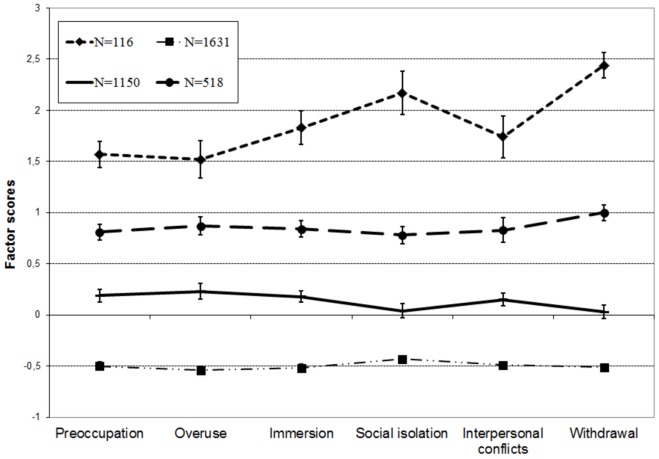
EFA revealed a six-factor structure in the background of problematic online gaming that was also confirmed by a CFA. For the assessment of the identified six dimensions--preoccupation, overuse, immersion, social isolation, interpersonal conflicts, and withdrawal--the 18-item Problematic Online Gaming Questionnaire (POGQ) proved to be exceedingly suitable. Based on the latent profile analysis, 3.4% of the gamer population was considered to be at high risk, while another 15.2% was moderately problematic.
The POGQ seems to be an adequate measurement tool for the differentiated assessment of gaming related problems on six subscales.
在线游戏越来越受欢迎。然而,这引发了人们的担忧,即这些游戏可能会导致少数玩家出现严重问题和/或成瘾。
本研究旨在揭示和操作在线游戏问题的组成部分。
通过在线游戏网站招募了 3415 名游戏玩家(90%为男性;平均年龄 21 岁)。采用探索性因素分析(EFA)和验证性因素分析(CFA)相结合的方法。应用潜在剖面分析来识别有风险的人群。
EFA 揭示了在线游戏问题背景下的六因素结构,这一结构也得到了 CFA 的证实。为了评估确定的六个维度——着迷、过度使用、沉浸、社交隔离、人际冲突和退出——18 项在线游戏问题问卷(POGQ)被证明非常适用。基于潜在剖面分析,3.4%的游戏玩家被认为处于高风险,另有 15.2%存在中度问题。
POGQ 似乎是一种评估游戏相关问题的适当工具,可以在六个子量表上进行区分评估。