Hall Peter A, Fong Geoffrey T
Faculty of Applied Health Sciences, University of Waterloo Waterloo, ON, Canada.
Department of Psychology, University of Waterloo Waterloo, ON, Canada.
Front Hum Neurosci. 2015 Mar 25;9:117. doi: 10.3389/fnhum.2015.00117. eCollection 2015.
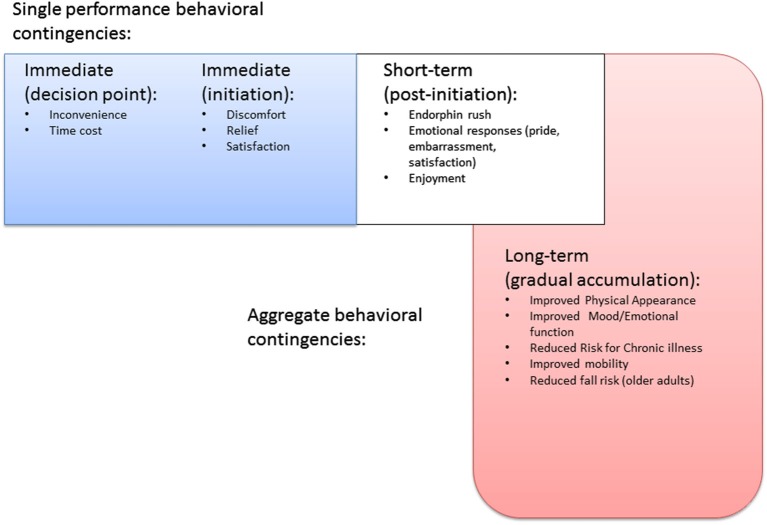
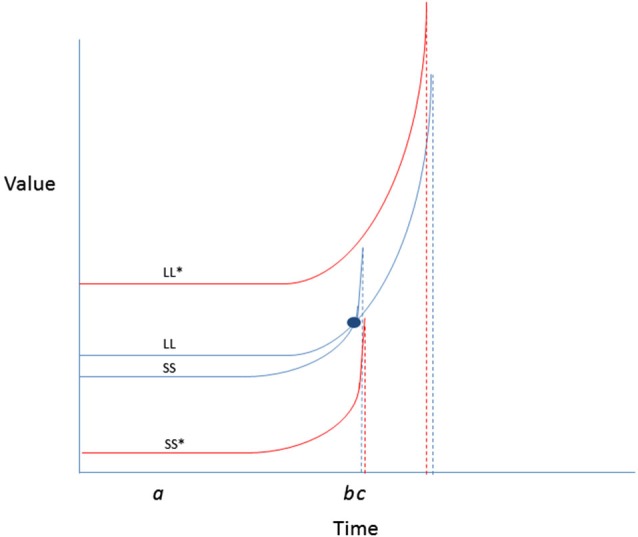
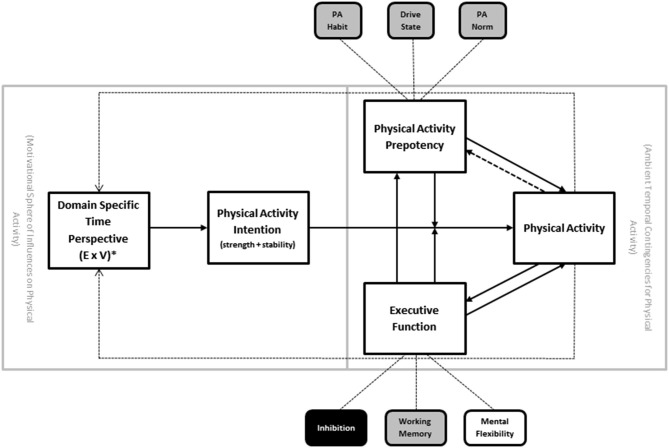
Dominant explanatory models for physical activity behavior are limited by the exclusion of several important components, including temporal dynamics, ecological forces, and neurobiological factors. The latter may be a critical omission, given the relevance of several aspects of cognitive function for the self-regulatory processes that are likely required for consistent implementation of physical activity behavior in everyday life. This narrative review introduces temporal self-regulation theory (TST; Hall and Fong, 2007, 2013) as a new explanatory model for physical activity behavior. Important features of the model include consideration of the default status of the physical activity behavior, as well as the disproportionate influence of temporally proximal behavioral contingencies. Most importantly, the TST model proposes positive feedback loops linking executive function (EF) and the performance of physical activity behavior. Specifically, those with relatively stronger executive control (and optimized brain structures supporting it, such as the dorsolateral prefrontal cortex (PFC)) are able to implement physical activity with more consistency than others, which in turn serves to strengthen the executive control network itself. The TST model has the potential to explain everyday variants of incidental physical activity, sport-related excellence via capacity for deliberate practice, and variability in the propensity to schedule and implement exercise routines.
身体活动行为的主要解释模型存在局限性,因为它们排除了几个重要因素,包括时间动态、生态力量和神经生物学因素。鉴于认知功能的几个方面与日常生活中持续进行身体活动行为可能所需的自我调节过程相关,后者可能是一个关键的遗漏。本叙述性综述引入了时间自我调节理论(TST;Hall和Fong,2007年、2013年),作为身体活动行为的一种新的解释模型。该模型的重要特征包括考虑身体活动行为的默认状态,以及时间上近端行为偶然性的不成比例影响。最重要的是,TST模型提出了连接执行功能(EF)和身体活动行为表现的正反馈回路。具体而言,那些执行控制相对较强(以及支持它的优化脑结构,如背外侧前额叶皮层(PFC))的人能够比其他人更一致地进行身体活动,这反过来又有助于加强执行控制网络本身。TST模型有可能解释偶然身体活动的日常变化、通过刻意练习能力实现的与运动相关的卓越表现,以及安排和执行锻炼计划倾向的变异性。