Chiovaro Francesca, Martina Enrico, Bottos Alessia, Scherberich Arnaud, Hynes Nancy E, Chiquet-Ehrismann Ruth
Friedrich Miescher Institute for Biomedical Research, Basel, Switzerland.
Faculty of Science, University of Basel, Basel, Switzerland.
Int J Cancer. 2015 Oct 15;137(8):1842-54. doi: 10.1002/ijc.29565. Epub 2015 Apr 29.
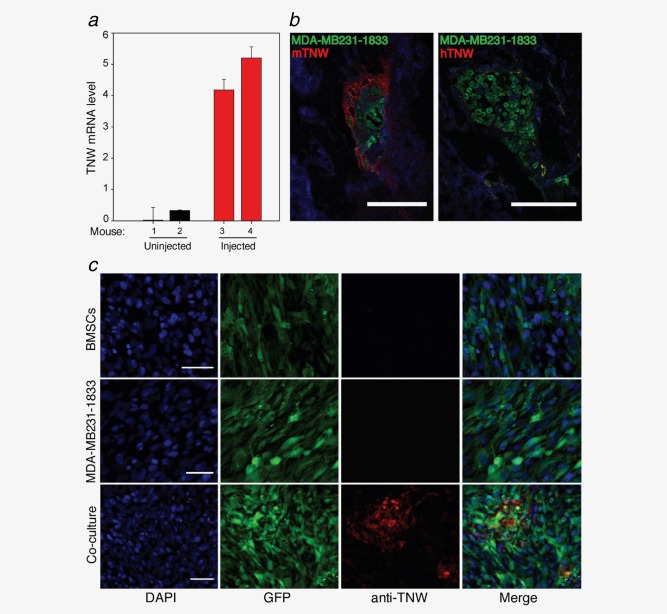
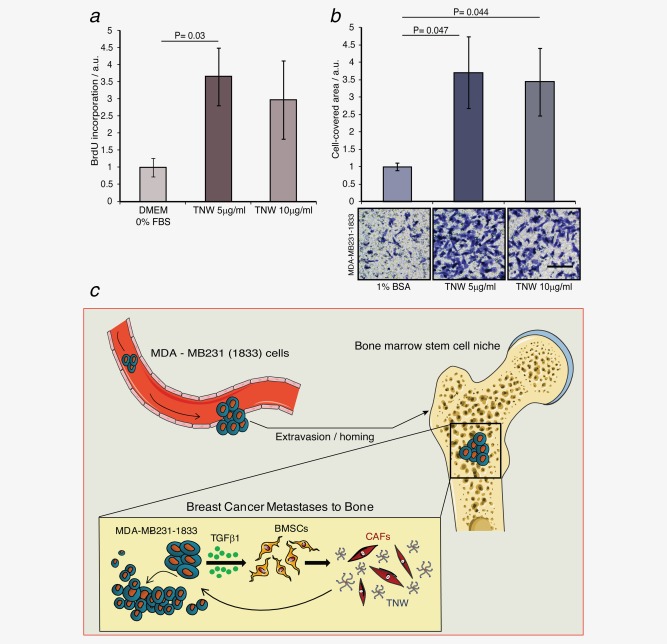
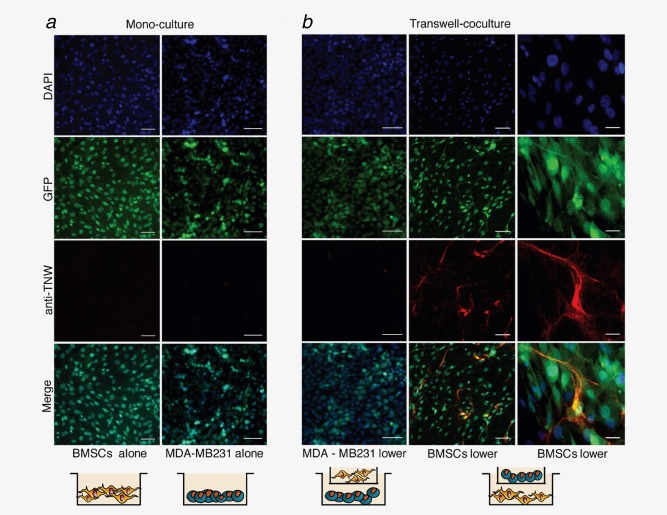
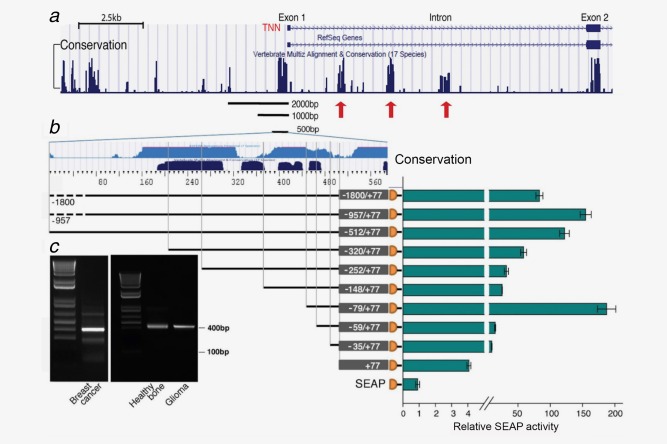
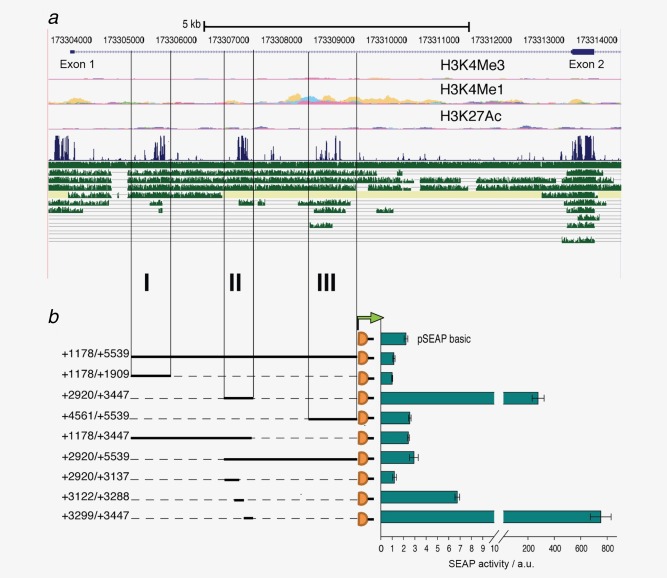
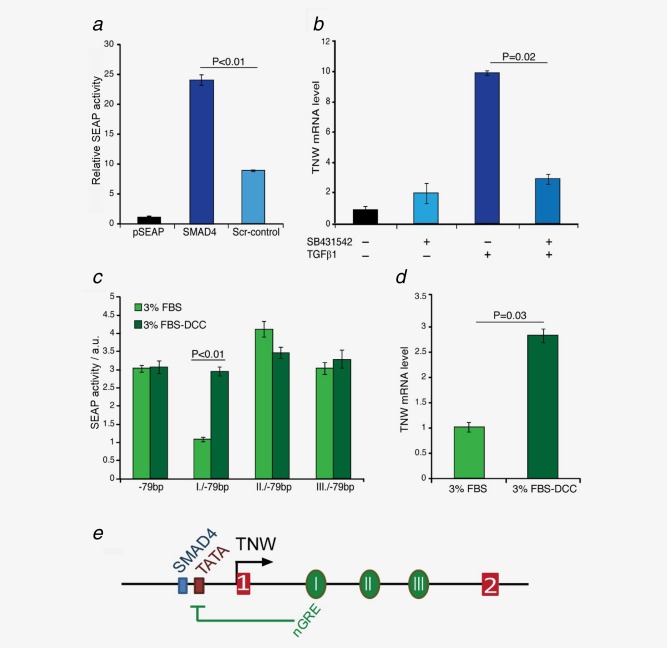
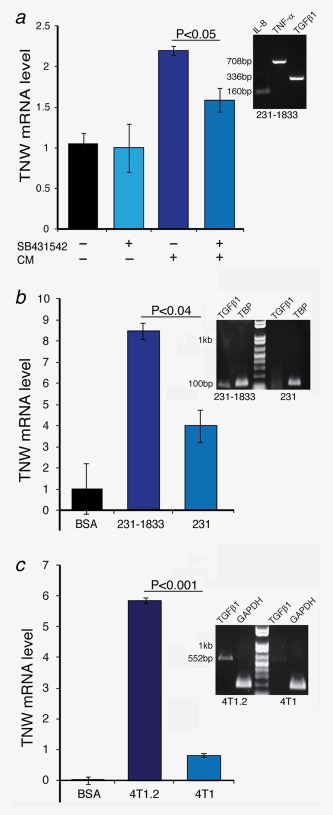
Tenascin-W is a matricellular protein with a dynamically changing expression pattern in development and disease. In adults, tenascin-W is mostly restricted to stem cell niches, and is also expressed in the stroma of solid cancers. Here, we analyzed its expression in the bone microenvironment of breast cancer metastasis. Osteoblasts were isolated from tumor-free or tumor-bearing bones of mice injected with MDA-MB231-1833 breast cancer cells. We found a fourfold upregulation of tenascin-W in the osteoblast population of tumor-bearing mice compared to healthy mice, indicating that tenascin-W is supplied by the bone metastatic niche. Transwell and co-culture studies showed that human bone marrow stromal cells (BMSCs) express tenascin-W protein after exposure to factors secreted by MDA-MB231-1833 breast cancer cells. To study tenascin-W gene regulation, we identified and analyzed the tenascin-W promoter as well as three evolutionary conserved regions in the first intron. 5'RACE analysis of mRNA from human breast cancer, glioblastoma and bone tissue showed a single tenascin-W transcript with a transcription start site at a noncoding first exon followed by exon 2 containing the ATG translation start. Site-directed mutagenesis of a SMAD4-binding element in proximity of the TATA box strongly impaired promoter activity. TGFβ1 induced tenascin-W expression in human BMSCs through activation of the TGFβ1 receptor ALK5, while glucocorticoids were inhibitory. Our experiments show that tenascin-W acts as a niche component for breast cancer metastasis to bone by supporting cell migration and cell proliferation of the cancer cells.
腱生蛋白-W是一种基质细胞蛋白,在发育和疾病过程中其表达模式动态变化。在成年人中,腱生蛋白-W大多局限于干细胞微环境,也在实体癌的基质中表达。在此,我们分析了其在乳腺癌转移的骨微环境中的表达。从注射了MDA-MB231-1833乳腺癌细胞的小鼠的无瘤或有瘤骨中分离成骨细胞。我们发现,与健康小鼠相比,有瘤小鼠的成骨细胞群体中腱生蛋白-W上调了四倍,表明腱生蛋白-W由骨转移微环境提供。Transwell和共培养研究表明,人骨髓基质细胞(BMSC)在暴露于MDA-MB231-1833乳腺癌细胞分泌的因子后表达腱生蛋白-W蛋白。为了研究腱生蛋白-W基因调控,我们鉴定并分析了腱生蛋白-W启动子以及第一个内含子中的三个进化保守区域。对人乳腺癌、胶质母细胞瘤和骨组织的mRNA进行5'RACE分析,显示单个腱生蛋白-W转录本,其转录起始位点位于非编码的第一个外显子,随后是包含ATG翻译起始位点的外显子2。TATA框附近的SMAD4结合元件的定点诱变强烈损害启动子活性。TGFβ1通过激活TGFβ1受体ALK5诱导人BMSC中腱生蛋白-W的表达,而糖皮质激素具有抑制作用。我们的实验表明,腱生蛋白-W通过支持癌细胞的细胞迁移和细胞增殖,作为乳腺癌向骨转移的微环境成分。