Brellier Florence, Martina Enrico, Degen Martin, Heuzé-Vourc'h Nathalie, Petit Agnès, Kryza Thomas, Courty Yves, Terracciano Luigi, Ruiz Christian, Chiquet-Ehrismann Ruth
Friedrich Miescher Institute for Biomedical Research, Novartis Research Foundation, Basel, Switzerland.
Faculty of Sciences, University of Basel, Basel, Switzerland.
BMC Clin Pathol. 2012 Sep 4;12:14. doi: 10.1186/1472-6890-12-14.
Tenascins are large glycoproteins found in the extracellular matrix of many embryonic and adult tissues. Tenascin-C is a well-studied biomarker known for its high overexpression in the stroma of most solid cancers. Tenascin-W, the least studied member of the family, is highly expressed in the stroma of colon and breast tumors and in gliomas, but not in the corresponding normal tissues. Other solid tumors have not been analyzed. The present study was undertaken to determine whether tenascin-W could serve as a cancer-specific extracellular matrix protein in a broad range of solid tumors.
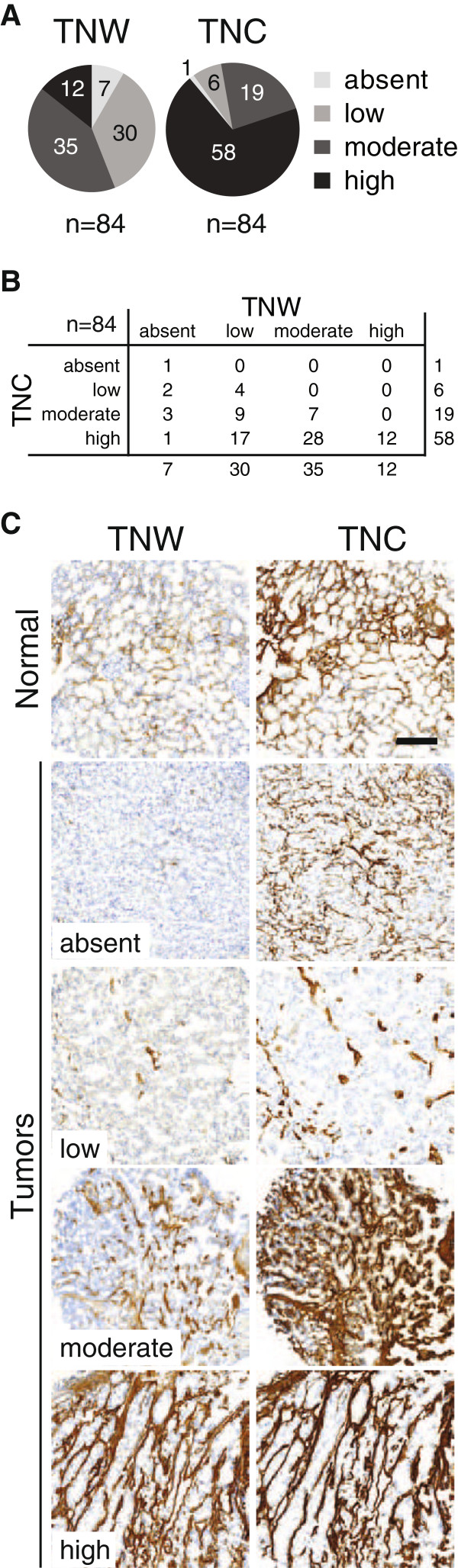
We analyzed the expression of tenascin-W and tenascin-C by immunoblotting and by immunohistochemistry on multiple frozen tissue microarrays of carcinomas of the pancreas, kidney and lung as well as melanomas and compared them to healthy tissues.
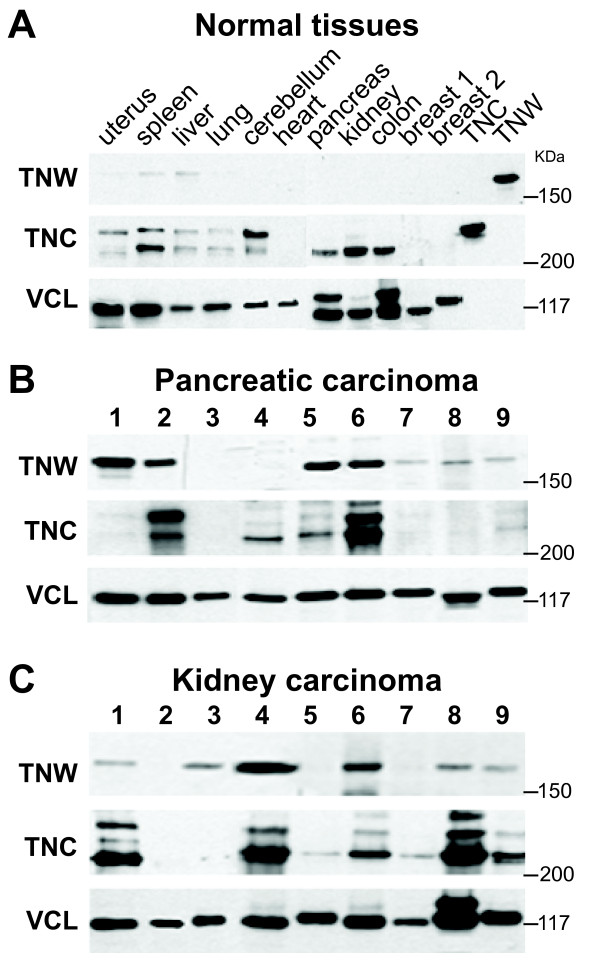
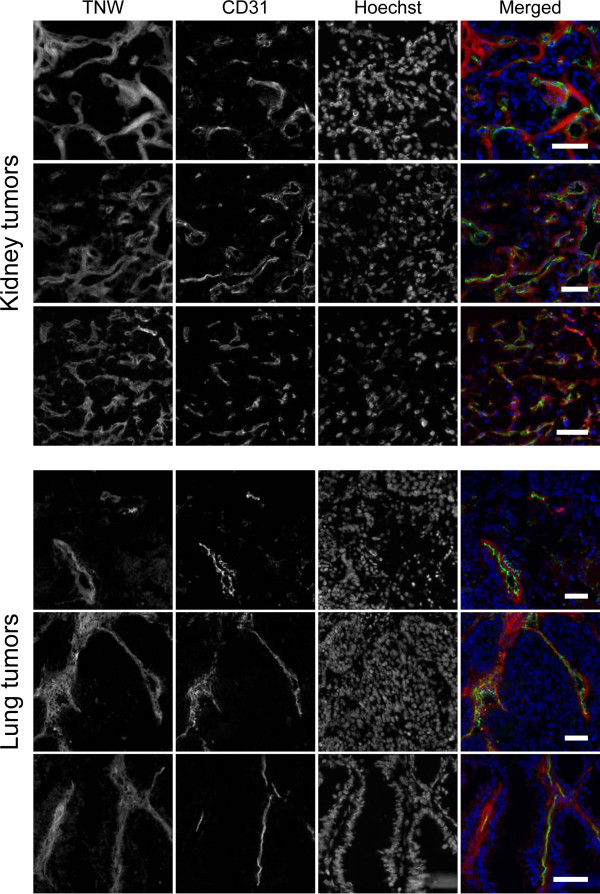
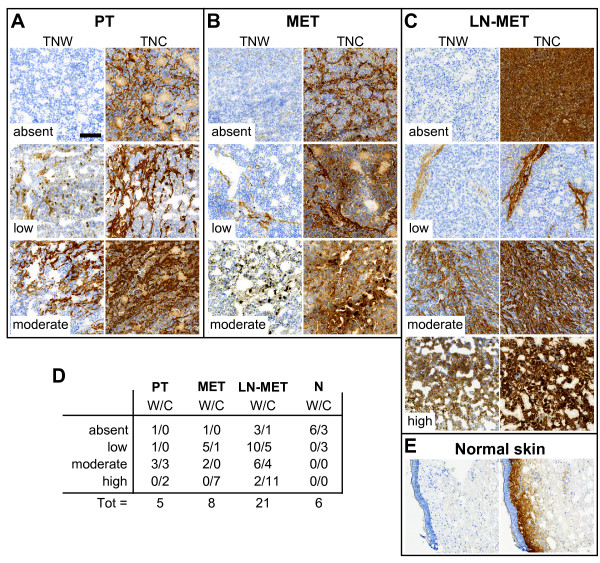
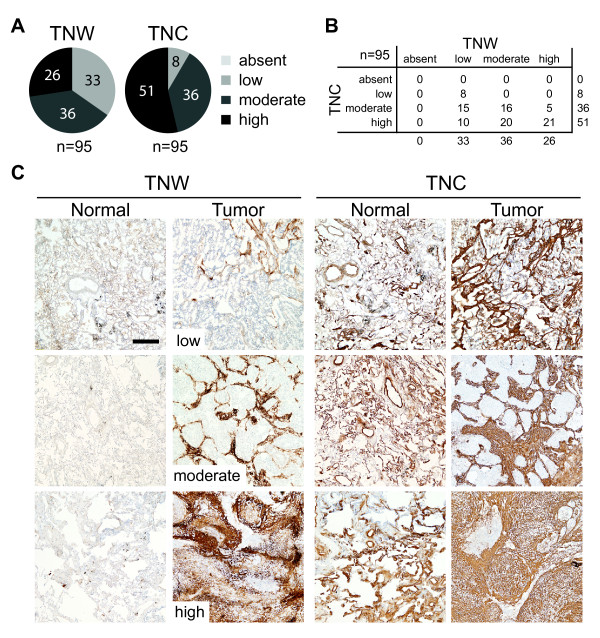
From all healthy adult organs tested, only liver and spleen showed detectable levels of tenascin-W, suggesting that tenascin-W is absent from most human adult organs under normal, non-pathological conditions. In contrast, tenascin-W was detectable in the majority of melanomas and their metastases, as well as in pancreas, kidney, and lung carcinomas. Comparing lung tumor samples and matching control tissues for each patient revealed a clear overexpression of tenascin-W in tumor tissues. Although the number of samples examined is too small to draw statistically significant conclusions, there seems to be a tendency for increased tenascin-W expression in higher grade tumors. Interestingly, in most tumor types, tenascin-W is also expressed in close proximity to blood vessels, as shown by CD31 co-staining of the samples.
The present study extends the tumor biomarker potential of tenascin-W to a broad range of solid tumors and shows its accessibility from the blood stream for potential therapeutic strategies.
腱糖蛋白是在许多胚胎和成年组织的细胞外基质中发现的大型糖蛋白。腱糖蛋白-C是一种经过充分研究的生物标志物,以其在大多数实体癌基质中的高表达而闻名。腱糖蛋白-W是该家族中研究最少的成员,在结肠和乳腺肿瘤以及神经胶质瘤的基质中高度表达,但在相应的正常组织中不表达。尚未对其他实体瘤进行分析。本研究旨在确定腱糖蛋白-W是否可作为广泛实体瘤中癌症特异性的细胞外基质蛋白。
我们通过免疫印迹和免疫组织化学方法,对胰腺、肾脏和肺癌以及黑色素瘤的多个冷冻组织微阵列进行分析,检测腱糖蛋白-W和腱糖蛋白-C的表达,并与健康组织进行比较。
在所有测试的健康成人器官中,只有肝脏和脾脏显示出可检测到的腱糖蛋白-W水平,这表明在正常、非病理条件下,大多数人类成人器官中不存在腱糖蛋白-W。相比之下,在大多数黑色素瘤及其转移灶以及胰腺癌、肾癌和肺癌中可检测到腱糖蛋白-W。比较每位患者的肺肿瘤样本和匹配的对照组织发现,肿瘤组织中腱糖蛋白-W明显过表达。尽管所检查的样本数量太少,无法得出具有统计学意义的结论,但似乎在高级别肿瘤中腱糖蛋白-W表达有增加的趋势。有趣的是,在大多数肿瘤类型中,如样本的CD31共染色所示,腱糖蛋白-W也在血管附近表达。
本研究将腱糖蛋白-W的肿瘤生物标志物潜力扩展到广泛的实体瘤,并表明其可从血流中获取,具有潜在的治疗策略。