Owen Van Horne Amanda J, Green Fager Melanie
a Department of Communication Sciences & Disorders , University of Iowa , Iowa City , IA , USA.
b Member, DeLTA Center, University of Iowa , Iowa City , IA , USA.
Int J Speech Lang Pathol. 2015 Dec;17(6):605-616. doi: 10.3109/17549507.2015.1034174. Epub 2015 Apr 16.
Children with specific language impairment (SLI) frequently have difficulty producing the past tense. This study aimed to quantify the relative influence of telicity (i.e. the completedness of an event), verb frequency and stem final phonemes on the production of past tense by school-age children with SLI and their typically-developing (TD) peers.
Archival elicited production data from children with SLI between the ages of 6-9 and TD peers aged 4-8 were re-analysed. Past tense accuracy was predicted using measures of telicity, verb frequency measures and properties of the final consonant of the verb stem.
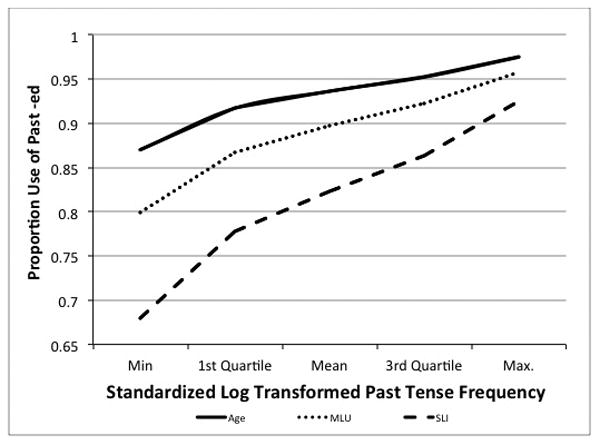
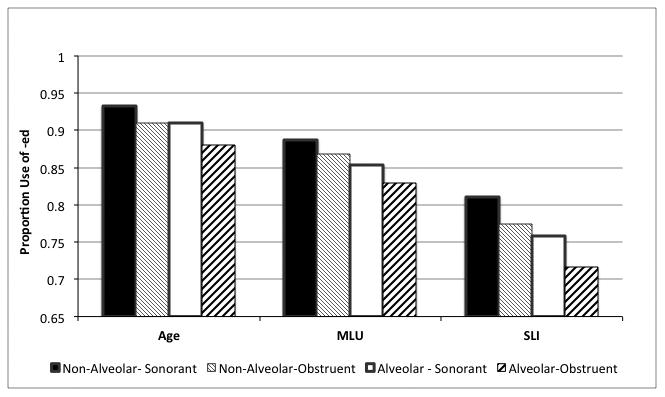
All children were highly accurate when verbs were telic, the inflected form was frequently heard in the past tense and the word ended in a sonorant/non-alveolar consonant. All children were less accurate when verbs were atelic, rarely heard in the past tense or ended in a word final obstruent or alveolar consonant. SLI status depressed overall accuracy rates, but did not influence how facilitative a given factor was.
Some factors that have been believed to be useful only when children are first discovering past tense, such as telicity, appear to be influential in later years as well.
特定语言障碍(SLI)儿童在过去时态的表达上常常存在困难。本研究旨在量化情状性(即事件的完整性)、动词频率和词干末尾音素对患有SLI的学龄儿童及其发育正常(TD)的同龄人过去时态表达的相对影响。
重新分析了6至9岁患有SLI的儿童以及4至8岁发育正常的同龄人的档案引出式产出数据。使用情状性测量、动词频率测量以及动词词干末尾辅音的属性来预测过去时态的准确性。
当动词具有情状性、过去时态中屈折形式经常被听到且单词以响音/非齿龈辅音结尾时,所有儿童的表达准确率都很高。当动词不具有情状性、在过去时态中很少被听到或以词尾阻塞音或齿龈辅音结尾时,所有儿童的表达准确率都较低。SLI状态降低了总体准确率,但不影响给定因素的促进作用。
一些被认为仅在儿童初次学习过去时态时有用的因素,如情状性,在后期似乎也具有影响力。