Division of Epidemiology and Community Health, School of Public Health, University of Minnesota, 1300 S. Second st. Suite 300, Minneapolis, MN, 55454, USA.
Bacterial Special Pathogens Branch, Centers for Disease Control United States, 1600 Clifton Road NE, Atlanta, GA, 30333, USA.
BMC Vet Res. 2015 Feb 12;11:31. doi: 10.1186/s12917-015-0341-9.
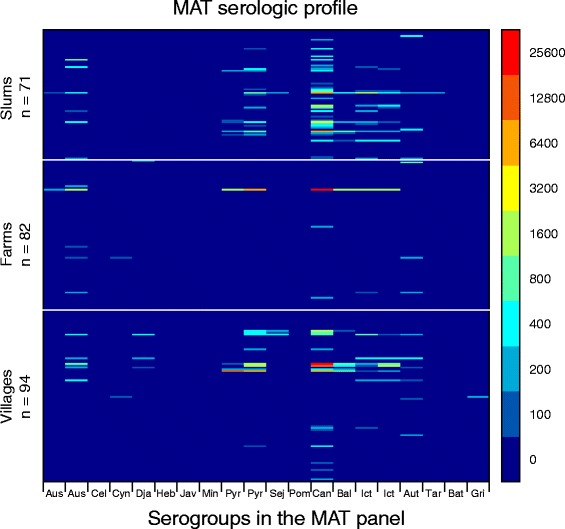
Leptospirosis is a zoonotic disease of global importance and often neglected as a public health problem due to lack of awareness, under-diagnosis and under-reporting. Animals serve as a source of transmission through the shedding of Leptospira in their urine. Because of their proximity to humans, dogs may play a role in human infections. In order to assess and mitigate leptospirosis in dogs and the risk of transmission to humans it is important to understand the epidemiology of leptospirosis under natural conditions. This study aimed to characterize leptospirosis in owned dogs from three distinct community types. Blood, dog and household data were collected from 265 dogs in 190 households from 12 communities representing farms, rural villages, and urban slums in the Los Rios region, Chile. Serologic profiles with a 20-serovar microagglutination test panel were obtained. Binomial and multinomial logistic regression models were used to evaluate the associations between spatial, ecological, socio-economic variables and overall seropositivity as well as seropositivity to serogroup Canicola.
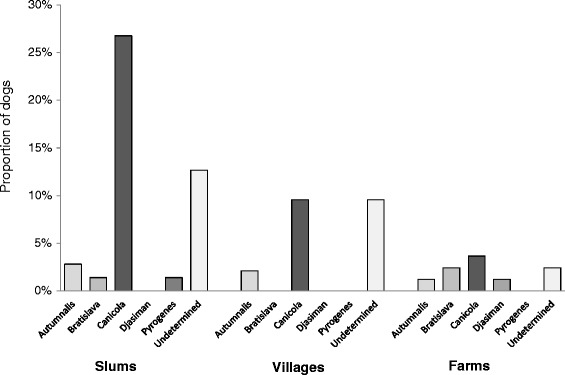
Results from 247 dogs with no history of vaccination were used. Overall seroprevalence was 25.1% (62/247) with significant differences by community type: 10.9% (9/82) in dogs from farms, 22.3% (21/94) from rural villages, and 45.1% (32/71) from urban slums (p <0.001). This trend by community type was also observed for dogs with evidence of seropositivity to the Canicola serogroup. Factors associated with seropositive dogs included dog density and precipitation two-weeks prior to sampling. Presence of Leptospira positive puddles collected from the peri-domestic household environment was also associated with increased seropositivity.
Results suggest that leptospirosis is actively maintained in the dog population in this study region with notably distinct patterns by community type. Dog populations from rural villages, and urban slums in particular, showed evidence of high levels of transmission probably as a result of the combined effects of dog living conditions as well as community-level ecological and environmental factors.
钩端螺旋体病是一种具有全球重要性的人畜共患病,由于缺乏认识、诊断不足和报告不足,常被忽视为公共卫生问题。动物通过尿液排出钩端螺旋体,成为传播的源头。由于它们与人类的密切接触,狗可能在人类感染中发挥作用。为了评估和减轻狗中的钩端螺旋体病以及传播给人类的风险,了解自然条件下的钩端螺旋体病流行病学非常重要。本研究旨在描述来自三个不同社区类型的犬类钩端螺旋体病的特征。从智利洛斯里奥斯地区 12 个社区的 190 户家庭的 265 只狗中收集了血液、狗和家庭数据。使用 20 血清型微量凝集试验板获得血清学图谱。使用二项式和多项逻辑回归模型评估空间、生态、社会经济变量与总体血清阳性率以及血清 Canicola 群血清阳性率之间的关系。
使用了 247 只没有接种疫苗史的狗的结果。总血清阳性率为 25.1%(62/247),社区类型之间存在显著差异:农场的狗为 10.9%(9/82),农村村庄的狗为 22.3%(21/94),城市贫民窟的狗为 45.1%(32/71)(p<0.001)。这种社区类型的趋势也观察到了血清阳性犬的 Canicola 血清群。与血清阳性犬相关的因素包括采样前两周的狗密度和降水。从家庭环境周围采集的含有阳性 Leptospira 的水坑的存在也与血清阳性率增加有关。
结果表明,在本研究区域,钩端螺旋体病在狗群中得到了积极的维持,社区类型之间存在明显不同的模式。农村村庄和特别是城市贫民窟的狗群表现出高传播水平的证据,这可能是狗的生活条件以及社区层面的生态和环境因素共同作用的结果。