Bhatnagar Rahul, Kahan Brennan C, Morley Anna J, Keenan Emma K, Miller Robert F, Rahman Najib M, Maskell Nick A
Academic Respiratory Unit, University of Bristol, Southmead Hospital, Learning and Research Building, Southmead Road, Bristol, BS10 5NB, UK.
Respiratory Research, Clinical Research Centre, Southmead Hospital, Southmead Road, Bristol, BS10 5NB, UK.
Trials. 2015 Feb 12;16:48. doi: 10.1186/s13063-015-0563-y.
Malignant pleural effusions (MPEs) remain a common problem, with 40,000 new cases in the United Kingdom each year and up to 250,000 in the United States. Traditional management of MPE usually involves an inpatient stay with placement of a chest drain, followed by the instillation of a pleural sclerosing agent such as talc, which aims to minimise further fluid build-up. Despite a good success rate in studies, this approach can be expensive, time-consuming and inconvenient for patients. More recently, an alternative method has become available in the form of indwelling pleural catheters (IPCs), which can be inserted and managed in an outpatient setting. It is currently unknown whether combining talc pleurodesis with IPCs will provide improved pleural symphysis rates over those of IPCs alone.
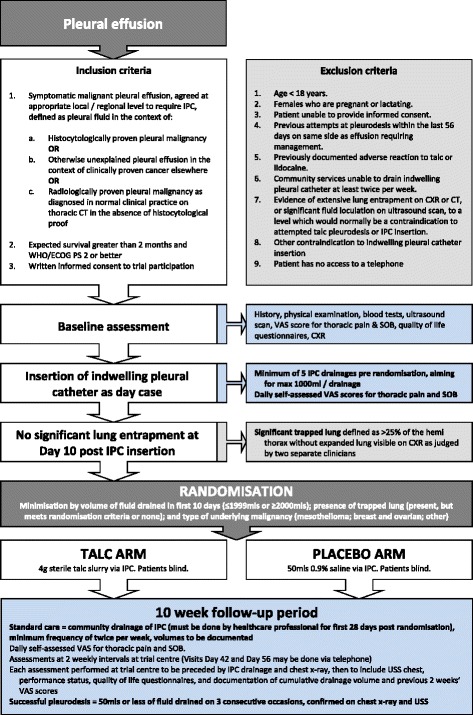
METHODS/DESIGN: IPC-PLUS is a patient-blind, multicentre randomised controlled trial (RCT) comparing the combination of talc with an IPC to the use of an IPC alone for inducing pleurodesis in MPEs. The primary outcome is successful pleurodesis at five weeks post-randomisation. This study will recruit 154 patients, with an interim analysis for efficacy after 100 patients, and aims to help to define the future gold standard for outpatient management of patients with symptomatic MPEs.
IPC-PLUS is the first RCT to examine the practicality and utility of talc administered via an IPC. The study remains in active recruitment and has the potential to significantly alter how patients requiring pleurodesis for MPE are approached in the future.
This trial was registered with Current Controlled Trials (identifier: ISRCTN73255764 ) on 23 August 2012.
恶性胸腔积液(MPE)仍然是一个常见问题,在英国每年有40000例新发病例,在美国多达250000例。MPE的传统治疗通常需要住院放置胸腔引流管,随后注入胸膜硬化剂如滑石粉,目的是尽量减少液体进一步积聚。尽管在研究中有较高的成功率,但这种方法可能成本高昂、耗时且给患者带来不便。最近,一种替代方法以留置胸腔导管(IPC)的形式出现,其可以在门诊环境中插入和管理。目前尚不清楚滑石粉胸膜固定术与IPC联合使用是否比单独使用IPC能提高胸膜粘连率。
方法/设计:IPC-PLUS是一项患者盲法、多中心随机对照试验(RCT),比较滑石粉与IPC联合使用和单独使用IPC诱导MPE胸膜固定术的效果。主要结局是随机分组后五周时胸膜固定术成功。本研究将招募154例患者,在100例患者后进行疗效中期分析,旨在帮助确定有症状MPE患者门诊管理的未来金标准。
IPC-PLUS是第一项研究通过IPC给予滑石粉的实用性和效用的RCT。该研究仍在积极招募患者,有可能显著改变未来对需要进行胸膜固定术治疗MPE患者的处理方式。
本试验于2012年8月23日在当前对照试验注册(标识符:ISRCTN73255764)。