Bosse Hans Martin, Mohr Jonathan, Buss Beate, Krautter Markus, Weyrich Peter, Herzog Wolfgang, Jünger Jana, Nikendei Christoph
General Pediatrics, Neonatology and Pediatric Cardiology, University Children's Hospital, Düsseldorf, Germany.
Department of General Internal and Psychosomatic Medicine, University of Heidelberg Medical Hospital, Im Neuenheimer Feld 410, 69120, Heidelberg, Germany.
BMC Med Educ. 2015 Feb 19;15:22. doi: 10.1186/s12909-015-0286-5.
Redundant training and feedback are crucial for successful acquisition of skills in simulation trainings. It is still unclear how or how much feedback should best be delivered to maximize its effect, and how learners' activity and feedback are optimally blended. To determine the influence of high- versus low-frequency expert feedback on the learning curve of students' clinical procedural skill acquisition in a prospective randomized study.
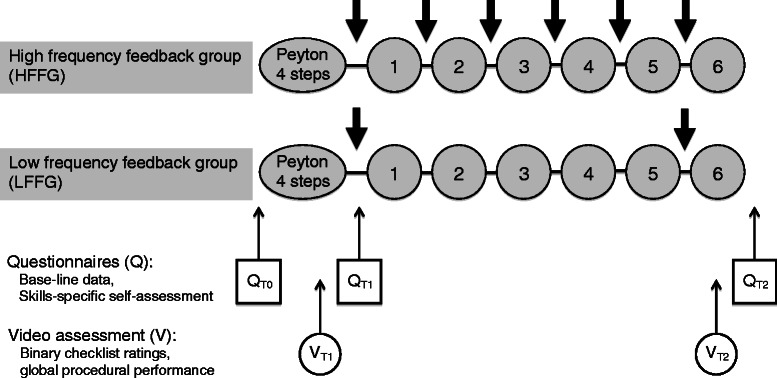
N = 47 medical students were trained to insert a nasogastric tube in a mannequin, including structured feedback in the initial instruction phase at the beginning of the training (T1), and either additional repetitive feedback after each of their five subsequent repetitions (high-frequency feedback group, HFF group; N = 23) or additional feedback on just one occasion, after the fifth repetition only (low-frequency feedback group, LFF group; N = 24). We assessed a) task-specific clinical skill performance and b) global procedural performance (five items of the Integrated Procedural Performance Instrument (IPPI); on the basis of expert-rated videotapes at the beginning of the training (T1) and during the final, sixth trial (T2).
The two study groups did not differ regarding their baseline data. The calculated ANOVA for task-specific clinical skill performance with the between-subject factor 'Group' (HFF vs. LFF) and within-subject factors 'Time' (T1 vs. T2) turned out not to be significant (p < .147). An exploratory post-hoc analyses revealed a trend towards a superior performance of HFF compared to LFF after the training (T2; p < .093), whereas both groups did not differ at the beginning (T1; p < .851). The smoothness of the procedure assessed as global procedural performance, was superior in HFF compared to LFF after the training (T2; p < .004), whereas groups did not differ at the beginning (T1; p < .941).
Deliberate practice with both high- and low-frequency intermittent feedback results in a strong improvement of students' early procedural skill acquisition. High-frequency intermittent feedback, however, results in even better and smoother performance. We discuss the potential role of the cognitive workload on the results. We advocate a thoughtful allocation of tutor resources to future skills training.
在模拟训练中,重复训练和反馈对于成功掌握技能至关重要。目前仍不清楚应如何或给予多少反馈才能最大程度地发挥其效果,以及学习者的活动与反馈如何实现最佳融合。在一项前瞻性随机研究中,确定高频与低频专家反馈对学生临床操作技能习得学习曲线的影响。
47名医学生接受在人体模型上插入鼻胃管的训练,包括在训练开始时的初始指导阶段(T1)给予结构化反馈,以及在随后的五次重复操作中,要么每次重复后都给予额外的重复性反馈(高频反馈组,HFF组;N = 23),要么仅在第五次重复操作后给予一次额外反馈(低频反馈组,LFF组;N = 24)。我们评估了:a)特定任务的临床技能表现;b)整体操作表现(综合操作表现量表(IPPI)的五个项目);基于训练开始时(T1)和最后第六次试验时(T2)专家评分的录像带进行评估。
两个研究组的基线数据无差异。计算得出的针对特定任务临床技能表现的方差分析,其组间因素为“组”(HFF组与LFF组),组内因素为“时间”(T1与T2),结果无统计学意义(p <.147)。一项探索性的事后分析显示,训练后(T2)HFF组的表现有优于LFF组的趋势(p <.093),而两组在开始时(T1)无差异(p <.851)。作为整体操作表现评估的操作流畅性,训练后(T2)HFF组优于LFF组(p <.004),而两组在开始时无差异(p <.941)。
高频和低频间歇性反馈的刻意练习能显著提高学生早期操作技能的习得。然而,高频间歇性反馈能带来更好、更流畅的表现。我们讨论了认知负荷对结果的潜在作用。我们主张在未来的技能训练中,要谨慎分配导师资源。