Zou Cao, Song Jianping, Li Hui, Huang Xingmei, Liu Yuping, Zhao Caiming, Shi Xin, Yang Xiangjun
Department of Cardiology, First Affiliated Hospital of Soochow University, Suzhou, China (C.Z., J.S., H.L., X.Y.).
Department of Electrocardiography, First Affiliated Hospital of Soochow University, Suzhou, China (X.H., Y.L.).
J Am Heart Assoc. 2015 Apr 20;4(4):e001777. doi: 10.1161/JAHA.115.001777.
The effects of right ventricular apical pacing (RVAP) and right ventricular outflow tract (RVOT) septal pacing on atrial and ventricular electrophysiology have not been thoroughly compared.
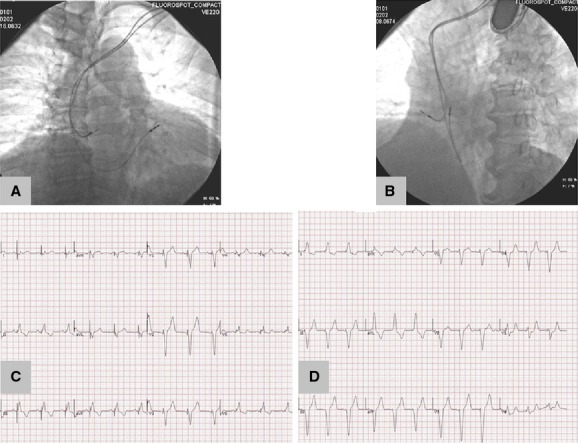
To identify a more favorable pacing strategy with fewer adverse effects, 80 patients who had complete atrioventricular block with normal cardiac function and who were treated with either RVAP (n=42) or RVOT septal pacing (n=38) were recruited after an average of 2 years of follow-up. The data from electrocardiography and echocardiography performed before pacemaker implantation and at the end of follow-up were collected. The patients in the RVOT septal pacing and RVAP groups showed similar demographic and clinical characteristics before pacing treatments. After a mean follow-up of 2 years, the final maximum P-wave duration; P-wave dispersion; Q-, R-, and S-wave complex duration; left atrial volume index; left ventricular end-systolic diameter; ratio of transmitral early diastolic filling velocity to mitral annular early diastolic velocity; and interventricular mechanical delay in the RVOT septal pacing group were significantly less than those in the RVAP group (P<0.05). The final left ventricular ejection fraction of the RVOT septal pacing group was significantly higher than that of the RVAP group (P<0.05).
Compared with RVAP, RVOT septal pacing has fewer adverse effects regarding atrial electrical activity and structure in patients with normal cardiac function.
右心室心尖部起搏(RVAP)和右心室流出道(RVOT)间隔起搏对心房和心室电生理的影响尚未得到充分比较。
为确定一种不良影响较少的更有利起搏策略,招募了80例心功能正常的完全性房室传导阻滞患者,他们接受了RVAP(n = 42)或RVOT间隔起搏(n = 38)治疗,平均随访2年。收集起搏器植入前和随访结束时进行的心电图和超声心动图数据。RVOT间隔起搏组和RVAP组患者在起搏治疗前的人口统计学和临床特征相似。平均随访2年后,RVOT间隔起搏组的最终最大P波时限、P波离散度、QRS波群时限、左心房容积指数、左心室收缩末期内径、二尖瓣舒张早期血流速度与二尖瓣环舒张早期速度之比以及心室间机械延迟均显著低于RVAP组(P<0.05)。RVOT间隔起搏组的最终左心室射血分数显著高于RVAP组(P<0.05)。
与RVAP相比,RVOT间隔起搏对心功能正常患者的心房电活动和结构的不良影响较少。