Bowers Jacob S, Nelson Michelle H, Kundimi Sreenath, Bailey Stefanie R, Huff Logan W, Schwartz Kristina M, Cole David J, Rubinstein Mark P, Paulos Chrystal M
Department of Microbiology and Immunology, Hollings Cancer Center, Medical University of South Carolina, Charleston, South Carolina. Department of Surgery, Hollings Cancer Center, Medical University of South Carolina, Charleston, South Carolina.
Clin Cancer Res. 2015 Jun 1;21(11):2546-57. doi: 10.1158/1078-0432.CCR-14-2294. Epub 2015 Apr 22.
The adoptive cell transfer (ACT) of CD8(+) T cells is a promising treatment for advanced malignancies. Lymphodepletion before ACT enhances IFNγ(+)CD8(+) T cell (Tc0)-mediated tumor regression. Yet, how lymphodepletion regulates the function and antitumor activity of IL17A(+)CD8(+) T cells (Tc17) is unknown.
To address this question, pmel-1 CD8(+) T cells were polarized to secrete either IL17A or IFNγ. These subsets were then infused into mice with B16F10 melanoma that were lymphoreplete [no total body irradiation (TBI)], or lymphodepleted with nonmyeloablative (5 Gy) or myeloablative (9 Gy with hematopoietic stem cell transplantation) TBI. The activation of innate immune cells and function of donor T-cell subsets were monitored in recipient mice.
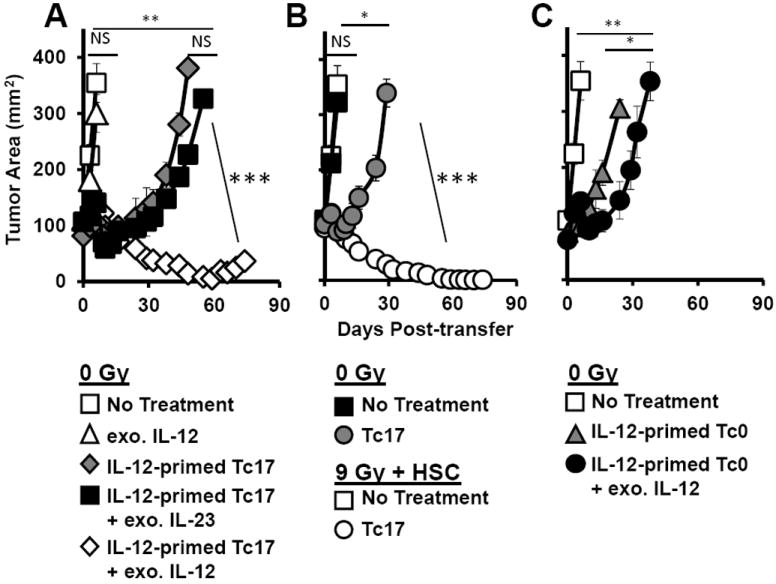
Tc17 cells regress melanoma in myeloablated mice to a greater extent than in lymphoreplete or nonmyeloablated mice. TBI induced functional plasticity in Tc17 cells, causing conversion from IL17A to IFNγ producers. Additional investigation revealed that Tc17 plasticity and antitumor activity were mediated by IL12 secreted by irradiated host dendritic cells (DC). Neutralization of endogenous IL12 reduced the antitumor activity of Tc17 cells in myeloablated mice, whereas ex vivo priming with IL12 enhanced their capacity to regress melanoma in nonmyeloablated animals. This, coupled with exogenous administration of low-dose IL12, obviated the need for host preconditioning, creating curative responses in nonirradiated mice.
Our findings indicate that TBI-induced IL12 augments Tc17 cell-mediated tumor immunity and underline the substantial implications of in vitro preparation of antitumor Tc17 cells with IL12 in the design of T-cell immunotherapies.
CD8(+) T细胞的过继性细胞转移(ACT)是一种很有前景的晚期恶性肿瘤治疗方法。ACT前的淋巴细胞清除可增强IFNγ(+)CD8(+) T细胞(Tc0)介导的肿瘤消退。然而,淋巴细胞清除如何调节IL17A(+)CD8(+) T细胞(Tc17)的功能和抗肿瘤活性尚不清楚。
为解决这个问题,将pmel-1 CD8(+) T细胞极化以分泌IL17A或IFNγ。然后将这些亚群注入患有B16F10黑色素瘤的小鼠体内,这些小鼠要么淋巴细胞完整[无全身照射(TBI)],要么用非清髓性(5 Gy)或清髓性(9 Gy并进行造血干细胞移植)TBI进行淋巴细胞清除。在受体小鼠中监测先天免疫细胞的激活和供体T细胞亚群的功能。
与淋巴细胞完整或未进行清髓的小鼠相比,Tc17细胞在清髓的小鼠中使黑色素瘤消退的程度更大。TBI诱导了Tc17细胞的功能可塑性,导致其从分泌IL17A转变为分泌IFNγ。进一步研究发现,Tc17的可塑性和抗肿瘤活性由受照射宿主树突状细胞(DC)分泌的IL12介导。内源性IL12的中和降低了清髓小鼠中Tc17细胞的抗肿瘤活性,而用IL12进行体外预刺激增强了它们在未进行清髓动物中使黑色素瘤消退的能力。这一点,再加上低剂量IL12的外源给药,消除了对宿主预处理的需求,在未照射的小鼠中产生了治愈性反应。
我们的研究结果表明,TBI诱导的IL12增强了Tc17细胞介导的肿瘤免疫,并强调了在T细胞免疫疗法设计中用IL12体外制备抗肿瘤Tc17细胞的重大意义。