Hobley Laura, Harkins Catriona, MacPhee Cait E, Stanley-Wall Nicola R
Division of Molecular Microbiology, College of Life Sciences, University of Dundee, Dundee DD1 5EH, UK.
James Clerk Maxwell Building, School of Physics, University of Edinburgh, Edinburgh EH9 3JZ, UK.
FEMS Microbiol Rev. 2015 Sep;39(5):649-69. doi: 10.1093/femsre/fuv015. Epub 2015 Apr 22.
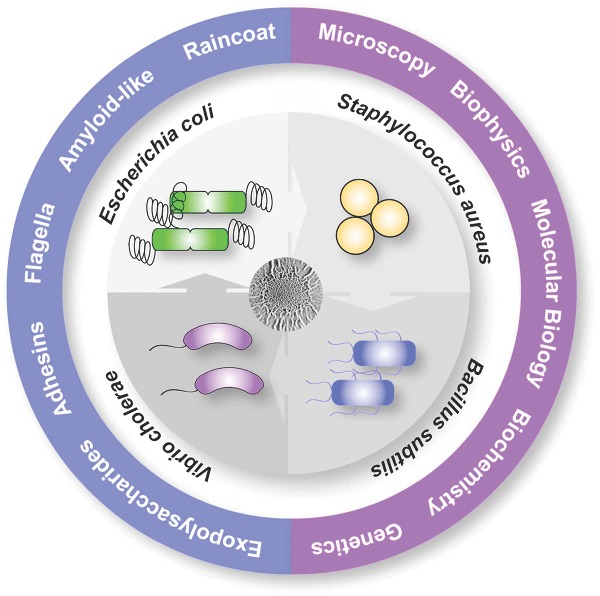
Biofilms are communities of microbial cells that underpin diverse processes including sewage bioremediation, plant growth promotion, chronic infections and industrial biofouling. The cells resident in the biofilm are encased within a self-produced exopolymeric matrix that commonly comprises lipids, proteins that frequently exhibit amyloid-like properties, eDNA and exopolysaccharides. This matrix fulfils a variety of functions for the community, from providing structural rigidity and protection from the external environment to controlling gene regulation and nutrient adsorption. Critical to the development of novel strategies to control biofilm infections, or the capability to capitalize on the power of biofilm formation for industrial and biotechnological uses, is an in-depth knowledge of the biofilm matrix. This is with respect to the structure of the individual components, the nature of the interactions between the molecules and the three-dimensional spatial organization. We highlight recent advances in the understanding of the structural and functional role that carbohydrates and proteins play within the biofilm matrix to provide three-dimensional architectural integrity and functionality to the biofilm community. We highlight, where relevant, experimental techniques that are allowing the boundaries of our understanding of the biofilm matrix to be extended using Escherichia coli, Staphylococcus aureus, Vibrio cholerae, and Bacillus subtilis as exemplars.
生物膜是微生物细胞群落,支撑着包括污水生物修复、促进植物生长、慢性感染和工业生物污垢在内的多种过程。生物膜中的细胞被包裹在一种自身产生的胞外聚合物基质中,该基质通常由脂质、经常表现出淀粉样特性的蛋白质、胞外DNA和胞外多糖组成。这种基质为群落履行多种功能,从提供结构刚性和保护免受外部环境影响到控制基因调控和营养吸附。深入了解生物膜基质对于开发控制生物膜感染的新策略,或利用生物膜形成的力量用于工业和生物技术用途的能力至关重要。这涉及到各个组分的结构、分子间相互作用的性质以及三维空间组织。我们重点介绍了在理解碳水化合物和蛋白质在生物膜基质中所起的结构和功能作用方面的最新进展,这些作用为生物膜群落提供了三维结构完整性和功能性。在相关情况下,我们还重点介绍了一些实验技术,这些技术以大肠杆菌、金黄色葡萄球菌、霍乱弧菌和枯草芽孢杆菌为例,正在扩展我们对生物膜基质的理解边界。