Reiss Katharina, Lehnhardt Jessica, Razum Oliver
Department of Epidemiology & International Public Health, Bielefeld School of Public Health (BiSPH), Bielefeld University, P.O. Box 10 01 31, 33501 Bielefeld, Germany.
Tob Induc Dis. 2015 Apr 16;13(1):11. doi: 10.1186/s12971-015-0036-9. eCollection 2015.
We aimed to identify factors associated with smoking among immigrants. In particular, we investigated the relationship between acculturation and smoking, taking into consideration the stage of the 'smoking epidemic' in the countries of origin and host countries of the immigrants.
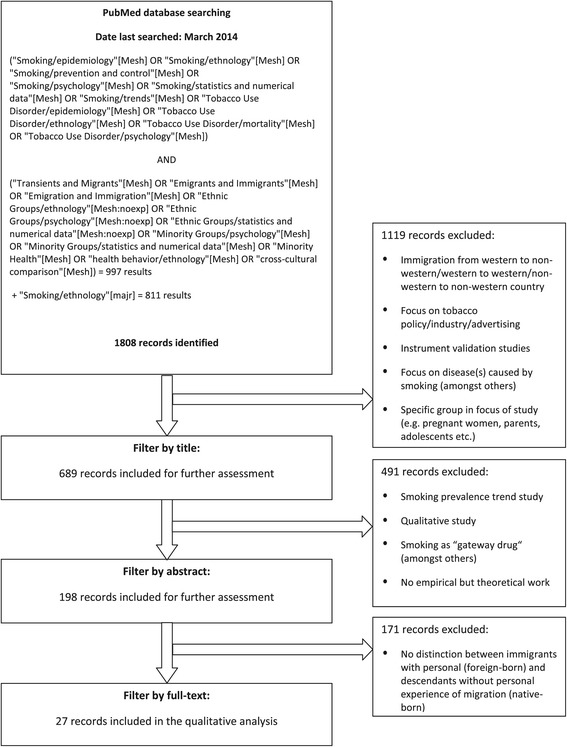
We searched PubMed for peer-reviewed quantitative studies. Studies were included if they focused on smoking among adult immigrants (foreign-born) from non-western countries now residing in the USA, Canada, Ireland, Germany, the Netherlands, Norway, the UK, and Australia. Studies were excluded if, among others, a distinction between immigrants and their (native-born) offspring was not made.
We retrieved 27 studies published between 1998 and 2013. 21 of the 27 studies focused on acculturation (using bidimensional multi-item scales particularly designed for the immigrant group under study and/or proxy measures such as language proficiency or length of stay in host country) and 16 of those found clear differences between men and women: whereas more acculturated women were more likely to smoke than less acculturated women, the contrary was observed among men.
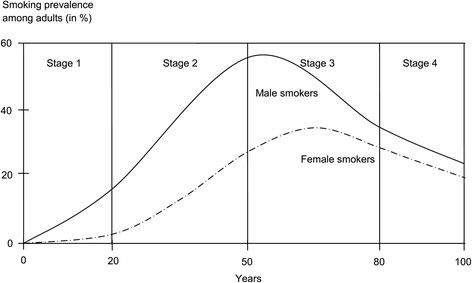
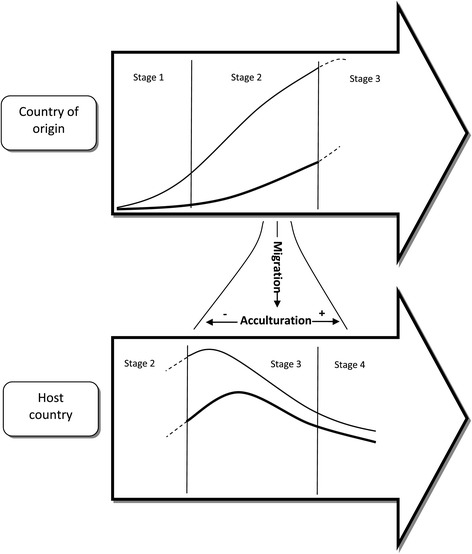
Immigrants' countries of origin and host countries have reached different stages of the 'smoking epidemic' where, in addition, smoking among women lags behind that in men. Immigrants might 'move' between the stages as (I) the (non-western) countries of origin tend to be in the early phase, (II) the (western) host countries more in the advanced phase of the epidemic and (III) the arrival in the host countries initiates the acculturation process. This could explain the 'imported' high (men)/low (women) prevalence among less acculturated immigrants. The low (men)/high (women) prevalence among more acculturated immigrants indicates an adaptation towards the social norms of the host countries with ongoing acculturation.
我们旨在确定与移民吸烟相关的因素。特别是,我们研究了文化适应与吸烟之间的关系,同时考虑了移民来源国和东道国的“吸烟流行”阶段。
我们在PubMed上搜索了同行评审的定量研究。纳入的研究需聚焦于现居住在美国、加拿大、爱尔兰、德国、荷兰、挪威、英国和澳大利亚的非西方国家成年移民(外国出生)的吸烟情况。若研究未区分移民与其(本土出生)后代等情况,则予以排除。
我们检索到1998年至2013年间发表的27项研究。其中27项研究中有21项聚焦于文化适应(使用专门为所研究的移民群体设计的二维多项目量表和/或代理指标,如语言能力或在东道国的停留时间),其中16项发现了男女之间的明显差异:文化适应程度较高的女性比文化适应程度较低的女性更有可能吸烟,而男性则相反。
移民的来源国和东道国处于“吸烟流行”的不同阶段,此外,女性吸烟率滞后于男性。随着(I)(非西方)来源国往往处于早期阶段,(II)(西方)东道国更多处于流行的后期阶段,以及(III)抵达东道国引发文化适应过程,移民可能在这些阶段之间“移动”。这可以解释文化适应程度较低的移民中(男性)吸烟率高/(女性)吸烟率低的“输入性”情况。文化适应程度较高的移民中(男性)吸烟率低/(女性)吸烟率高,表明随着文化适应的进行,他们正在适应东道国的社会规范。