Dodd Antony N, Belbin Fiona E, Frank Alexander, Webb Alex A R
School of Biological Sciences, University of Bristol , Bristol, UK ; Cabot Institute, University of Bristol , Bristol, UK.
Department of Plant Sciences, University of Cambridge , Cambridge, UK.
Front Plant Sci. 2015 Apr 9;6:245. doi: 10.3389/fpls.2015.00245. eCollection 2015.
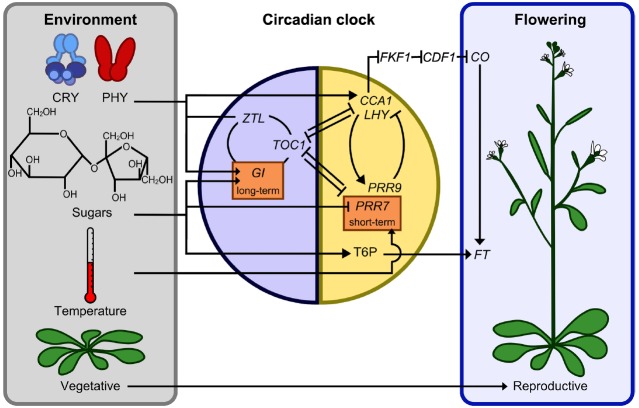
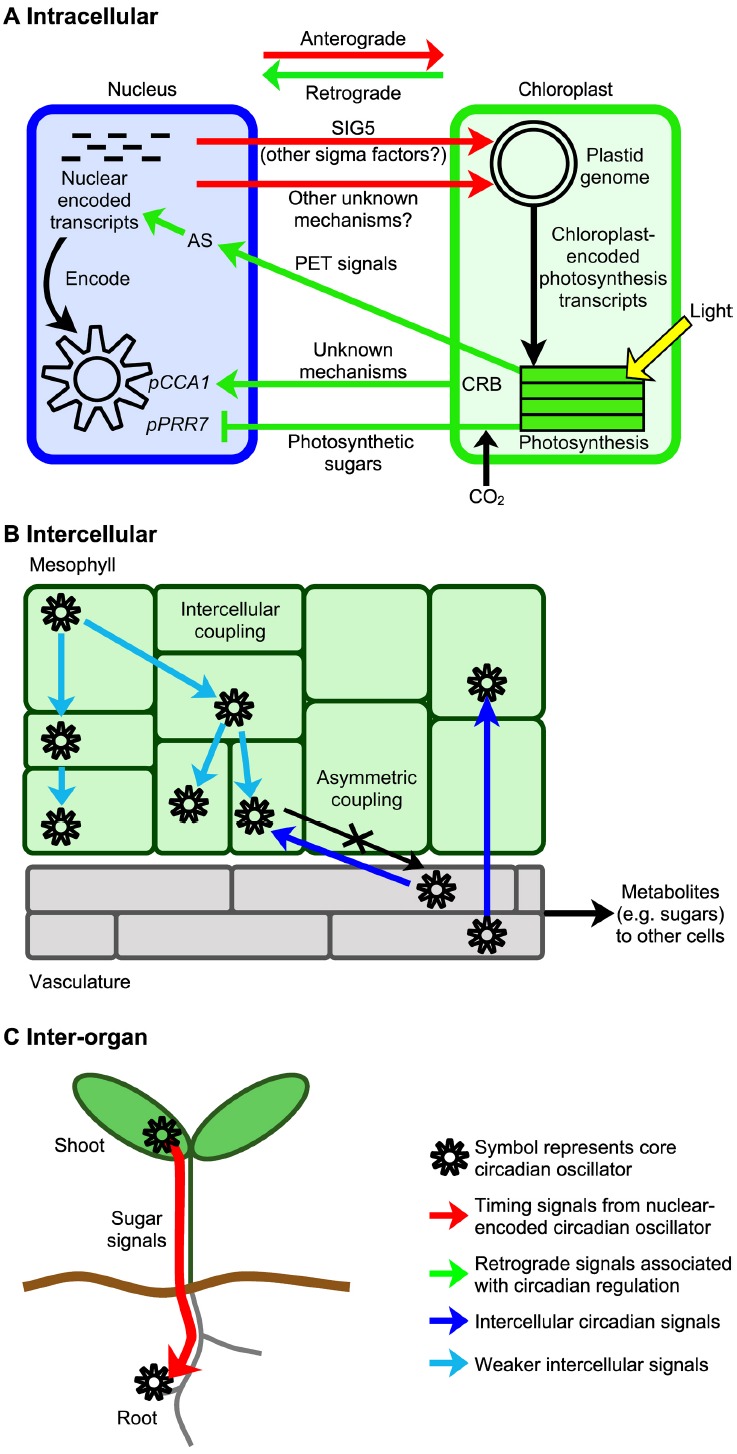
All plant productivity, including the food that we eat, arises from the capture of solar energy by plants. At most latitudes sunlight is available for only part of the 24 h day due to the rotation of the planet. This rhythmic and predictable alteration in the environment has driven the evolution of the circadian clock, which has an extremely pervasive influence upon plant molecular biology, physiology and phenology. A number of recent studies have demonstrated that the circadian clock is integrated very closely with photosynthesis and its metabolic products. We consider the coupling of the circadian oscillator with carbohydrate biochemistry and the connections between the nuclear-encoded circadian clock and processes within chloroplasts. We describe how this might provide adaptations to optimize plant performance in an environment that varies both predictably upon a daily and seasonal basis, and unpredictably due to the weather.
所有植物的生产力,包括我们食用的食物,都源于植物对太阳能的捕获。由于地球的自转,在大多数纬度地区,一天24小时中只有部分时间有阳光。这种环境中节律性且可预测的变化推动了生物钟的进化,生物钟对植物分子生物学、生理学和物候学有着极其广泛的影响。最近的一些研究表明,生物钟与光合作用及其代谢产物紧密结合。我们探讨了生物钟振荡器与碳水化合物生物化学的耦合,以及核编码生物钟与叶绿体内部过程之间的联系。我们描述了这如何为植物在每日和季节性可预测变化以及因天气导致的不可预测变化的环境中优化性能提供适应性。