Mojica Maria F, Mahler S Graciela, Bethel Christopher R, Taracila Magdalena A, Kosmopoulou Magda, Papp-Wallace Krisztina M, Llarrull Leticia I, Wilson Brigid M, Marshall Steven H, Wallace Christopher J, Villegas Maria V, Harris Michael E, Vila Alejandro J, Spencer James, Bonomo Robert A
∥Research Service, Louis Stokes Cleveland Veterans Affairs Medical Center, Cleveland, Ohio 44106, United States.
⊥Laboratorio de Química Farmacéutica, Universidad de la República, Montevideo, Uruguay.
Biochemistry. 2015 May 26;54(20):3183-96. doi: 10.1021/acs.biochem.5b00106. Epub 2015 May 12.
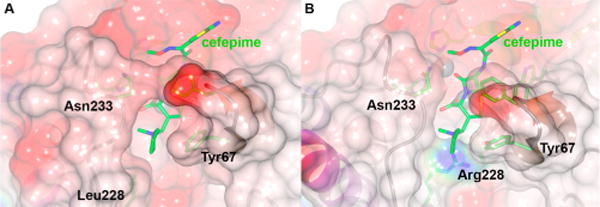
β-Lactamase inhibitors (BLIs) restore the efficacy of otherwise obsolete β-lactams. However, commercially available BLIs are not effective against metallo-β-lactamases (MBLs), which continue to be disseminated globally. One group of the most clinically important MBLs is the VIM family. The discovery of VIM-24, a natural variant of VIM-2, possessing an R228L substitution and a novel phenotype, compelled us to explore the role of this position and its effects on substrate specificity. We employed mutagenesis, biochemical and biophysical assays, and crystallography. VIM-24 (R228L) confers enhanced resistance to cephems and increases the rate of turnover compared to that of VIM-2 (kcat/KM increased by 6- and 10-fold for ceftazidime and cefepime, respectively). Likely the R → L substitution relieves steric clashes and accommodates the C3N-methyl pyrrolidine group of cephems. Four novel bisthiazolidine (BTZ) inhibitors were next synthesized and tested against these MBLs. These inhibitors inactivated VIM-2 and VIM-24 equally well (Ki* values of 40-640 nM) through a two-step process in which an initial enzyme (E)-inhibitor (I) complex (EI) undergoes a conformational transition to a more stable species, E*I. As both VIM-2 and VIM-24 were inhibited in a similar manner, the crystal structure of a VIM-2-BTZ complex was determined at 1.25 Å and revealed interactions of the inhibitor thiol with the VIM Zn center. Most importantly, BTZs also restored the activity of imipenem against Klebsiella pneumoniae and Pseudomonas aeruginosa in whole cell assays producing VIM-24 and VIM-2, respectively. Our results suggest a role for position 228 in defining the substrate specificity of VIM MBLs and show that BTZ inhibitors are not affected by the R228L substitution.
β-内酰胺酶抑制剂(BLIs)可恢复原本已过时的β-内酰胺类药物的疗效。然而,市售的BLIs对金属β-内酰胺酶(MBLs)无效,而MBLs仍在全球范围内传播。临床上最重要的一类MBLs是VIM家族。VIM-2的天然变体VIM-24的发现,其具有R228L取代和新的表型,促使我们探索该位置的作用及其对底物特异性的影响。我们采用了诱变、生化和生物物理分析以及晶体学方法。与VIM-2相比,VIM-24(R228L)对头孢菌素的耐药性增强,周转速率增加(头孢他啶和头孢吡肟的kcat/KM分别增加了6倍和10倍)。可能是R→L取代缓解了空间冲突,并容纳了头孢菌素的C3N-甲基吡咯烷基团。接下来合成了四种新型双噻唑烷(BTZ)抑制剂,并针对这些MBLs进行了测试。这些抑制剂通过两步过程同等程度地灭活VIM-2和VIM-24(Ki值为40 - 640 nM),其中初始的酶(E)-抑制剂(I)复合物(EI)经历构象转变为更稳定的物种EI。由于VIM-2和VIM-24以相似的方式被抑制,VIM-2 - BTZ复合物的晶体结构在1.25 Å分辨率下得以确定,并揭示了抑制剂硫醇与VIM锌中心的相互作用。最重要的是,在全细胞试验中,BTZs分别恢复了亚胺培南对产生VIM-24和VIM-2的肺炎克雷伯菌和铜绿假单胞菌的活性。我们的结果表明228位在定义VIM MBLs的底物特异性中起作用,并表明BTZ抑制剂不受R228L取代的影响。