Osorio Alfonso, Lopez-del Burgo Cristina, Ruiz-Canela Miguel, Carlos Silvia, de Irala Jokin
Institute for Culture and Society (ICS), University of Navarra, Pamplona, Spain School of Education and Psychology, University of Navarra, Pamplona, Spain IdiSNA, Navarra Institute for Health Research, Pamplona, Spain.
Institute for Culture and Society (ICS), University of Navarra, Pamplona, Spain IdiSNA, Navarra Institute for Health Research, Pamplona, Spain Department of Preventive Medicine and Public Health, University of Navarra, Pamplona, Spain.
BMJ Open. 2015 Apr 27;5(4):e007826. doi: 10.1136/bmjopen-2015-007826.
This study intends to evaluate whether the belief that condoms are 100% effective in protecting against HIV infection is associated with sexual risk behaviours among youth.
A cross-sectional study was performed in representative samples of high-school students in the Philippines, El Salvador and Peru. Participants completed a self-administered questionnaire. Students were asked about the risk of HIV transmission if one has sex using condoms. They were also asked to indicate whether they had ever had sexual relations and whether they used a condom in their first sexual relation. The sample was composed of 8994 students, aged 13-18.
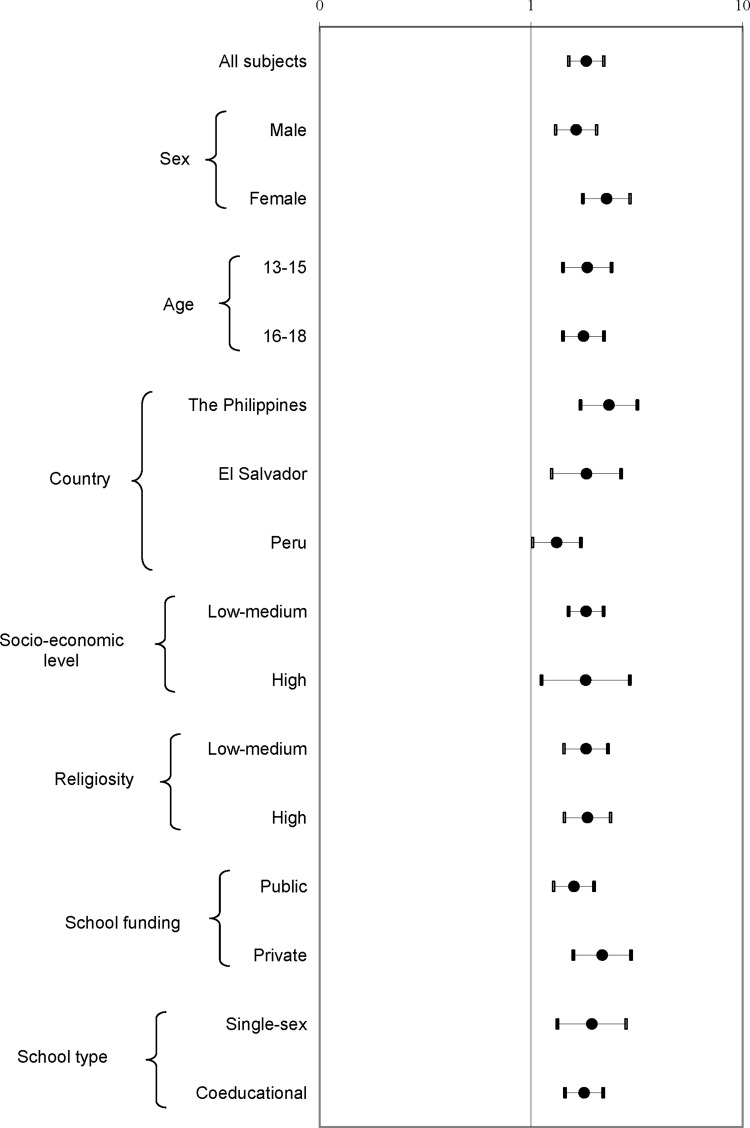
One out of seven adolescents believed condoms are 100% effective (safe-sex believers). Those adolescents were 82% more likely to have had sex than those without such belief, after adjusting for confounders (OR=1.82; 95% CI 1.51 to 2.21). On the contrary, no association was found between risk perception and condom use. Subgroup and sensitivity analyses produced similar results.
This is, to the best of our knowledge, the first study conducted specifically to evaluate this phenomenon and that has used the same questionnaire and the same data collection protocol in three different developing countries from Asia, Central and South America. These results reasonably suggest that there could be an association between safe sex beliefs and sexual initiation. Longitudinal studies are needed to better understand this possible association as it could influence how to better promote sexual health.
本研究旨在评估认为避孕套能100%有效预防艾滋病毒感染的观念是否与青少年的性风险行为相关。
在菲律宾、萨尔瓦多和秘鲁的高中生代表性样本中开展了一项横断面研究。参与者完成了一份自填式问卷。学生们被问及如果使用避孕套进行性行为,感染艾滋病毒的风险。他们还被要求表明自己是否有过性行为,以及在首次性行为中是否使用了避孕套。样本由8994名年龄在13至18岁的学生组成。
七分之一的青少年认为避孕套是100%有效的(安全性行为信奉者)。在对混杂因素进行调整后,与没有这种观念的青少年相比,这些青少年发生性行为的可能性高出82%(比值比=1.82;95%置信区间为1.51至2.21)。相反,未发现风险认知与避孕套使用之间存在关联。亚组分析和敏感性分析得出了相似的结果。
据我们所知,这是第一项专门评估这一现象的研究,并且在亚洲、中美洲和南美洲的三个不同发展中国家使用了相同的问卷和相同的数据收集方案。这些结果合理地表明,安全性行为观念与开始性行为之间可能存在关联。需要开展纵向研究以更好地理解这种可能的关联,因为它可能会影响如何更好地促进性健康。