• 文献检索
  • 文档翻译
  • 深度研究
  • 学术资讯
  • Suppr Zotero 插件Zotero 插件
  • 邀请有礼
  • 套餐&价格
  • 历史记录
应用&插件
Suppr Zotero 插件Zotero 插件浏览器插件Mac 客户端Windows 客户端微信小程序
定价
高级版会员购买积分包购买API积分包
服务
文献检索文档翻译深度研究API 文档MCP 服务
关于我们
关于 Suppr公司介绍联系我们用户协议隐私条款
关注我们

Suppr 超能文献

核心技术专利:CN118964589B侵权必究
粤ICP备2023148730 号-1Suppr @ 2026

文献检索

告别复杂PubMed语法,用中文像聊天一样搜索,搜遍4000万医学文献。AI智能推荐,让科研检索更轻松。

立即免费搜索

文件翻译

保留排版,准确专业,支持PDF/Word/PPT等文件格式,支持 12+语言互译。

免费翻译文档

深度研究

AI帮你快速写综述,25分钟生成高质量综述,智能提取关键信息,辅助科研写作。

立即免费体验

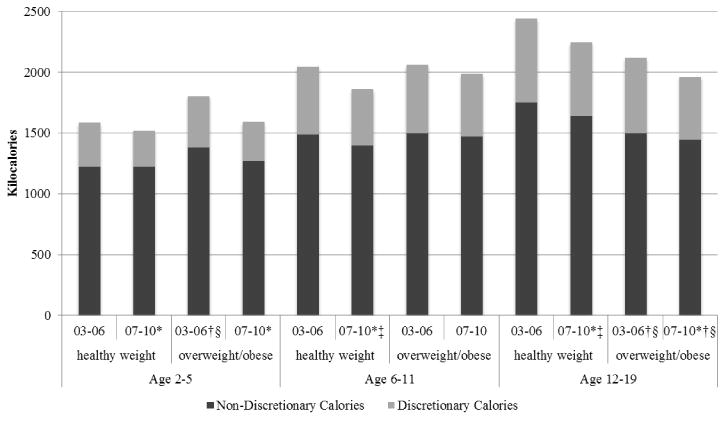
按年龄、体重和种族/族裔划分的儿童含糖饮料和零食消费趋势。

Trends in SSBs and snack consumption among children by age, body weight, and race/ethnicity.

作者信息

Bleich Sara N, Wolfson Julia A

机构信息

Department of Health Policy and Management, Johns Hopkins Bloomberg School of Public Health, Baltimore, Maryland, USA.

出版信息

Obesity (Silver Spring). 2015 May;23(5):1039-46. doi: 10.1002/oby.21050.

DOI:10.1002/oby.21050
PMID:25919923
原文链接:https://pmc.ncbi.nlm.nih.gov/articles/PMC4414044/
Abstract

OBJECTIVE

To describe national trends in discretionary calories from sugar sweetened beverage (SSB) and snacks by age-specific body weight categories and by age- and weight-specific race/ethnicity groups. Examining these subpopulations is important as population averages may mask important differences.

DESIGN AND METHODS

24-hour dietary recall data obtained from the National Health and Nutrition Examination Survey 2003-2010 among children aged 2 to 19 (N = 14,092) were used. Logistic and linear regression methods were used to adjust for multiple covariates and survey design.

RESULTS

The number of calories from SSBs declined significantly for nearly all age-specific body weight groups. Among overweight or obese children, significant declines in the number of calories from SSBs were observed among Hispanic children aged 2 to 5 (117 vs. 174 kcal) and white adolescents aged 12 to 19 (299 vs. 365 kcal). Significant declines in the number of calories from salty snacks were observed among white children aged 2 to 5 (192 to 134 kcal) and 6 to 11 (273 vs. 200 kcal).

CONCLUSIONS

The decrease in SSB consumption and increase in snack consumption observed in prior research are not uniform when children are examined within subgroups accounting for age, weight, and race/ethnicity.

摘要

目的

按特定年龄体重类别以及按年龄和体重特定的种族/族裔群体描述来自含糖饮料(SSB)和零食的 discretionary 卡路里的全国趋势。由于总体平均值可能掩盖重要差异,因此对这些亚人群进行研究很重要。

设计与方法

使用了2003 - 2010年全国健康与营养检查调查中2至19岁儿童(N = 14,092)的24小时饮食回忆数据。使用逻辑回归和线性回归方法对多个协变量和调查设计进行调整。

结果

几乎所有特定年龄体重组来自含糖饮料的卡路里数量均显著下降。在超重或肥胖儿童中,2至5岁的西班牙裔儿童(117千卡对174千卡)和12至19岁的白人青少年(299千卡对365千卡)中观察到来自含糖饮料的卡路里数量显著下降。2至5岁(192千卡至134千卡)和6至11岁(273千卡对200千卡)的白人儿童中观察到来自咸味零食的卡路里数量显著下降。

结论

在按年龄、体重和种族/族裔划分的亚组中对儿童进行检查时,先前研究中观察到的含糖饮料消费减少和零食消费增加并非一致。
https://cdn.ncbi.nlm.nih.gov/pmc/blobs/4adb/4414044/ee8e7cf8b156/nihms658374f1.jpg

相似文献

1
Trends in SSBs and snack consumption among children by age, body weight, and race/ethnicity.按年龄、体重和种族/族裔划分的儿童含糖饮料和零食消费趋势。
Obesity (Silver Spring). 2015 May;23(5):1039-46. doi: 10.1002/oby.21050.
2
Dietary sodium intake is associated with total fluid and sugar-sweetened beverage consumption in US children and adolescents aged 2-18 y: NHANES 2005-2008.美国 2-18 岁儿童和青少年的膳食钠摄入量与总液体和含糖饮料的摄入量有关:NHANES 2005-2008。
Am J Clin Nutr. 2013 Jul;98(1):189-96. doi: 10.3945/ajcn.112.051508. Epub 2013 May 15.
3
U.S. adults and child snacking patterns among sugar-sweetened beverage drinkers and non-drinkers.美国成年人和儿童在含糖饮料饮用者和非饮用者中的零食消费模式。
Prev Med. 2015 Mar;72:8-14. doi: 10.1016/j.ypmed.2015.01.003. Epub 2015 Jan 10.
4
Increasing consumption of sugar-sweetened beverages among US adults: 1988-1994 to 1999-2004.美国成年人中含糖饮料消费量的增加:1988 - 1994年至1999 - 2004年。
Am J Clin Nutr. 2009 Jan;89(1):372-81. doi: 10.3945/ajcn.2008.26883. Epub 2008 Dec 3.
5
Weight loss strategies: association with consumption of sugary beverages, snacks and values about food purchases.减肥策略:与含糖饮料、零食的消费以及食品购买观念的关联
Patient Educ Couns. 2014 Jul;96(1):128-34. doi: 10.1016/j.pec.2014.04.008. Epub 2014 Apr 26.
6
Trends in sugar-sweetened beverage consumption among youth and adults in the United States: 1999-2010.美国青少年和成年人含糖饮料消费趋势:1999-2010 年。
Am J Clin Nutr. 2013 Jul;98(1):180-8. doi: 10.3945/ajcn.112.057943. Epub 2013 May 15.
7
Determinants of Sugar-Sweetened Beverage Consumption among Low-Income Children: Are There Differences by Race/Ethnicity, Age, and Sex?低收入儿童含糖饮料消费的决定因素:按种族/民族、年龄和性别划分是否存在差异?
J Acad Nutr Diet. 2017 Dec;117(12):1900-1920. doi: 10.1016/j.jand.2017.03.013. Epub 2017 May 8.
8
Foods and beverages associated with higher intake of sugar-sweetened beverages.与高糖饮料摄入相关的食物和饮料。
Am J Prev Med. 2013 Apr;44(4):351-357. doi: 10.1016/j.amepre.2012.11.036.
9
Prevalence of Sugar-Sweetened Beverage Intake Among Adults--23 States and the District of Columbia, 2013.成年人含糖饮料摄入量的流行情况——2013 年 23 个州和哥伦比亚特区。
MMWR Morb Mortal Wkly Rep. 2016 Feb 26;65(7):169-74. doi: 10.15585/mmwr.mm6507a1.
10
Sugar-sweetened beverage intake and serum testosterone levels in adult males 20-39 years old in the United States.美国 20-39 岁成年男性的含糖饮料摄入与血清睾丸酮水平。
Reprod Biol Endocrinol. 2018 Jun 23;16(1):61. doi: 10.1186/s12958-018-0378-2.

引用本文的文献

1
Beverage Consumption Patterns Among Navajo Children Aged 2-5 Years.2至5岁纳瓦霍儿童的饮料消费模式
Curr Dev Nutr. 2024 Oct 26;9(3):104493. doi: 10.1016/j.cdnut.2024.104493. eCollection 2025 Mar.
2
U-shaped nonlinear relationship between dietary copper intake and peripheral neuropathy.膳食铜摄入与周围神经病之间呈 U 型非线性关系。
Sci Rep. 2024 Oct 25;14(1):25263. doi: 10.1038/s41598-024-76159-6.
3
Interpersonal Discrimination, Neighborhood Inequities, and Children's Body Mass Index: A Descriptive, Cross-Sectional Analysis.

本文引用的文献

1
Prevalence of childhood and adult obesity in the United States, 2011-2012.美国儿童和成人肥胖率,2011-2012 年。
JAMA. 2014 Feb 26;311(8):806-14. doi: 10.1001/jama.2014.732.
2
Declines in sugar-sweetened beverage consumption among children in Los Angeles County, 2007 and 2011.洛杉矶县儿童含糖饮料消费下降,2007 年和 2011 年。
Prev Chronic Dis. 2013 Aug 8;10:E131. doi: 10.5888/pcd10.130049.
3
Resolved: there is sufficient scientific evidence that decreasing sugar-sweetened beverage consumption will reduce the prevalence of obesity and obesity-related diseases.
人际歧视、邻里不平等与儿童身体质量指数:描述性、横断面分析。
Fam Community Health. 2023;46(Suppl 1):S30-S40. doi: 10.1097/FCH.0000000000000372.
4
Is the transition from primary to secondary school a risk factor for energy balance-related behaviours? A systematic review.从小学升入中学是否是与能量平衡相关行为的一个风险因素?系统评价。
Public Health Nutr. 2023 Sep;26(9):1754-1774. doi: 10.1017/S1368980023000812. Epub 2023 May 4.
5
Sugar-Sweetened Beverages and Metabolic Risk in Children and Adolescents with Obesity: A Narrative Review.含糖饮料与肥胖儿童和青少年的代谢风险:一项叙述性综述。
Nutrients. 2023 Jan 30;15(3):702. doi: 10.3390/nu15030702.
6
Effect of Front-of-Package Information, Fruit Imagery, and High-Added Sugar Warning Labels on Parent Beverage Choices for Children: A Randomized Clinical Trial.包装正面信息、水果图像和高添加糖警示标签对儿童饮料选择的影响:一项随机临床试验。
JAMA Netw Open. 2022 Oct 3;5(10):e2236384. doi: 10.1001/jamanetworkopen.2022.36384.
7
Do types of snacks, sleep hours, and eating places affect nutritional intakes and its adequacy in adolescents?零食种类、睡眠时间和就餐地点会影响青少年的营养摄入及其充足性吗?
Nutr Res Pract. 2021 Jun;15(3):396-410. doi: 10.4162/nrp.2021.15.3.396. Epub 2021 Feb 9.
8
SODA MAPS: A Framework for Understanding Caffeinated Sugary Drink Consumption Among Children.苏打水地图:一个理解儿童含咖啡因含糖饮料消费情况的框架。
Front Nutr. 2021 Mar 10;8:640531. doi: 10.3389/fnut.2021.640531. eCollection 2021.
9
Nutrition Claims on Fruit Drinks Are Inconsistent Indicators of Nutritional Profile: A Content Analysis of Fruit Drinks Purchased by Households With Young Children.果汁饮料上的营养声称并不能一致地反映其营养状况:一项针对有幼儿家庭购买的果汁饮料的内容分析。
J Acad Nutr Diet. 2021 Jan;121(1):36-46.e4. doi: 10.1016/j.jand.2020.08.009. Epub 2020 Sep 22.
10
The Special Supplemental Nutrition Program for Women, Infants, and Children Spillover Effect: Do Siblings Reap the Benefits?妇女、婴儿和儿童特别补充营养计划溢出效应:兄弟姐妹受益吗?
J Acad Nutr Diet. 2020 Aug;120(8):1288-1294. doi: 10.1016/j.jand.2020.02.013. Epub 2020 May 10.
结论:有足够的科学证据表明,减少含糖饮料的消费将降低肥胖症和肥胖相关疾病的发病率。
Obes Rev. 2013 Aug;14(8):606-19. doi: 10.1111/obr.12040. Epub 2013 Jun 13.
4
Trends in sugar-sweetened beverage consumption among youth and adults in the United States: 1999-2010.美国青少年和成年人含糖饮料消费趋势:1999-2010 年。
Am J Clin Nutr. 2013 Jul;98(1):180-8. doi: 10.3945/ajcn.112.057943. Epub 2013 May 15.
5
Consumption patterns of sugar-sweetened beverages in the United States.美国含糖饮料的消费模式。
J Acad Nutr Diet. 2013 Jan;113(1):43-53. doi: 10.1016/j.jand.2012.09.016.
6
Factors affecting sugar-sweetened beverage availability in competitive venues of US secondary schools.影响美国中学竞争性场馆含糖饮料供应的因素。
J Sch Health. 2012 Jan;82(1):44-55. doi: 10.1111/j.1746-1561.2011.00666.x.
7
Expert panel on integrated guidelines for cardiovascular health and risk reduction in children and adolescents: summary report.儿童和青少年心血管健康与风险降低综合指南专家小组:总结报告
Pediatrics. 2011 Dec;128 Suppl 5(Suppl 5):S213-56. doi: 10.1542/peds.2009-2107C. Epub 2011 Nov 14.
8
Trends in the nutritional content of television food advertisements seen by children in the United States: analyses by age, food categories, and companies.美国儿童观看的电视食品广告中的营养成分趋势:按年龄、食品类别和公司进行的分析。
Arch Pediatr Adolesc Med. 2011 Dec;165(12):1078-86. doi: 10.1001/archpediatrics.2011.131. Epub 2011 Aug 1.
9
Consumption of added sugars is decreasing in the United States.美国人摄入的添加糖正在减少。
Am J Clin Nutr. 2011 Sep;94(3):726-34. doi: 10.3945/ajcn.111.018366. Epub 2011 Jul 13.
10
Substantial decline in sugar-sweetened beverage consumption among California's children and adolescents.加州儿童和青少年含糖饮料摄入量大幅下降。
Int J Gen Med. 2010 Aug 30;3:221-4. doi: 10.2147/ijgm.s12464.