Hong Liya, Guo Zhiyong, Huang Kunhui, Wei Shanjun, Liu Bo, Meng Shaowu, Long Chunlin
College of Life and Environmental Sciences, Minzu University of China, Beijing, 100081, People's Republic of China.
Lineberger Comprehensive Cancer Center, University of North Carolina at Chapel Hill, Chapel Hill, NC, 27599, USA.
J Ethnobiol Ethnomed. 2015 Apr 30;11:32. doi: 10.1186/s13002-015-0019-1.
This paper is based on an ethnobotanical investigation that focused on the traditional medicinal plants used by local Maonan people to treat human diseases in Maonan concentration regions. The Maonan people have relied on traditional medicine since ancient times, especially medicinal plants. The aim of this study is to document medicinal plants used by the Maonans and to report the status of medicinal plants and associated traditional knowledge.
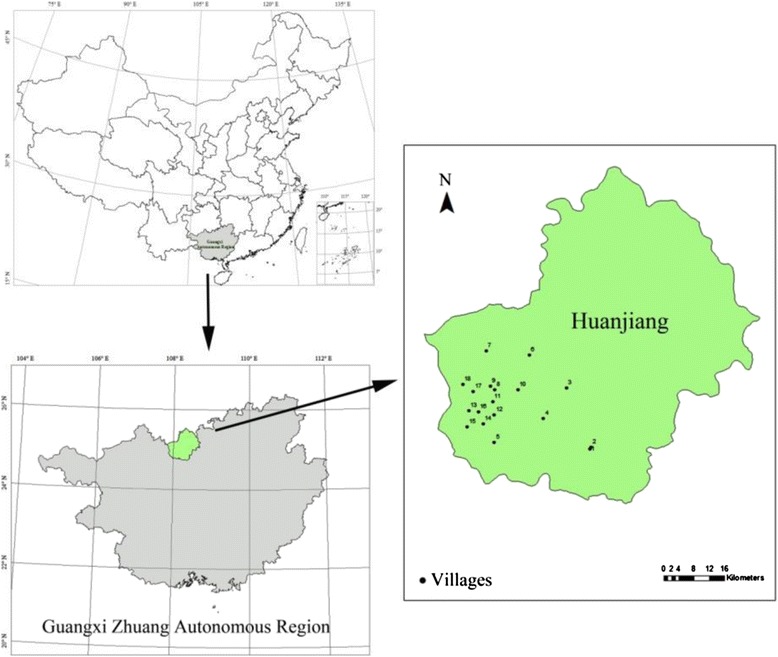
Ethnobotanical data were collected from June 2012 to September 2014 in Huanjiang Maonan Autonomous County, northern Guangxi, southwest China. In total, 118 knowledgeable informants were interviewed. Following statistically sampling method, eighteen villages from 5 townships were selected to conduct field investigations. Information was collected through the approache of participatory observation, semi-structured interviews, ranking exercises, key informant interviews, focus group discussions, and participatory rural appraisals.
A total of 368 medicinal plant species were investigated and documented together with their medicinal uses by the Maonans, most of which were obtained from the wild ecosystems. The plants were used to treat 95 human diseases. Grinding was a widely used method to prepare traditional herbal medicines. There were significant relationships between gender and age, and between gender and informants' knowledge of medicinal plant use. Deforestation for agricultural purposes was identified as the most destructive factor of medicinal plants, followed by drought and over-harvest.
The species diversity of medicinal plants used by the Maonans in the study area was very rich. Medicinal plants played a significant role in healing various human disorders in the Maonan communities. However, the conflicts between traditional inheriting system and recent socio-economic changes (and other factors) resulted in the reduction or loss of both medicinal plants and associated indigenous knowledge. Thus, conservation efforts and policies, and innovation of inheriting system are necessary for protecting the medicinal plants and associated indigenous knowledge. Awareness is also needed to be raised among local Maonans focusing on sustainable utilization and management of both medicinal plants and traditional knowledge.
本文基于一项民族植物学调查,该调查聚焦于毛南族聚居地区当地毛南人用于治疗人类疾病的传统药用植物。毛南族自古以来就依赖传统医学,尤其是药用植物。本研究的目的是记录毛南族使用的药用植物,并报告药用植物及其相关传统知识的现状。
2012年6月至2014年9月在中国西南部广西北部的环江毛南族自治县收集民族植物学数据。总共采访了118位有见识的信息提供者。按照统计抽样方法,从5个乡镇中选取18个村庄进行实地调查。通过参与观察、半结构化访谈、排序活动、关键信息提供者访谈、焦点小组讨论和参与式农村评估等方法收集信息。
共调查并记录了368种药用植物及其毛南族的药用用途,其中大部分取自野生生态系统。这些植物用于治疗95种人类疾病。研磨是制备传统草药的一种广泛使用的方法。性别与年龄之间、性别与信息提供者对药用植物使用的知识之间存在显著关系。农业用途的森林砍伐被认为是药用植物最具破坏性的因素,其次是干旱和过度采摘。
研究区域内毛南族使用的药用植物物种多样性非常丰富。药用植物在毛南族社区治疗各种人类疾病方面发挥了重要作用。然而,传统传承体系与近期社会经济变化(以及其他因素)之间的冲突导致了药用植物和相关本土知识的减少或丧失。因此,需要采取保护措施和政策,并创新传承体系,以保护药用植物和相关本土知识。还需要提高当地毛南族对药用植物和传统知识可持续利用和管理的认识。