Rapp Brenda, Fischer-Baum Simon, Miozzo Michele
Department of Cognitive Science, Johns Hopkins University
Department of Psychology, Rice University.
Psychol Sci. 2015 Jun;26(6):892-902. doi: 10.1177/0956797615573520. Epub 2015 Apr 29.
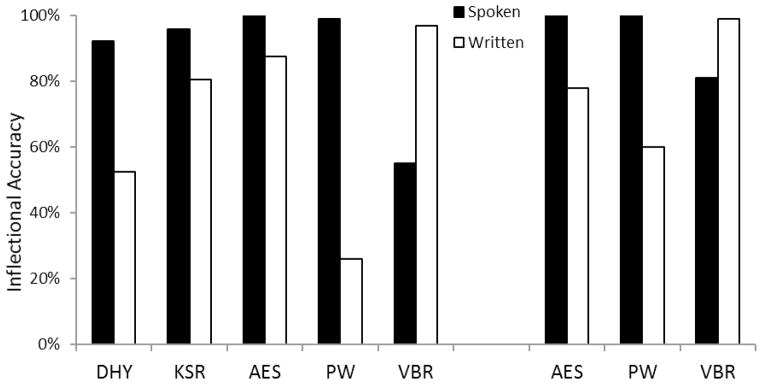
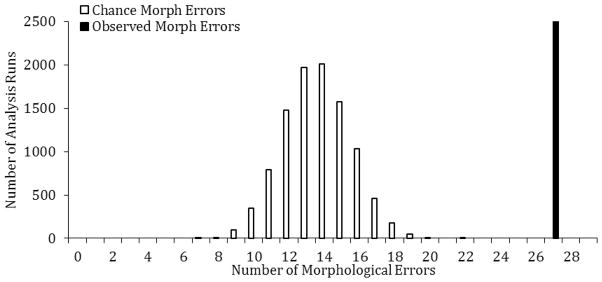
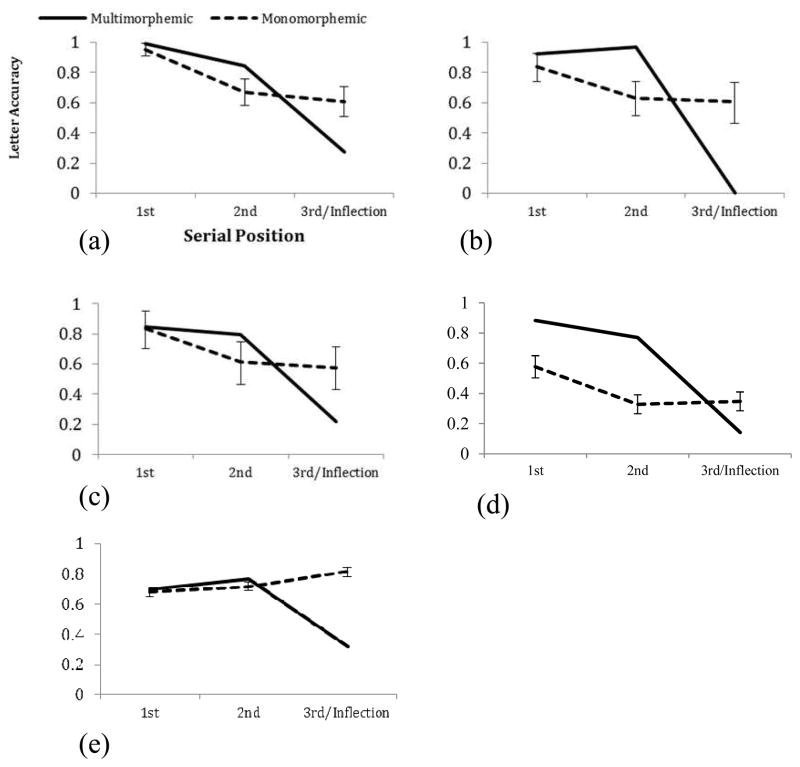
Written language is an evolutionarily recent human invention; consequently, its neural substrates cannot be determined by the genetic code. How, then, does the brain incorporate skills of this type? One possibility is that written language is dependent on evolutionarily older skills, such as spoken language; another is that dedicated substrates develop with expertise. If written language does depend on spoken language, then acquired deficits of spoken and written language should necessarily co-occur. Alternatively, if at least some substrates are dedicated to written language, such deficits may doubly dissociate. We report on 5 individuals with aphasia, documenting a double dissociation in which the production of affixes (e.g., the -ing in jumping) is disrupted in writing but not speaking or vice versa. The findings reveal that written- and spoken-language systems are considerably independent from the standpoint of morpho-orthographic operations. Understanding this independence of the orthographic system in adults has implications for the education and rehabilitation of people with written-language deficits.
书面语言是人类在进化过程中较晚才发明的;因此,其神经基础无法由遗传密码决定。那么,大脑是如何掌握这类技能的呢?一种可能性是书面语言依赖于进化上更古老的技能,比如口语;另一种可能性是专门的神经基础随着专业技能的发展而形成。如果书面语言确实依赖于口语,那么后天获得的口语和书面语言缺陷必然会同时出现。或者,如果至少有一些神经基础专门用于书面语言,那么这些缺陷可能会出现双重分离。我们报告了5例失语症患者的情况,记录了一种双重分离现象,即词缀的生成(例如jumping中的-ing)在书写时受到干扰,但在口语中不受影响,反之亦然。研究结果表明,从形态正字法操作的角度来看,书面语言和口语系统相当独立。了解成年人正字法系统的这种独立性,对有书面语言缺陷的人的教育和康复具有启示意义。