Lv Jing, Wei Liangmeng, Yang Yan, Wang Bingxiao, Liang Wei, Gao Yuwei, Xia Xianzhu, Gao Lili, Cai Yumei, Hou Peiqiang, Yang Huili, Wang Airong, Huang Rong, Gao Jing, Chai Tongjie
College of Animal Science and Veterinary Medicine, Shandong Agricultural University; Sino-German Cooperative Research Centre for Zoonosis of Animal Origin Shandong Province; Key Laboratory of Animal Biotechnology and Disease Control and Prevention of Shandong Province, Shandong Agricultural University, Daizong Street 61, Taian, 271018, China.
Taian Municipal Center for Disease Control and Prevention, Changcheng Street, Taian, 271000, China.
Vet Res. 2015 Apr 18;46(1):44. doi: 10.1186/s13567-014-0142-3.
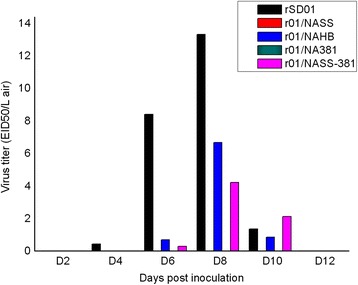
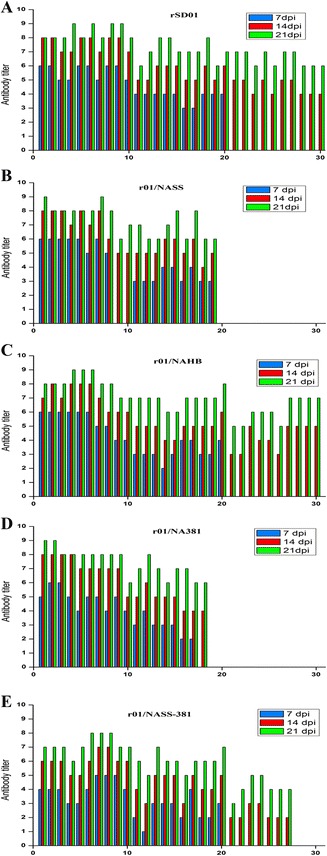
Cases of H9N2 avian influenza virus (AIV) in poultry are increasing throughout many Eurasian countries, and co-infections with other pathogens have resulted in high morbidity and mortality in poultry. Few studies have investigated the genetic factors of virus airborne transmission which determine the scope of this epidemic. In this study, we used specific-pathogen-free chickens housed in isolators to investigate the airborne transmissibility of five recombinant H9N2 AIV rescued by reverse genetic technology. The results show that airborne transmission of A/Chicken/Shandong/01/2008 (SD01) virus was related to the neuraminidase (NA) gene, and four amino acid mutations (D368E, S370L, E313K and G381D) within the head region of the SD01 NA, reduced virus replication in the respiratory tract of chickens, reduced virus NA activity, and resulted in a loss of airborne transmission ability in chickens. Similarly, reverse mutations of these four amino acids in the NA protein of r01/NASS virus, conferred an airborne transmission ability to the recombinant virus. We conclude that these four NA residues may be significant genetic markers for evaluating potential disease outbreak of H9N2 AIV, and propose that immediate attention should be paid to the airborne transmission of this virus.
在许多欧亚国家,家禽感染H9N2禽流感病毒(AIV)的病例不断增加,且与其他病原体的共同感染已导致家禽的高发病率和死亡率。很少有研究调查决定这种流行病传播范围的病毒空气传播的遗传因素。在本研究中,我们使用饲养在隔离器中的无特定病原体鸡,来研究通过反向遗传学技术拯救的五种重组H9N2 AIV的空气传播能力。结果表明,A/鸡/山东/01/2008(SD01)病毒的空气传播与神经氨酸酶(NA)基因有关,SD01 NA头部区域内的四个氨基酸突变(D368E、S370L、E313K和G381D),降低了病毒在鸡呼吸道中的复制,降低了病毒NA活性,并导致鸡失去空气传播能力。同样,r01/NASS病毒NA蛋白中这四个氨基酸的反向突变,赋予了重组病毒空气传播能力。我们得出结论,这四个NA残基可能是评估H9N2 AIV潜在疾病爆发的重要遗传标记,并建议应立即关注该病毒的空气传播。