Taccone Fabio Silvio, Van den Abeele Anne-Marie, Bulpa Pierre, Misset Benoit, Meersseman Wouter, Cardoso Teresa, Paiva José-Artur, Blasco-Navalpotro Miguel, De Laere Emmanuel, Dimopoulos George, Rello Jordi, Vogelaers Dirk, Blot Stijn I
Department of Intensive Care Erasme Hospital, Free University of Brussels, Route de Lennik 808, 1070, Brussels, Belgium.
Department of Microbiology General Hospital St. Lucas, Groenebriel 1, 9000, Ghent, Belgium.
Crit Care. 2015 Jan 12;19(1):7. doi: 10.1186/s13054-014-0722-7.
Invasive aspergillosis (IA) is a fungal infection that particularly affects immunocompromised hosts. Recently, several studies have indicated a high incidence of IA in intensive care unit (ICU) patients. However, few data are available on the epidemiology and outcome of patients with IA in this setting.
An observational study including all patients with a positive Aspergillus culture during ICU stay was performed in 30 ICUs in 8 countries. Cases were classified as proven IA, putative IA or Aspergillus colonization according to recently validated criteria. Demographic, microbiologic and diagnostic data were collected. Outcome was recorded 12 weeks after Aspergillus isolation.
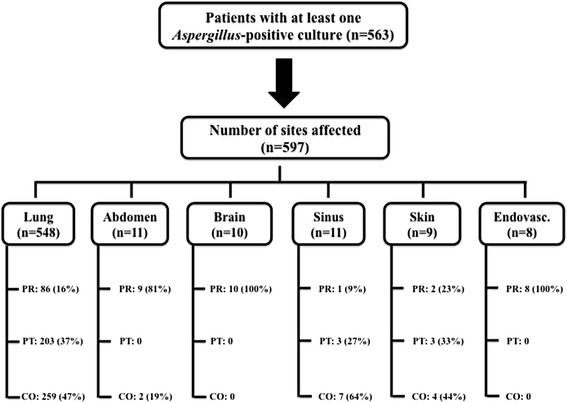
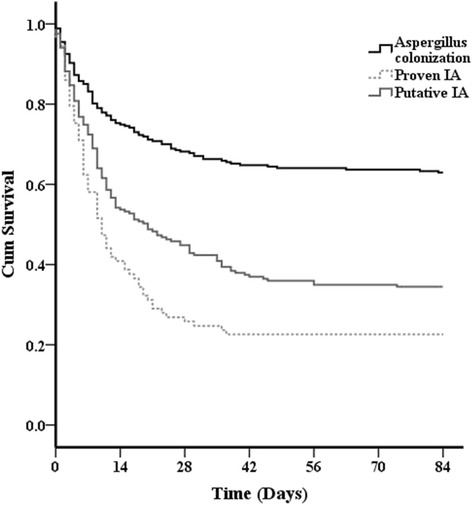
A total of 563 patients were included, of whom 266 were colonized (47%), 203 had putative IA (36%) and 94 had proven IA (17%). The lung was the most frequent site of infection (94%), and Aspergillus fumigatus the most commonly isolated species (92%). Patients with IA had higher incidences of cancer and organ transplantation than those with colonization. Compared with other patients, they were more frequently diagnosed with sepsis on ICU admission and more frequently received vasopressors and renal replacement therapy (RRT) during the ICU stay. Mortality was 38% among colonized patients, 67% in those with putative IA and 79% in those with proven IA (P < 0.001). Independent risk factors for death among patients with IA included older age, history of bone marrow transplantation, and mechanical ventilation, RRT and higher Sequential Organ Failure Assessment score at diagnosis.
IA among critically ill patients is associated with high mortality. Patients diagnosed with proven or putative IA had greater severity of illness and more frequently needed organ support than those with Aspergillus spp colonization.
侵袭性曲霉病(IA)是一种真菌感染,尤其影响免疫功能低下的宿主。最近,多项研究表明重症监护病房(ICU)患者中IA的发病率很高。然而,关于这种情况下IA患者的流行病学和转归的数据却很少。
在8个国家的30个ICU进行了一项观察性研究,纳入所有在ICU住院期间曲霉培养呈阳性的患者。根据最近验证的标准,将病例分为确诊IA、疑似IA或曲霉定植。收集人口统计学、微生物学和诊断数据。在分离出曲霉12周后记录转归。
共纳入563例患者,其中266例为定植(47%),203例为疑似IA(36%),94例为确诊IA(17%)。肺部是最常见的感染部位(94%),烟曲霉是最常分离出的菌种(92%)。IA患者的癌症和器官移植发生率高于定植患者。与其他患者相比,他们在ICU入院时更常被诊断为脓毒症,在ICU住院期间更常接受血管活性药物和肾脏替代治疗(RRT)。定植患者的死亡率为38%,疑似IA患者为67%,确诊IA患者为79%(P<0.001)。IA患者死亡的独立危险因素包括年龄较大、骨髓移植史、机械通气、RRT以及诊断时较高的序贯器官衰竭评估评分。
危重症患者中的IA与高死亡率相关。与曲霉属定植患者相比,确诊或疑似IA的患者病情更严重,更常需要器官支持。