Milner James, Green Rosemary, Dangour Alan D, Haines Andy, Chalabi Zaid, Spadaro Joseph, Markandya Anil, Wilkinson Paul
Department of Social and Environmental Health Research, London School of Hygiene and Tropical Medicine, London, UK.
Department of Population Health, London School of Hygiene and Tropical Medicine, London, UK Leverhulme Centre for Integrative Research on Agriculture and Health, London, UK.
BMJ Open. 2015 Apr 30;5(4):e007364. doi: 10.1136/bmjopen-2014-007364.
Dietary changes which improve health are also likely to be beneficial for the environment by reducing emissions of greenhouse gases (GHG). However, previous analyses have not accounted for the potential acceptability of low GHG diets to the general public. This study attempted to quantify the health effects associated with adopting low GHG emission diets in the UK.
Epidemiological modelling study.
UK.
UK population.
Adoption of diets optimised to achieve the WHO nutritional recommendations and reduce GHG emissions while remaining as close as possible to existing dietary patterns.
Changes in years of life lost due to coronary heart disease, stroke, several cancers and type II diabetes, quantified using life tables.
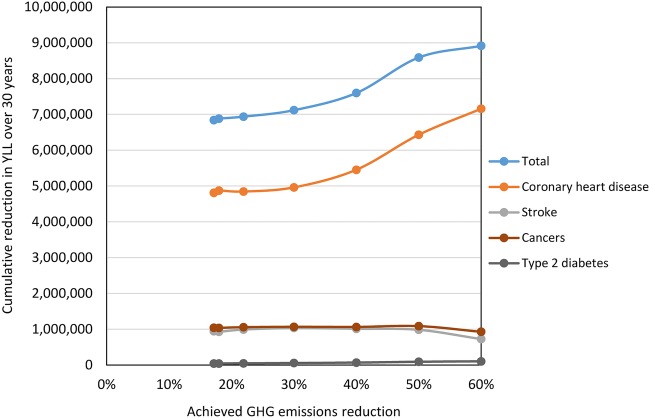
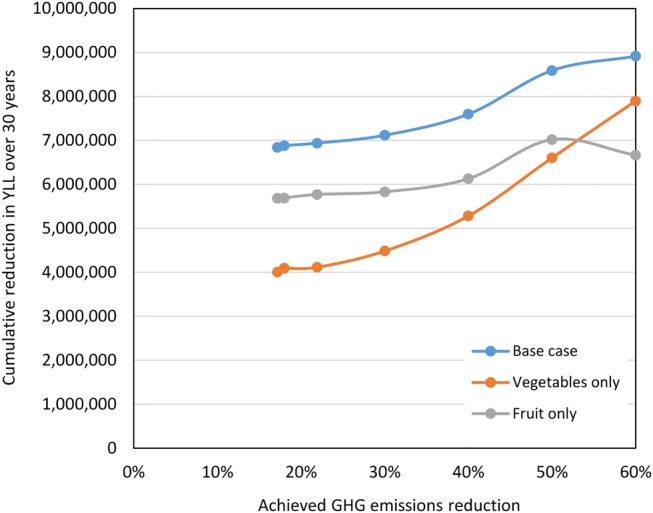
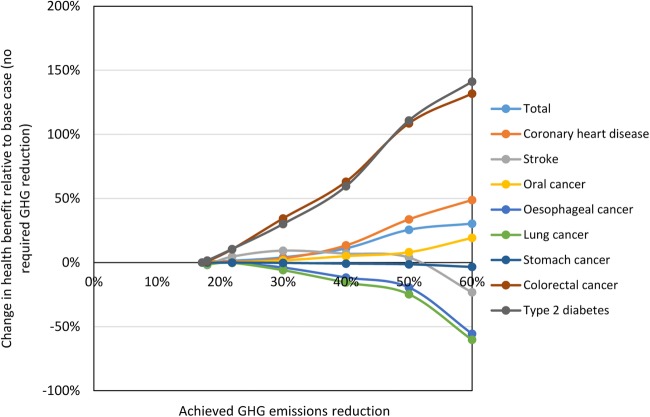
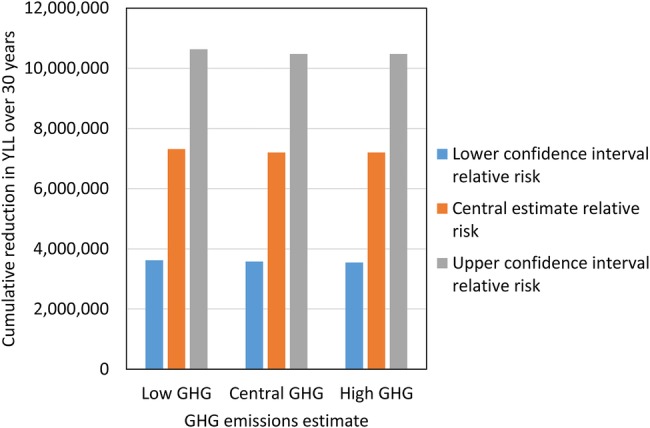
If the average UK dietary intake were optimised to comply with the WHO recommendations, we estimate an incidental reduction of 17% in GHG emissions. Such a dietary pattern would be broadly similar to the current UK average. Our model suggests that it would save almost 7 million years of life lost prematurely in the UK over the next 30 years and increase average life expectancy by over 8 months. Diets that result in additional GHG emission reductions could achieve further net health benefits. For emission reductions greater than 40%, improvements in some health outcomes may decrease and acceptability will diminish.
There are large potential benefits to health from adopting diets with lower associated GHG emissions in the UK. Most of these benefits can be achieved without drastic changes to existing dietary patterns. However, to reduce emissions by more than 40%, major dietary changes that limit both acceptability and the benefits to health are required.
改善健康的饮食变化也可能通过减少温室气体(GHG)排放对环境有益。然而,以往的分析并未考虑低GHG饮食对普通大众的潜在可接受性。本研究试图量化在英国采用低GHG排放饮食相关的健康影响。
流行病学建模研究。
英国。
英国人群。
采用经过优化的饮食,以实现世界卫生组织的营养建议并减少GHG排放,同时尽可能贴近现有的饮食模式。
使用生命表量化因冠心病、中风、几种癌症和II型糖尿病导致的寿命损失年数的变化。
如果将英国的平均饮食摄入量优化以符合世界卫生组织的建议,我们估计温室气体排放将意外减少17%。这种饮食模式与当前英国的平均水平大致相似。我们的模型表明,在未来30年内,这将在英国挽救近700万年过早失去的生命,并使平均预期寿命增加8个月以上。导致进一步减少温室气体排放的饮食可以实现更大的净健康效益。对于减排超过40%的情况,某些健康结果的改善可能会减少,可接受性也会降低。
在英国采用与较低温室气体排放相关的饮食对健康有巨大的潜在益处。其中大部分益处可以在不对现有饮食模式进行剧烈改变的情况下实现。然而,要将排放量减少超过40%,则需要进行重大的饮食改变,这会限制可接受性以及对健康的益处。