Aston Louise M, Smith James N, Powles John W
Department of Public Health and Primary Care, Cambridge, Institute of Public Health, University of Cambridge, Cambridge, UK.
BMJ Open. 2012 Sep 10;2(5). doi: 10.1136/bmjopen-2012-001072. Print 2012.
Consumption of red and processed meat (RPM) is a leading contributor to greenhouse gas (GHG) emissions, and high intakes of these foods increase the risks of several leading chronic diseases. The aim of this study was to use newly derived estimates of habitual meat intakes in UK adults to assess potential co-benefits to health and the environment from reduced RPM consumption.
Modelling study using dietary intake data from the National Diet and Nutrition Survey of British Adults.
British general population.
Respondents were divided into fifths by energy-adjusted RPM intakes, with vegetarians constituting a sixth stratum. GHG emitted in supplying the diets of each stratum was estimated using data from life-cycle analyses. A feasible counterfactual UK population was specified, in which the proportion of vegetarians measured in the survey population doubled, and the remainder adopted the dietary pattern of the lowest fifth of RPM consumers.
Reductions in risks of coronary heart disease, diabetes and colorectal cancer, and GHG emissions, under the counterfactual.
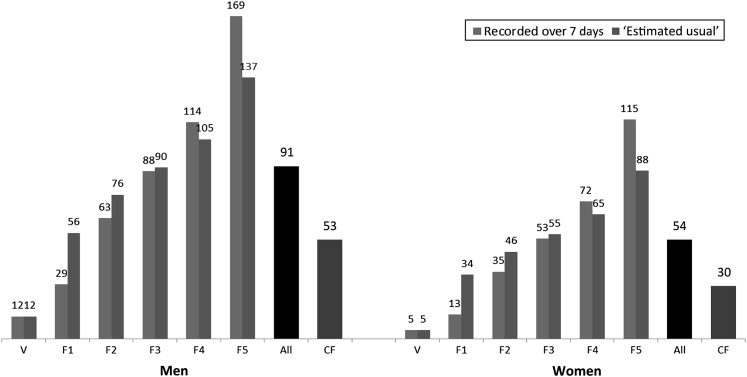
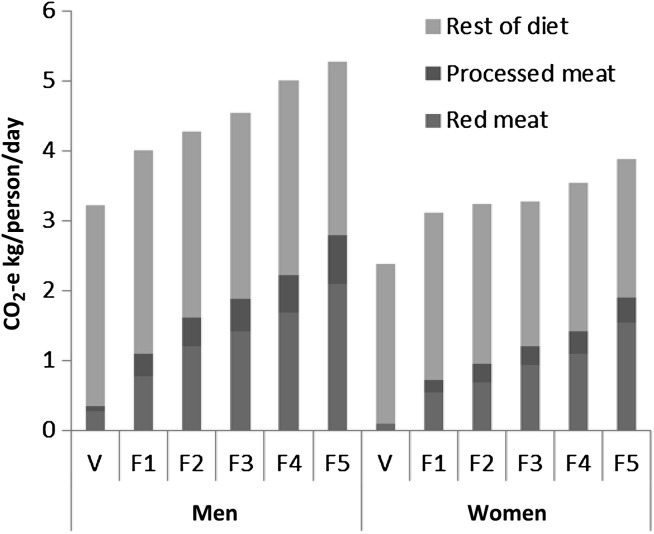
Habitual RPM intakes were 2.5 times higher in the top compared with the bottom fifth of consumers. Under the counterfactual, statistically significant reductions in population aggregate risks ranged from 3.2% (95% CI 1.9 to 4.7) for diabetes in women to 12.2% (6.4 to 18.0) for colorectal cancer in men, with those moving from the highest to lowest consumption levels gaining about twice these averages. The expected reduction in GHG emissions was 0.45 tonnes CO(2) equivalent/person/year, about 3% of the current total, giving a reduction across the UK population of 27.8 million tonnes/year.
Reduced consumption of RPM would bring multiple benefits to health and environment.
红肉和加工肉类(RPM)的消费是温室气体(GHG)排放的主要贡献因素,并且这些食物的高摄入量会增加几种主要慢性病的风险。本研究的目的是利用英国成年人习惯性肉类摄入量的最新估算值,评估减少RPM消费对健康和环境的潜在共同益处。
使用来自英国成年人全国饮食与营养调查的饮食摄入数据进行建模研究。
英国普通人群。
根据能量调整后的RPM摄入量将受访者分为五等份,素食者构成第六个阶层。使用生命周期分析数据估算为每个阶层提供饮食所排放的温室气体。确定了一个可行的反事实英国人群,其中调查人群中测量的素食者比例翻倍,其余人群采用RPM消费者最低五分之一的饮食模式。
反事实情况下冠心病、糖尿病和结直肠癌风险的降低以及温室气体排放。
消费者中最高五分之一人群的习惯性RPM摄入量是最低五分之一人群的2.5倍。在反事实情况下,人群总体风险的统计学显著降低范围从女性糖尿病的3.2%(95%CI 1.9至4.7)到男性结直肠癌的12.2%(6.4至18.0),从最高消费水平转变为最低消费水平的人群获得的降低幅度约为这些平均值的两倍。温室气体排放的预期减少量为0.45吨二氧化碳当量/人/年,约占当前总量的3%,使英国人口每年减少2780万吨。
减少RPM的消费将给健康和环境带来多重益处。