British Heart Foundation Health Promotion Research Group, Department of Public Health, University of Oxford, Oxford, UK.
Eur J Clin Nutr. 2012 Jun;66(6):710-5. doi: 10.1038/ejcn.2012.34. Epub 2012 Apr 11.
BACKGROUND/OBJECTIVES: Food is responsible for around one-fifth of all greenhouse gas (GHG) emissions from products consumed in the UK, the largest contributor of which is meat and dairy. The Committee on Climate Change have modelled the impact on GHG emissions of three dietary scenarios for food consumption in the UK. This paper models the impact of the three scenarios on mortality from cardiovascular disease and cancer.
SUBJECTS/METHODS: A previously published model (DIETRON) was used. The three scenarios were parameterised by fruit and vegetables, fibre, total fat, saturated fat, monounsaturated fatty acids, polyunsaturated fatty acids, cholesterol and salt using the 2008 Family Food Survey. A Monte Carlo simulation generated 95% credible intervals.
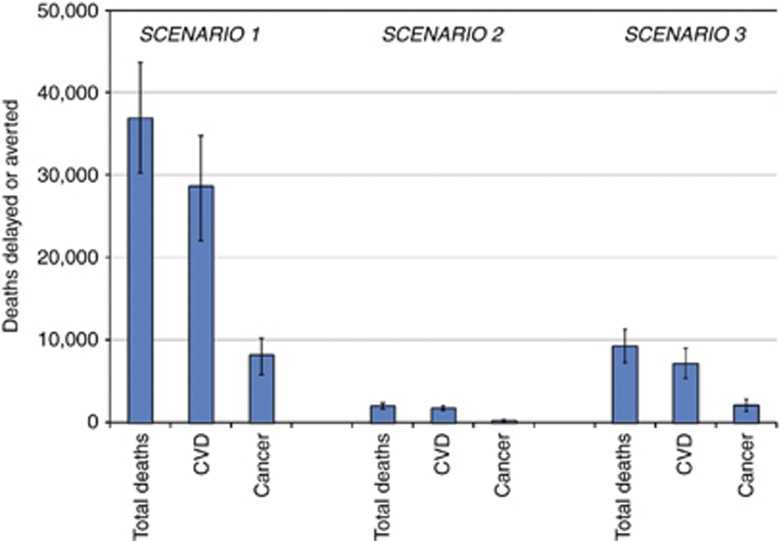
Scenario 1 (50% reduction in meat and dairy replaced by fruit, vegetables and cereals: 19% reduction in GHG emissions) resulted in 36,910 (30,192 to 43,592) deaths delayed or averted per year. Scenario 2 (75% reduction in cow and sheep meat replaced by pigs and poultry: 9% reduction in GHG emissions) resulted in 1999 (1739 to 2389) deaths delayed or averted. Scenario 3 (50% reduction in pigs and poultry replaced with fruit, vegetables and cereals: 3% reduction in GHG emissions) resulted in 9297 (7288 to 11,301) deaths delayed or averted.
Modelled results suggest that public health and climate change dietary goals are in broad alignment with the largest results in both domains occurring when consumption of all meat and dairy products are reduced. Further work in real-life settings is needed to confirm these results.
背景/目的:在英国,食品导致了所有消费产品温室气体(GHG)排放的五分之一,其中最大的贡献者是肉类和奶制品。气候变化委员会已经模拟了英国三种饮食方案对 GHG 排放的影响。本文模拟了这三种方案对心血管疾病和癌症死亡率的影响。
对象/方法:使用了先前发表的模型(DIETRON)。通过使用 2008 年家庭食品调查,三种方案通过水果和蔬菜、纤维、总脂肪、饱和脂肪、单不饱和脂肪酸、多不饱和脂肪酸、胆固醇和盐来参数化。蒙特卡罗模拟生成了 95%置信区间。
方案 1(将肉类和奶制品减少 50%,用水果、蔬菜和谷物替代:GHG 排放量减少 19%)导致每年 36910 人(30192 至 43592 人)的死亡延迟或避免。方案 2(将牛和羊肉减少 75%,用猪和家禽替代:GHG 排放量减少 9%)导致每年 1999 人(1739 至 2389 人)的死亡延迟或避免。方案 3(将猪和家禽减少 50%,用水果、蔬菜和谷物替代:GHG 排放量减少 3%)导致每年 9297 人(7288 至 11301 人)的死亡延迟或避免。
模拟结果表明,公共卫生和气候变化饮食目标与两个领域中最大的结果大致一致,当所有肉类和奶制品的消费减少时,这两个领域都会产生最大的结果。需要在现实环境中进一步开展工作以确认这些结果。