Farchi Sara, De Sario Manuela, Lapucci Enrica, Davoli Marina, Michelozzi Paola
Department of Epidemiology of Regional Health Service, ASL Roma 1, Lazio Region, Rome, Italy.
PLoS One. 2017 Aug 15;12(8):e0182960. doi: 10.1371/journal.pone.0182960. eCollection 2017.
Animal agriculture has exponentially grown in recent decades in response to the rise in global demand for meat, even in countries like Italy that traditionally eat a Mediterranean, plant-based diet. Globalization related dietary changes are contributing to the epidemic of non-communicable diseases and to the global climate crisis, and are associated with huge carbon and water footprints. The objective of the study is to assess inequalities in health impacts and in attributable greenhouse gases-GHG emissions in Italy by hypothesizing different scenarios of reduction in red and processed meat consumption towards healthier consumption patterns more compliant with the recommendations of the Mediterranean food pyramid.
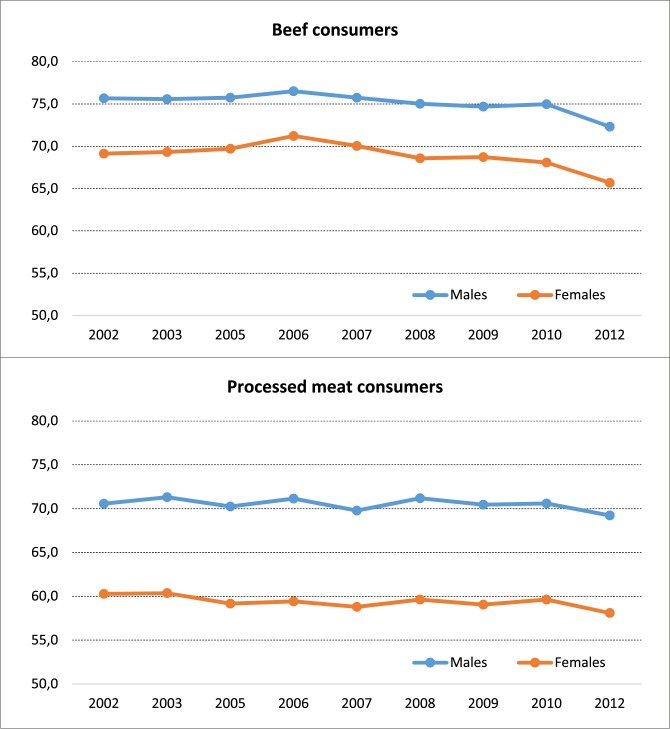
We used demographic and food consumption patterns from national surveys and risk relationships between meat intake and cardiovascular and colorectal cancer mortality from IARC and other meta-analyses. From the baseline data (year 2005-2006, average 406 gr/week beef and 245 gr/week processed meat), we considered hypothetical meat reduction scenarios according to international dietary guidelines such as the Mediterranean pyramid targets. For each geographical area (Northwest, Northeast, Centre, and South) and gender, we calculated the number of avoidable deaths from colorectal cancer, and cardiovascular disease among the adult population. Moreover, years of life gained by the adult population from 2012 to 2030 and changes in life expectancy of the 2012 birth cohort were quantified using gender-specific life tables. GHG emission reductions under Mediterranean scenario were estimated only for beef by applying the Global Warming Potential (GWP) coefficient to total consumption and to a low carbon food substitution in adult diet.
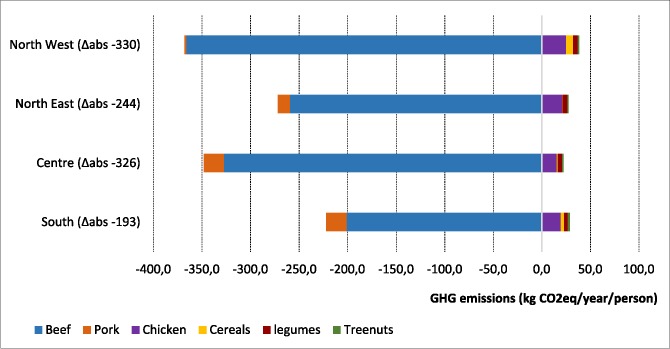
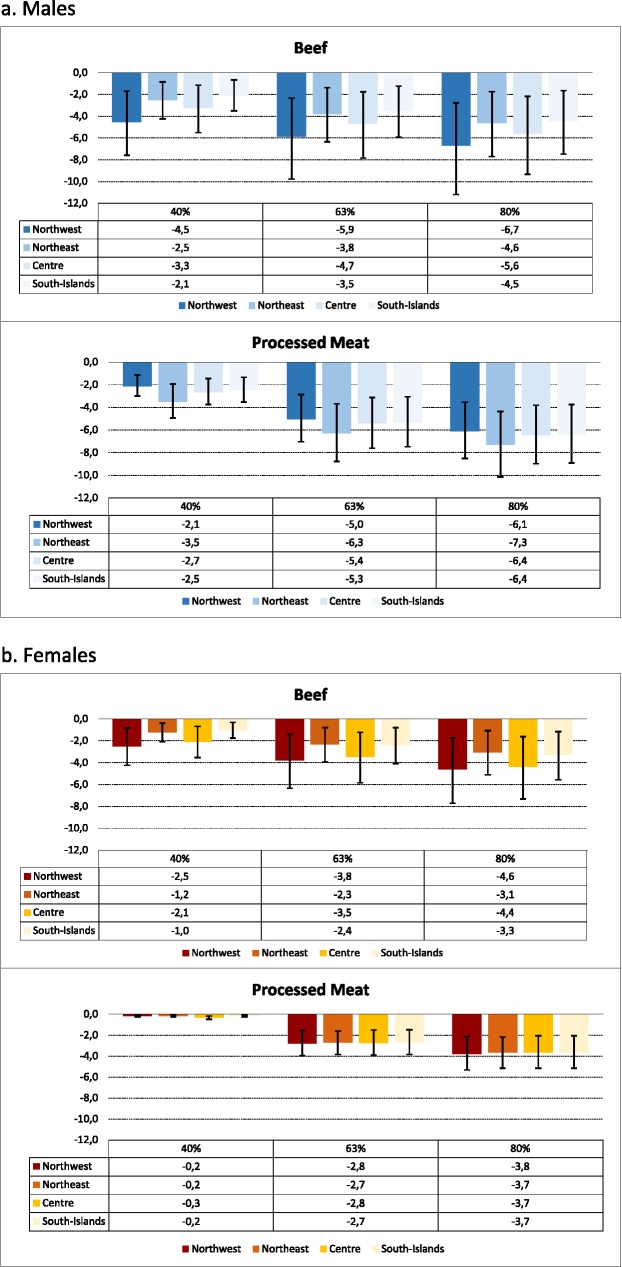
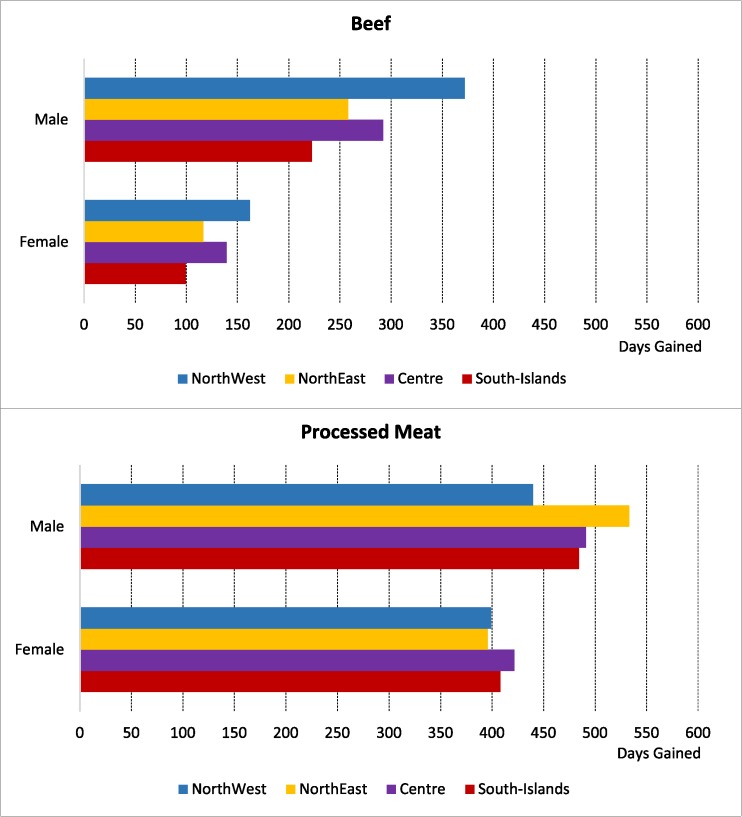
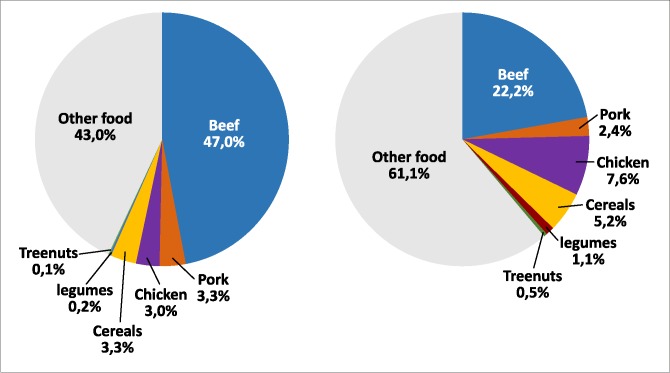
The deaths avoidable (as percentage change compared to baseline) according to the three reduction scenarios for beef consumption were between 2.3% and 4.5% for colorectal cancer, and between 2.1% and 4.0% for cardiovascular disease; higher benefits would be observed in Northwestern areas and among males. In parallel, 5% and 6.4% of colorectal cancer and CVD deaths would be avoided if the Italian population ate the advised quantity of processed meat. Life table analysis suggests that the scenario that is fully compliant with the Mediterranean diet model would save 5 million years of life lost prematurely among men and women over the next 18 years and would increase average life expectancy of future generations by over 7 months. Considering the environmental impact, emissions associated with the actual total intake of beef range from 12,900 to 21,800 Gg CO2 eq; emissions saved according to the Mediterranean scenario are in the range 8000-14000 Gg CO2 eq per year. The per capita reduction is 263 KgCO2eq/year/person with higher reductions in Northwestern and Central areas.
In Italy, scenarios for reducing beef consumption are consistent with significant health and environmental co-benefits on current and future generations. Results support introducing policies to promote healthier behavior towards red and processed meat in the adult population within an overall balanced and healthy dietary pattern. Interventions should address gender, vulnerable population groups, and geographical differences in order to be more effective.
近几十年来,随着全球肉类需求的增长,畜牧业呈指数级增长,即使在意大利这样传统上以地中海式植物性饮食为主的国家也是如此。与全球化相关的饮食变化正在导致非传染性疾病的流行和全球气候危机,并且与巨大的碳足迹和水足迹相关联。本研究的目的是通过假设减少红肉和加工肉类消费以实现更符合地中海食物金字塔建议的更健康消费模式的不同情景,来评估意大利在健康影响和可归因的温室气体(GHG)排放方面的不平等情况。
我们使用了来自全国调查的人口统计和食物消费模式,以及国际癌症研究机构(IARC)和其他荟萃分析中肉类摄入量与心血管疾病和结直肠癌死亡率之间的风险关系。根据基线数据(2005 - 2006年,平均每周牛肉摄入量406克,每周加工肉类摄入量245克),我们根据国际饮食指南(如地中海金字塔目标)考虑了假设的肉类减少情景。对于每个地理区域(西北部、东北部、中部和南部)和性别,我们计算了成年人口中结直肠癌和心血管疾病可避免死亡的数量。此外,使用特定性别的生命表对2012年至2030年成年人口获得的生命年数以及2012年出生队列的预期寿命变化进行了量化。通过将全球变暖潜能值(GWP)系数应用于成年饮食中的总消费量和低碳食物替代量,仅对牛肉估算了地中海情景下的温室气体减排量。
根据牛肉消费的三种减少情景,结直肠癌可避免死亡(与基线相比的百分比变化)在2.3%至4.5%之间,心血管疾病在2.1%至4.0%之间;在西北部地区和男性中观察到的益处更大。同时,如果意大利人口食用建议量的加工肉类,将避免5%和6.4%的结直肠癌和心血管疾病死亡。生命表分析表明,完全符合地中海饮食模式的情景将在未来18年中挽救男性和女性过早失去的500万年生命,并使后代的平均预期寿命增加超过7个月。考虑到环境影响,与牛肉实际总摄入量相关的排放量在12900至21800千兆克二氧化碳当量之间;根据地中海情景每年节省的排放量在8000 - 14000千兆克二氧化碳当量范围内。人均减少量为每年每人263千克二氧化碳当量,西北部和中部地区的减少量更高。
在意大利,减少牛肉消费的情景与对当代和后代的重大健康和环境协同效益相一致。结果支持在总体均衡和健康的饮食模式内引入政策,以促进成年人口对红肉和加工肉类采取更健康的行为。干预措施应考虑性别、弱势群体和地理差异,以便更有效。