Berents Teresa Løvold, Rønnevig Jørgen, Søyland Elisabeth, Gaustad Peter, Nylander Gro, Løland Beate Fossum
Institute of Clinical Medicine, University of Oslo, Oslo, Norway.
Department of Dermatology, Oslo University Hospital, Oslo, Norway.
BMC Dermatol. 2015 May 4;15:7. doi: 10.1186/s12895-015-0027-9.
Public health nurses report on effects of fresh human milk as treatment for conjunctivitis, rhinitis and atopic eczema (AE), the latter being highly prevalent in early childhood. Emollients and topical corticosteroids are first line treatment of AE. As many caregivers have steroid phobia, alternative treatment options for mild AE are of interest. The aim of this small pilot study was to assess the potential effects and risks of applying fresh human milk locally on eczema spots in children with AE.
This was a split body, controlled, randomized and physician blinded pilot study, of children with AE with two similar contralateral eczema spots having a mother breastfeeding the child or a sibling. Fresh expressed milk and emollient was applied on the intervention spot and emollient alone on the control area, three times a day for four weeks. The severity and area of the eczema spots was evaluated weekly, and samples from milk and the spots were analysed weekly with respect to bacterial colonisation.
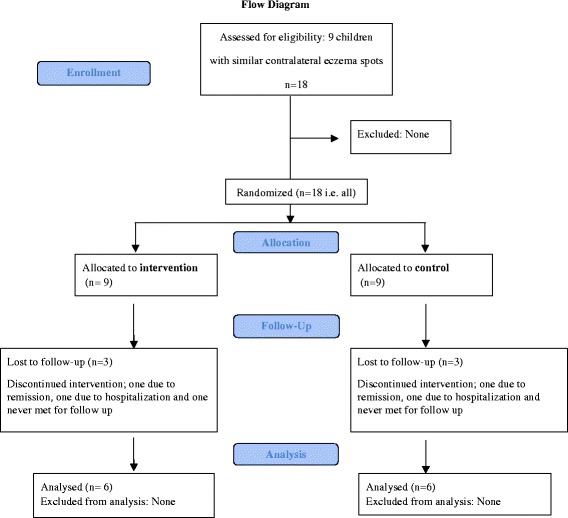
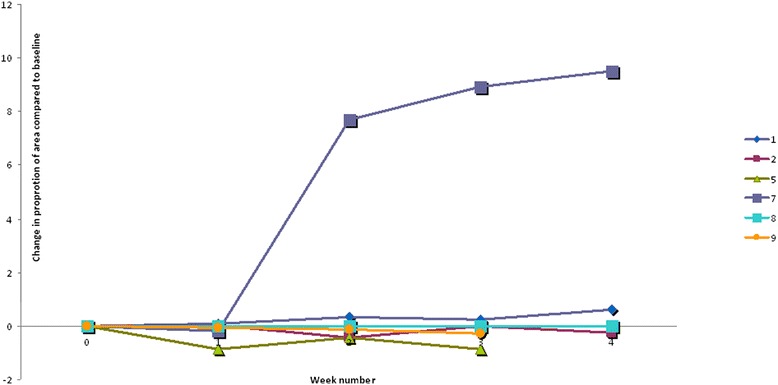
Of nine patients included, six completed the study. Mean age at inclusion was 18.5 months. The spots examined were localized on the arms, legs or cheeks. The spots were similar in severity, but differed in area. In one patient the eczema ceased after inclusion. In four patients both control and intervention areas increased during the intervention. The relative change in eczema area compared to baseline showed less increase in the intervention spots in two patients, whereas the opposite was observed in three. In four children Staphylococcus aureus was found in their eczema once or more. In three of the 28 human milk samples, Staphylococcus aureus, alfa haemolytic streptococci or coagulase negative staphylococci were detected. Staphylococcus aureus was found once both in human milk and in the eczema spots, no clinical signs of infection were however observed. No secondary infection due to milk application was detected.
In this small pilot study, no effect was found on eczema spots treated with topical application of fresh human milk. (ClinicalTrials.gov Identifier, NCT02381028 ).
公共卫生护士报告了新鲜人乳用于治疗结膜炎、鼻炎和特应性皮炎(AE)的效果,特应性皮炎在幼儿期非常普遍。润肤剂和外用皮质类固醇是特应性皮炎的一线治疗方法。由于许多护理人员对类固醇存在恐惧,轻度特应性皮炎的替代治疗方案备受关注。这项小型试点研究的目的是评估局部应用新鲜人乳对患有特应性皮炎儿童的湿疹斑的潜在影响和风险。
这是一项针对患有特应性皮炎儿童的分体、对照、随机且医生盲法的试点研究,这些儿童有两个相似的对侧湿疹斑,其母亲正在母乳喂养该儿童或有一个兄弟姐妹。将新鲜挤出的母乳和润肤剂涂抹在干预部位,仅在对照区域涂抹润肤剂,每天三次,持续四周。每周评估湿疹斑的严重程度和面积,并每周对母乳和湿疹斑的样本进行细菌定植分析。
纳入的9名患者中,6名完成了研究。纳入时的平均年龄为18.5个月。检查的湿疹斑位于手臂、腿部或脸颊。湿疹斑的严重程度相似,但面积不同。一名患者在纳入后湿疹消失。在4名患者中,干预期间对照区域和干预区域均增大。与基线相比,两名患者干预部位湿疹面积的相对变化显示增加较少,而另外三名患者则相反。4名儿童的湿疹中曾一次或多次检测到金黄色葡萄球菌。在28份母乳样本中的3份中,检测到金黄色葡萄球菌、α溶血性链球菌或凝固酶阴性葡萄球菌。在母乳和湿疹斑中均曾发现一次金黄色葡萄球菌,但未观察到感染的临床迹象。未检测到因涂抹母乳导致的继发感染。
在这项小型试点研究中,未发现局部应用新鲜人乳治疗湿疹斑有效果。(ClinicalTrials.gov标识符,NCT02381028)