Ayub Qasim, Mezzavilla Massimo, Pagani Luca, Haber Marc, Mohyuddin Aisha, Khaliq Shagufta, Mehdi Syed Qasim, Tyler-Smith Chris
Wellcome Trust Sanger Institute, Wellcome Trust Genome Campus, Hinxton, Cambridgeshire CB10 1SA, UK.
Wellcome Trust Sanger Institute, Wellcome Trust Genome Campus, Hinxton, Cambridgeshire CB10 1SA, UK; Institute for Maternal and Child Health, IRCCS Burlo Garofolo, University of Trieste, 34137 Trieste, Italy.
Am J Hum Genet. 2015 May 7;96(5):775-83. doi: 10.1016/j.ajhg.2015.03.012. Epub 2015 Apr 30.
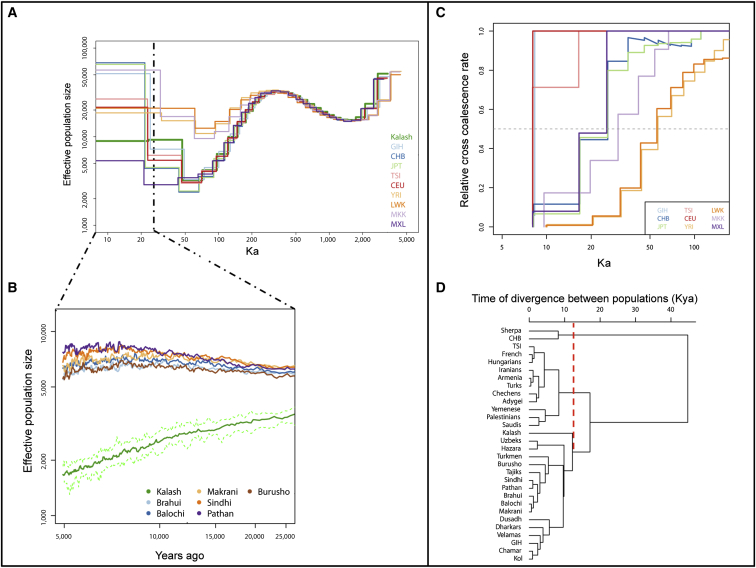
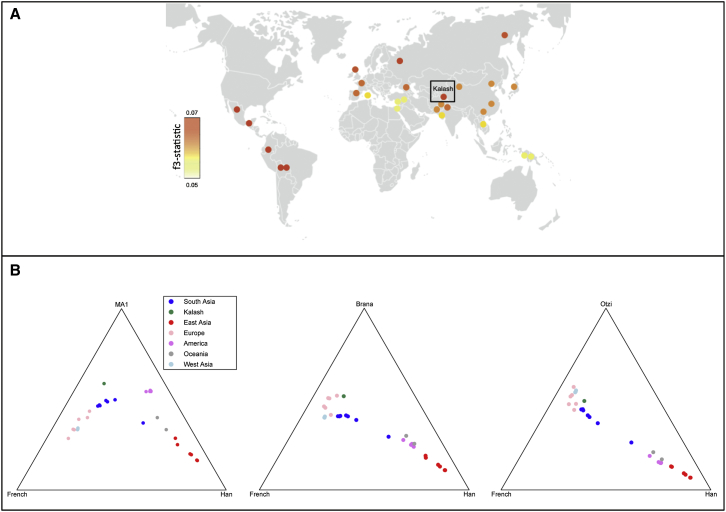
The Kalash represent an enigmatic isolated population of Indo-European speakers who have been living for centuries in the Hindu Kush mountain ranges of present-day Pakistan. Previous Y chromosome and mitochondrial DNA markers provided no support for their claimed Greek descent following Alexander III of Macedon's invasion of this region, and analysis of autosomal loci provided evidence of a strong genetic bottleneck. To understand their origins and demography further, we genotyped 23 unrelated Kalash samples on the Illumina HumanOmni2.5M-8 BeadChip and sequenced one male individual at high coverage on an Illumina HiSeq 2000. Comparison with published data from ancient hunter-gatherers and European farmers showed that the Kalash share genetic drift with the Paleolithic Siberian hunter-gatherers and might represent an extremely drifted ancient northern Eurasian population that also contributed to European and Near Eastern ancestry. Since the split from other South Asian populations, the Kalash have maintained a low long-term effective population size (2,319-2,603) and experienced no detectable gene flow from their geographic neighbors in Pakistan or from other extant Eurasian populations. The mean time of divergence between the Kalash and other populations currently residing in this region was estimated to be 11,800 (95% confidence interval = 10,600-12,600) years ago, and thus they represent present-day descendants of some of the earliest migrants into the Indian sub-continent from West Asia.
卡拉什人代表着一个说印欧语系语言的神秘孤立群体,他们在当今巴基斯坦的兴都库什山脉生活了几个世纪。先前的Y染色体和线粒体DNA标记并未为他们声称的在亚历山大大帝三世入侵该地区后拥有希腊血统提供支持,而常染色体位点分析提供了存在严重遗传瓶颈的证据。为了进一步了解他们的起源和人口统计学特征,我们在Illumina HumanOmni2.5M - 8 BeadChip上对23个无亲缘关系的卡拉什样本进行了基因分型,并在Illumina HiSeq 2000上对一名男性个体进行了高覆盖度测序。与古代狩猎采集者和欧洲农民的已发表数据进行比较表明,卡拉什人与旧石器时代的西伯利亚狩猎采集者存在遗传漂变,可能代表了一个极度漂变的古代北欧亚人群,该人群也对欧洲和近东血统有所贡献。自与其他南亚人群分离以来,卡拉什人的长期有效人口规模一直较低(2319 - 2603),并且没有检测到来自其在巴基斯坦的地理邻居或其他现存欧亚人群的基因流动。卡拉什人与目前居住在该地区的其他人群之间的平均分化时间估计为11800(95%置信区间 = 10600 - 12600)年前,因此他们代表了一些最早从西亚迁移到印度次大陆的人群的现代后裔。