Medical Psychological Institute, Second Xiangya Hospital, Central South University, Changsha, Hunan, 410011, P.R. China.
National Technology Institute of Psychiatry, Central South University, Changsha, China.
Health Qual Life Outcomes. 2015 May 6;13:51. doi: 10.1186/s12955-015-0242-4.
In recent decades, researchers and clinicians have sought to determine how to improve the quality of life (QOL) of women with breast cancer. Previous research has shown that many women have particular behavioral coping styles, which are important determinants of QOL. As behavior is closely associated with cognition, these patients may also have particular cognitive coping styles. However, the cognitive coping characteristics and their effects on QOL in women with breast cancer remain unclear. Thus, this study aimed to characterize cognitive coping styles among women with breast cancer and explore the effects of cognitive emotion regulation strategies on QOL.
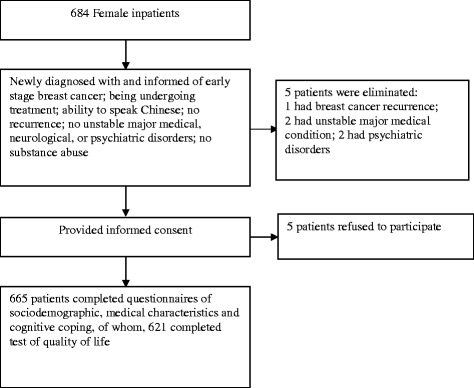
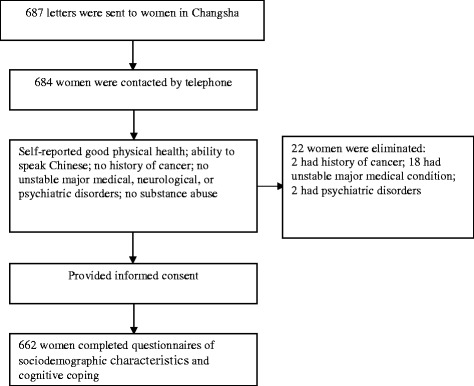
The Chinese version of the Cognitive Emotion Regulation Questionnaire was used to assess cognitive coping strategies in 665 women newly diagnosed with breast cancer and 662 healthy women. QOL of patients was assessed using the Functional Assessment of Cancer Therapy for Breast Cancer Scale. Independent-samples t-tests were performed to investigate group differences in reporting of cognitive coping strategies. Multiple regression analyses were performed to examine the effects of cognitive coping strategies on QOL in patients after controlling for sociodemographic and medical variables.
Compared with control subjects, patients reported less frequent use of self-blame, rumination, positive refocusing, refocusing on planning, positive reappraisal, and blaming others, and more frequent use of acceptance and catastrophizing (all p < 0.01). The three strongest predictors of group membership were catastrophizing (B = -0.35), acceptance (B = -0.29), and positive reappraisal (B = 0.23). All nine coping strategies were significantly correlated with QOL in patients (all p < 0.05). After controlling for sociodemographic and medical variables, self-blame, rumination, and catastrophizing negatively affected QOL (all p < 0.05), whereas acceptance and positive reappraisal had positive effects (all p < 0.01).
Compared with healthy women, women newly diagnosed with breast cancer use catastrophizing and acceptance more frequently, and positive reappraisal, self-blame, rumination, positive refocusing, refocusing on planning, and blaming others less frequently. Catastrophizing, rumination, and self-blame may be not conducive to QOL of women with breast cancer and acceptance and positive reappraisal may be useful.
近几十年来,研究人员和临床医生一直在努力提高乳腺癌女性的生活质量(QOL)。既往研究表明,许多女性具有特定的行为应对方式,这是 QOL 的重要决定因素。由于行为与认知密切相关,这些患者也可能具有特定的认知应对方式。然而,乳腺癌患者的认知应对特征及其对 QOL 的影响尚不清楚。因此,本研究旨在描述乳腺癌患者的认知应对方式,并探讨认知情绪调节策略对 QOL 的影响。
采用中文版认知情绪调节问卷评估 665 例新诊断乳腺癌女性和 662 例健康女性的认知应对策略。采用乳腺癌患者功能评估量表评估患者的 QOL。采用独立样本 t 检验比较两组报告的认知应对策略差异。采用多元回归分析控制社会人口学和医学变量后,探讨认知应对策略对患者 QOL 的影响。
与对照组相比,患者自责、反刍、积极重聚焦、重新关注计划、积极重新评价和责怪他人的频率较低,接受和灾难化的频率较高(均 P<0.01)。群体归属的三个最强预测因子是灾难化(B=-0.35)、接受(B=-0.29)和积极重新评价(B=0.23)。所有 9 种应对策略与患者的 QOL 均显著相关(均 P<0.05)。控制社会人口学和医学变量后,自责、反刍和灾难化对 QOL 有负面影响(均 P<0.05),而接受和积极重新评价有积极影响(均 P<0.01)。
与健康女性相比,新诊断为乳腺癌的女性更频繁地使用灾难化和接受,而较少使用积极重聚焦、重新关注计划和责怪他人、自责、反刍。灾难化、反刍和自责可能不利于乳腺癌女性的 QOL,而接受和积极重新评价可能是有益的。