Raimondi Lavinia, De Luca Angela, Amodio Nicola, Manno Mauro, Raccosta Samuele, Taverna Simona, Bellavia Daniele, Naselli Flores, Fontana Simona, Schillaci Odessa, Giardino Roberto, Fini Milena, Tassone Pierfrancesco, Santoro Alessandra, De Leo Giacomo, Giavaresi Gianluca, Alessandro Riccardo
Laboratory of Tissue Engineering - Innovative Technology Platforms for Tissue Engineering (PON01-00829), Rizzoli Orthopedic Institute, Palermo, Italy.
Department of Experimental and Clinical Medicine, Magna Graecia University and Medical Oncology Unit, T. Campanella Cancer Center, Salvatore Venuta University Campus, Catanzaro, Italy.
Oncotarget. 2015 May 30;6(15):13772-89. doi: 10.18632/oncotarget.3830.
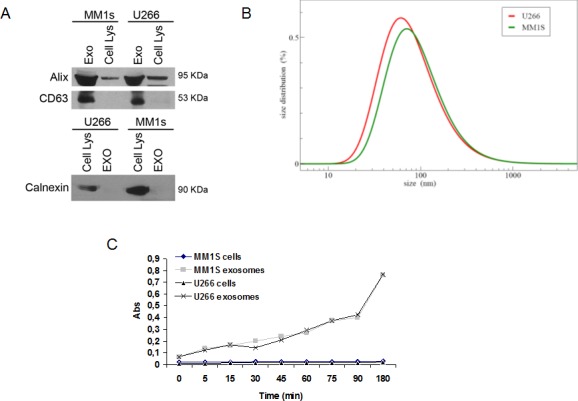
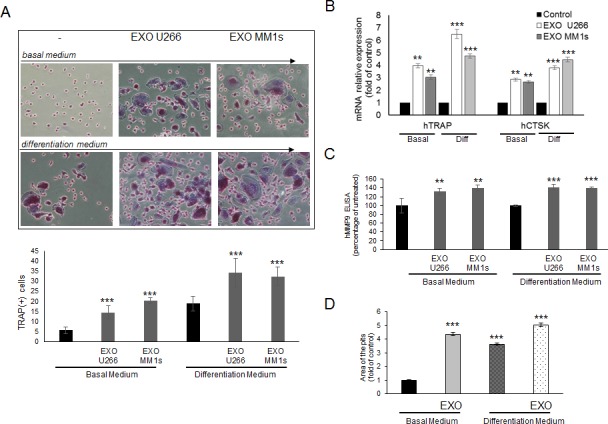
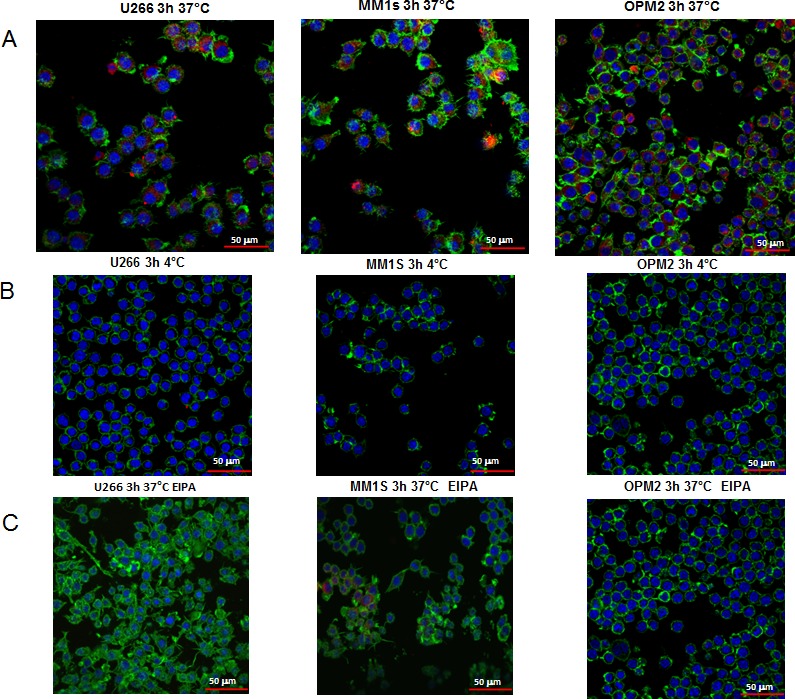
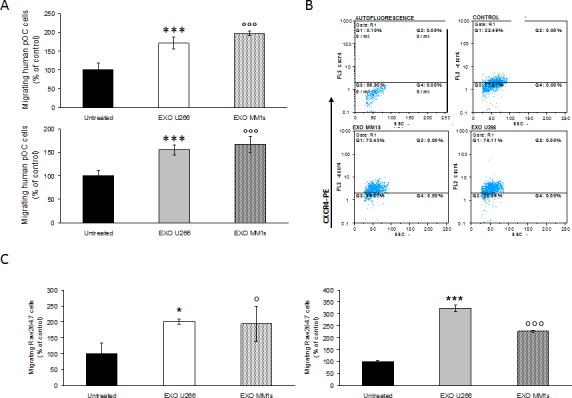
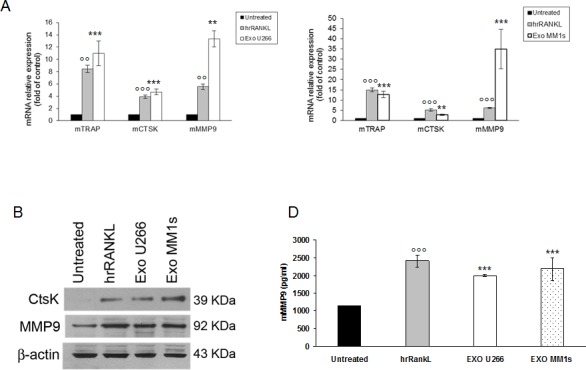
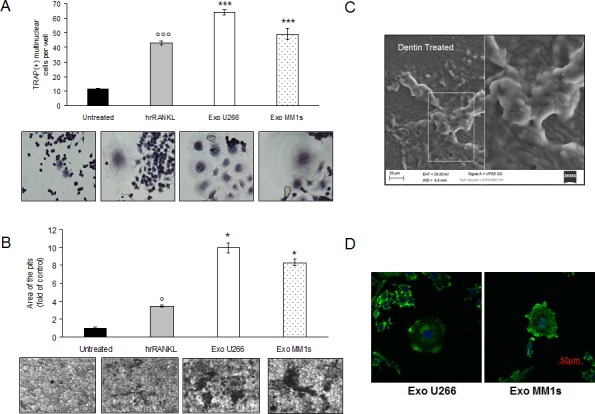
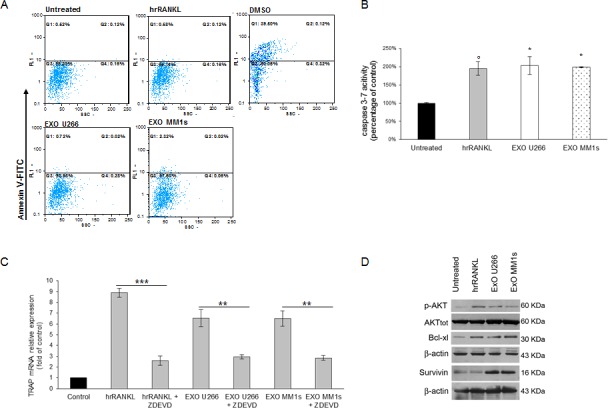
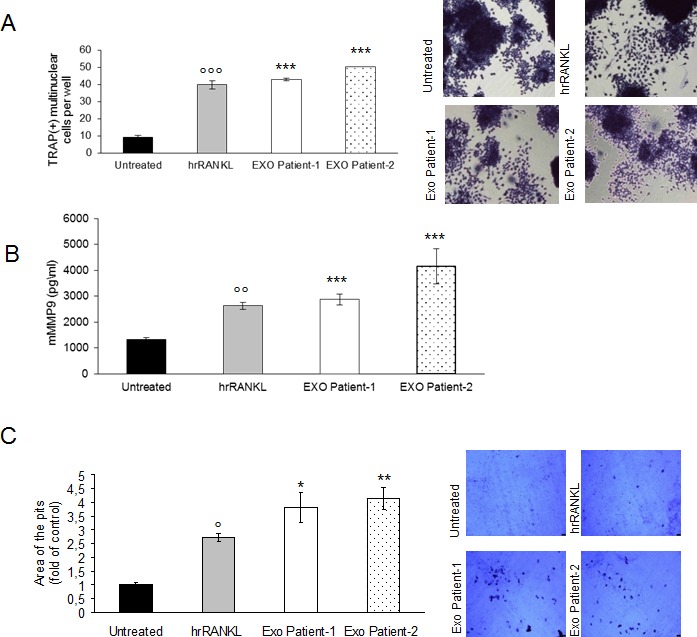
Bone disease is the most frequent complication in multiple myeloma (MM) resulting in osteolytic lesions, bone pain, hypercalcemia and renal failure. In MM bone disease the perfect balance between bone-resorbing osteoclasts (OCs) and bone-forming osteoblasts (OBs) activity is lost in favour of OCs, thus resulting in skeletal disorders. Since exosomes have been described for their functional role in cancer progression, we here investigate whether MM cell-derived exosomes may be involved in OCs differentiation. We show that MM cells produce exosomes which are actively internalized by Raw264.7 cell line, a cellular model of osteoclast formation. MM cell-derived exosomes positively modulate pre-osteoclast migration, through the increasing of CXCR4 expression and trigger a survival pathway. MM cell-derived exosomes play a significant pro-differentiative role in murine Raw264.7 cells and human primary osteoclasts, inducing the expression of osteoclast markers such as Cathepsin K (CTSK), Matrix Metalloproteinases 9 (MMP9) and Tartrate-resistant Acid Phosphatase (TRAP). Pre-osteoclast treated with MM cell-derived exosomes differentiate in multinuclear OCs able to excavate authentic resorption lacunae. Similar results were obtained with exosomes derived from MM patient's sera. Our data indicate that MM-exosomes modulate OCs function and differentiation. Further studies are needed to identify the OCs activating factors transported by MM cell-derived exosomes.
骨病是多发性骨髓瘤(MM)最常见的并发症,会导致溶骨性病变、骨痛、高钙血症和肾衰竭。在MM骨病中,骨吸收破骨细胞(OCs)和成骨细胞(OBs)活性之间的完美平衡被打破,有利于OCs,从而导致骨骼疾病。由于外泌体在癌症进展中的功能作用已被描述,我们在此研究MM细胞衍生的外泌体是否可能参与OCs分化。我们发现MM细胞产生的外泌体被破骨细胞形成的细胞模型Raw264.7细胞系主动内化。MM细胞衍生的外泌体通过增加CXCR4表达正向调节前破骨细胞迁移,并触发一条存活途径。MM细胞衍生的外泌体在小鼠Raw264.7细胞和人原代破骨细胞中发挥显著的促分化作用,诱导破骨细胞标志物如组织蛋白酶K(CTSK)、基质金属蛋白酶9(MMP9)和抗酒石酸酸性磷酸酶(TRAP)的表达。用MM细胞衍生的外泌体处理的前破骨细胞分化为能够挖掘真实吸收陷窝的多核OCs。从MM患者血清中获得的外泌体也得到了类似结果。我们的数据表明MM外泌体调节OCs的功能和分化。需要进一步研究以鉴定MM细胞衍生的外泌体转运的OCs激活因子。