Hunter Institute of Mental Health, Hunter New England Local Health District, Newcastle, Australia ; School of Medicine and Public Health, University of Newcastle, PO Box 833, Newcastle, NSW 2300 Australia.
School of Medicine and Public Health, University of Newcastle, PO Box 833, Newcastle, NSW 2300 Australia ; Hunter New England Population Health, Hunter New England Local Health District, Newcastle, Australia.
BMC Psychol. 2014 Mar 11;2(1):5. doi: 10.1186/2050-7283-2-5. eCollection 2014.
Families of children living with chronic illness are more vulnerable to mental health problems, however this can be ameliorated by a family's resilience. The Child Illness and Resilience Program (CHiRP) will develop and evaluate a parent-focussed family intervention designed to increase the resilience and wellbeing of families living with childhood chronic illness.
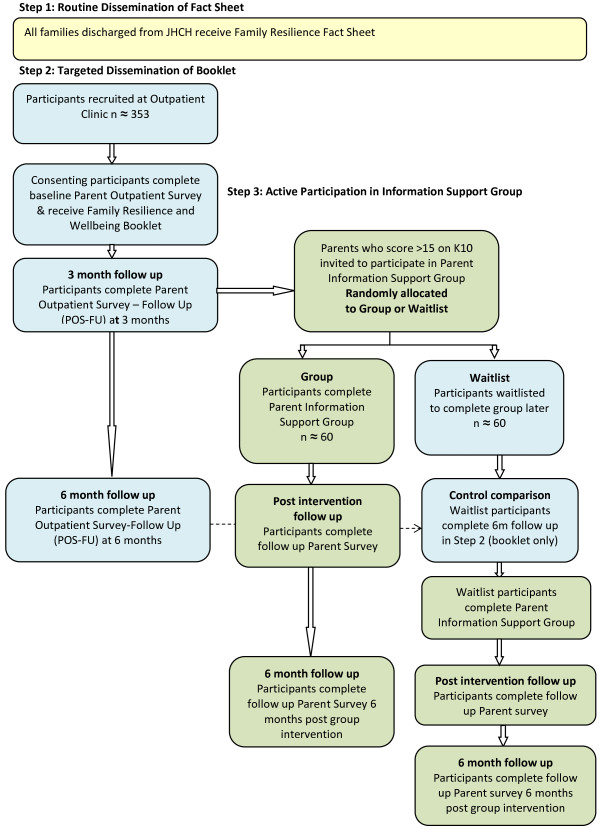
METHODS/DESIGN: The study will be conducted in an Australian regional paediatric hospital and will use a stepped care intervention that increases in intensity according to parental distress. All parents of children discharged from the hospital will receive a family resilience and wellbeing factsheet (Step 1). Parents of children attending selected outpatient clinics will receive a family resilience and wellbeing activity booklet (Step 2). Parents who receive the booklet and report psychological distress at three-month follow-up will be randomised to participate in a family resilience information support group or waitlist control (Step 3). The Step 3 control group will provide data to compare the relative effectiveness of the booklet intervention alone versus the booklet combined with the group intervention for distressed parents. These participants will then receive the information support group intervention. All parents in Step 2 and 3 will complete baseline, post-intervention and six month follow up assessments. The primary outcomes of the study will be changes in scores between baseline and follow-up assessments on measures of constructs of family resilience, including parental wellbeing, family functioning, family beliefs and perceived social support. Qualitative feedback regarding the utility and acceptability of the different intervention components will also be collected.
It is hypothesised that participation in the CHiRP intervention will be associated with positive changes in the key outcome measures. If effective, CHiRP will provide an opportunity for the health sector to deliver a standardised stepped care mental health promotion intervention to families living with childhood chronic illness.
Australian clinical Trials Registry ACTRN 12613000844741 Universal Trial Number (UTN): 1111-1142-8829.
患有慢性疾病的儿童的家庭更容易出现心理健康问题,但这可以通过家庭的适应能力得到改善。儿童疾病和适应力计划(CHiRP)将开发和评估一种以父母为中心的家庭干预措施,旨在提高患有儿童慢性疾病的家庭的适应力和幸福感。
方法/设计:该研究将在澳大利亚一家地区儿科医院进行,采用逐步护理干预措施,根据父母的痛苦程度增加干预强度。所有从医院出院的儿童的父母都将收到一份家庭适应力和幸福感情况说明书(第 1 步)。在选定的门诊诊所就诊的儿童的父母将收到一份家庭适应力和幸福感活动手册(第 2 步)。在三个月随访时报告心理困扰的父母将被随机分配参加家庭适应力信息支持小组或候补对照组(第 3 步)。第 3 步对照组将提供数据,比较单独使用手册干预对有困扰的父母的效果与手册干预结合小组干预的相对效果。然后,这些参与者将接受信息支持小组干预。第 2 步和第 3 步的所有父母将完成基线、干预后和六个月随访评估。该研究的主要结果将是在家庭适应力的结构,包括父母幸福感、家庭功能、家庭信念和感知社会支持方面,在基线和随访评估之间的得分变化。还将收集关于不同干预措施组成部分的实用性和可接受性的定性反馈。
假设参与 CHiRP 干预将与关键结果测量的积极变化相关。如果有效,CHiRP 将为卫生部门提供一个机会,为患有儿童慢性疾病的家庭提供标准化的逐步护理心理健康促进干预。
澳大利亚临床试验注册 ACTRN 12613000844741 通用试验编号(UTN):1111-1142-8829。