Yau Gordon S K, Lee Jacky W Y, Tam Victor T Y, Yip Stan, Cheng Edith, Liu Catherine C L, Chu Benjamin C Y, Wong Ian Y H
From the Department of Ophthalmology, Caritas Medical Centre, Hong Kong SAR (GSKY, JWYL, VTYT, BCYC); Department of Applied Mathematics, The Hong Kong Polytechnic University, Hong Kong SAR (SY, CCLU); Centre of Health Behaviours Research, The Chinese University of Hong Kong, Hong Kong SAR (EC); Department of Ophthalmology, The University of Hong Kong, Hong Kong SAR, People's Republic of China (IYHW, JWYL).
Medicine (Baltimore). 2015 May;94(18):e867. doi: 10.1097/MD.0000000000000867.
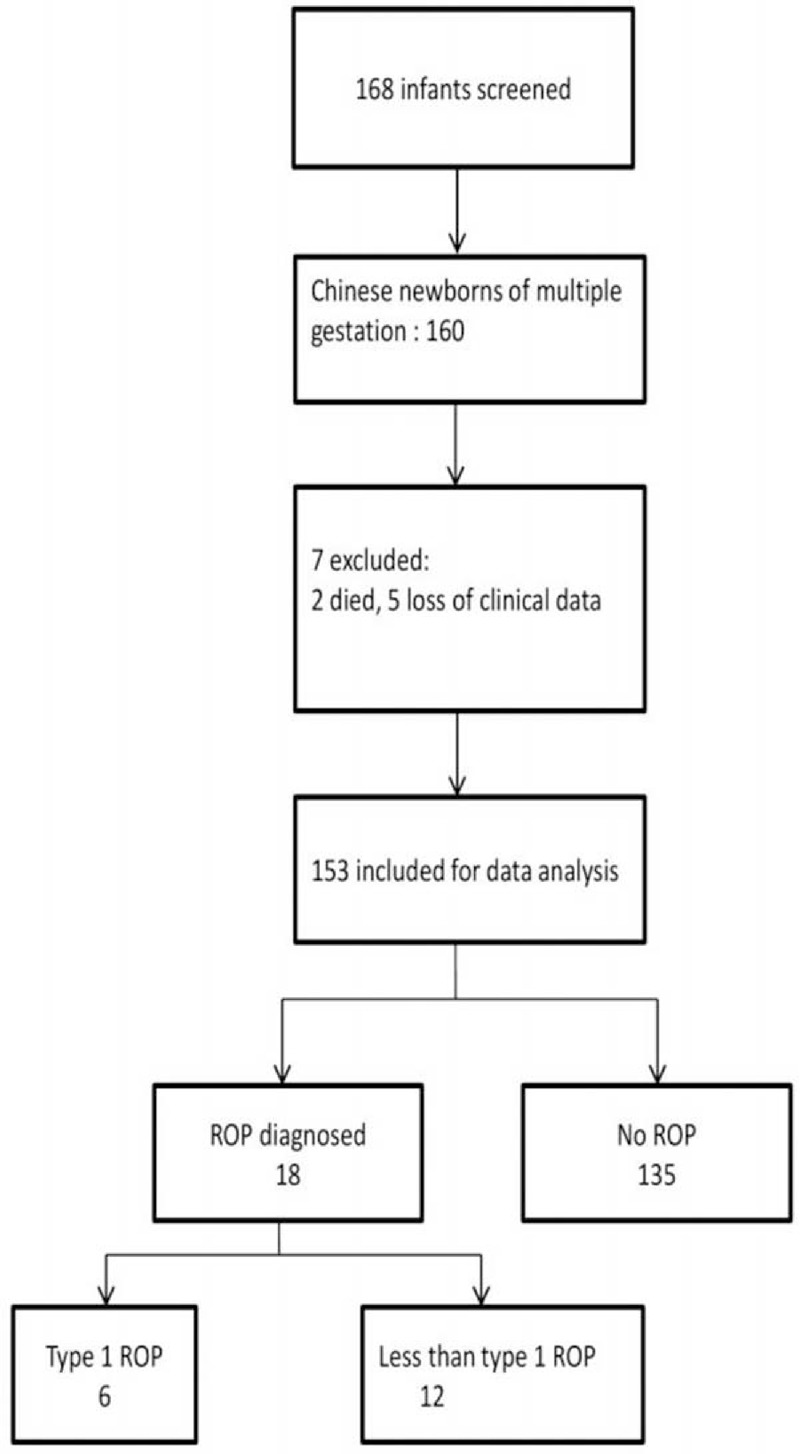
To determine the incidence and risk factors of retinopathy of prematurity (ROP) among new-born Chinese infants of multiple gestations.A retrospective review of medical records was performed for all neonates of multiple gestations screened for ROP between January 2007 and December 2012 in 2 neonatal intensive care units in Hong Kong. Screening was offered to very low birth weight (VLBW; ≤1500 g) and/or preterm (gestation ≤32 weeks) neonates using the Royal College of Ophthalmologists ROP guideline and the International Classification of ROP by 3 pediatric ophthalmologists. Maternal and neonatal covariates were analyzed using univariate and multivariate regression analyses for both ROP and Type 1 ROP.A total of 153 Chinese infants of multiple gestations were included in the study. The mean gestational age (GA) was 30.8 ± 2.4 weeks and the mean birth weight (BW) was 1284.8 ± 267.4 g. The incidence of ROP and Type 1 ROP was 11.8% and 3.9%, respectively. On univariate analysis, younger GA, lighter birth weight, postnatal hypotension, inotropes use, bronchopulmonary disease, and intraventricular hemorrhage were common independent risk factors for the development of ROP and Type 1 ROP (all P ≤ 0.04). On multivariate analysis, younger GA, surfactant use, invasive mechanical ventilation, higher mean oxygen concentration, thrombocytopenia, intraventricular hemorrhage, total parental nutrition, and hypoglycemia were significant risk factors for ROP. For Type 1 ROP, there were no significant dependent risk factors.In preterm Chinese infants born from multiple gestations, prematurity, lighter weight, postnatal hypotension, inotropes use, bronchopulmonary dysplasia, and an intraventricular hemorrhage were common independent risk factors for the development of ROP and Type 1 ROP.
确定中国多胎妊娠新生儿中早产儿视网膜病变(ROP)的发病率及危险因素。对2007年1月至2012年12月期间在香港2家新生儿重症监护病房接受ROP筛查的所有多胎妊娠新生儿的病历进行回顾性分析。按照皇家眼科医学院ROP指南及国际ROP分类标准,由3名儿科眼科医生对极低出生体重(VLBW;≤1500 g)和/或早产(孕周≤32周)的新生儿进行筛查。对ROP和1型ROP的产妇及新生儿协变量进行单因素和多因素回归分析。
本研究共纳入153例中国多胎妊娠婴儿。平均孕周(GA)为30.8±2.4周,平均出生体重(BW)为1284.8±267.4 g。ROP和1型ROP的发病率分别为11.8%和3.9%。单因素分析显示,孕周较小、出生体重较轻、出生后低血压、使用血管活性药物、支气管肺疾病及脑室内出血是ROP和1型ROP发生的常见独立危险因素(均P≤0.04)。多因素分析显示,孕周较小、使用表面活性剂、有创机械通气、平均氧浓度较高、血小板减少、脑室内出血、全胃肠外营养及低血糖是ROP的显著危险因素。对于1型ROP,无显著相关危险因素。
在多胎妊娠的中国早产儿中,早产、体重较轻、出生后低血压、使用血管活性药物、支气管肺发育不良及脑室内出血是ROP和1型ROP发生的常见独立危险因素。