Tang Feng, Chen Feilong, Ling Xiao, Huang Yao, Zheng Xiaomei, Tang Qingfa, Tan Xiaomei
School of Traditional Chinese Medical Sciences, Southern Medical University, Guangzhou 510515, China ; Guangdong Province Key Laboratory of Chinese Medicine Pharmaceutics, Southern Medical University, Guangzhou 510515, China.
Mediators Inflamm. 2015;2015:463530. doi: 10.1155/2015/463530. Epub 2015 Apr 16.
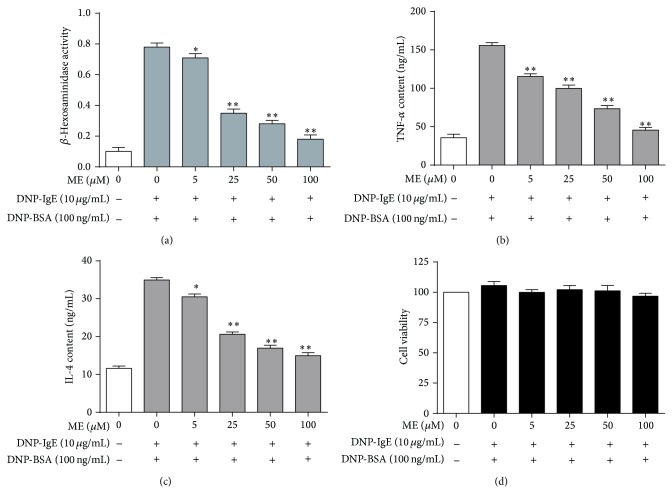
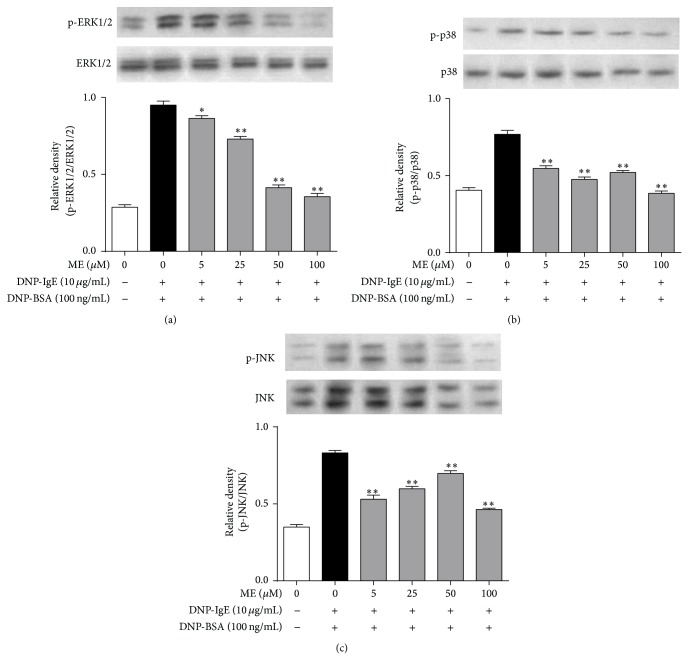
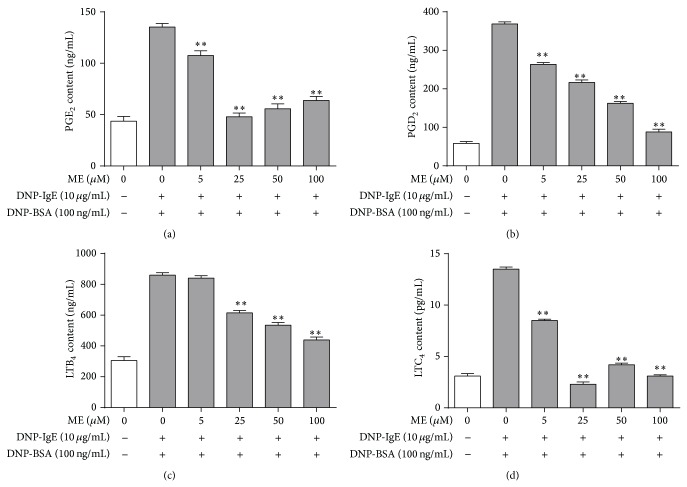
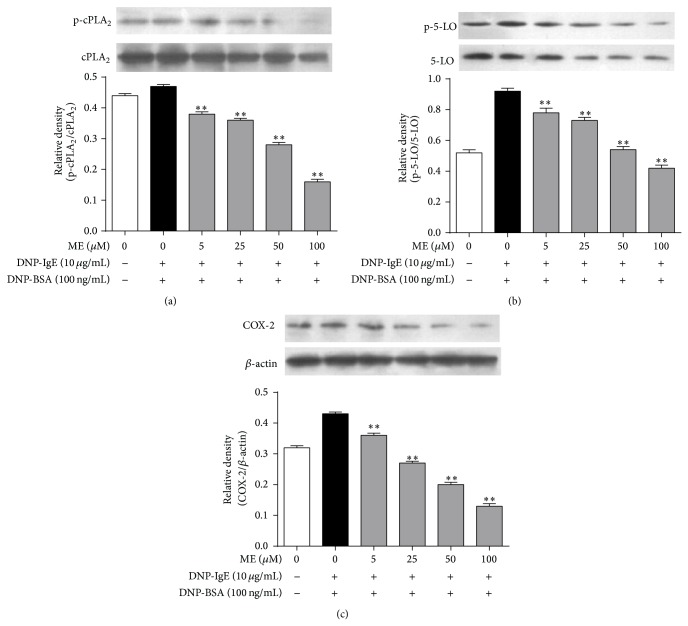
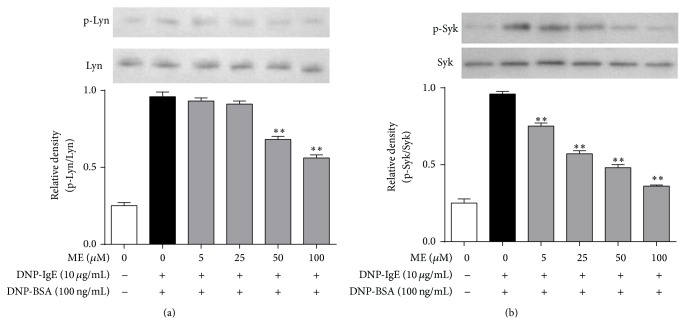
Allergic diseases, such as asthma and allergic rhinitis, are common. Therefore, the discovery of therapeutic drugs for these conditions is essential. Methyleugenol (ME) is a natural compound with antiallergic, antianaphylactic, antinociceptive, and anti-inflammatory effects. This study examined the antiallergic effect of ME on IgE-mediated inflammatory responses and its antiallergy mechanism in the mast cell line, RBL-2H3. We found that ME significantly inhibited the release of β-hexosaminidase, tumor necrosis factor- (TNF-) α, and interleukin- (IL-) 4, and was not cytotoxic at the tested concentrations (0-100 μM). Additionally, ME markedly reduced the production of the proinflammatory lipid mediators prostaglandin E2 (PGE2), prostaglandin D2 (PGD2), leukotriene B4 (LTB4), and leukotriene C4 (LTC4). We further evaluated the effect of ME on the early stages of the FcεRI cascade. ME significantly inhibited Syk phosphorylation and expression but had no effect on Lyn. Furthermore, it suppressed ERK1/2, p38, and JNK phosphorylation, which is implicated in proinflammatory cytokine expression. ME also decreased cytosolic phospholipase A2 (cPLA2) and 5-lipoxygenase (5-LO) phosphorylation and cyclooxygenase-2 (COX-2) expression. These results suggest that ME inhibits allergic response by suppressing the activation of Syk, ERK1/2, p38, JNK, cPLA2, and 5-LO. Furthermore, the strong inhibition of COX-2 expression may also contribute to the antiallergic action of ME. Our study provides further information about the biological functions of ME.
哮喘和过敏性鼻炎等过敏性疾病很常见。因此,发现针对这些病症的治疗药物至关重要。甲基丁香酚(ME)是一种具有抗过敏、抗过敏反应、镇痛和抗炎作用的天然化合物。本研究检测了ME对IgE介导的炎症反应的抗过敏作用及其在肥大细胞系RBL-2H3中的抗过敏机制。我们发现ME显著抑制β-己糖胺酶、肿瘤坏死因子-(TNF-)α和白细胞介素-(IL-)4的释放,并且在测试浓度(0-100μM)下没有细胞毒性。此外,ME显著降低了促炎脂质介质前列腺素E2(PGE2)、前列腺素D2(PGD2)、白三烯B4(LTB4)和白三烯C4(LTC4)的产生。我们进一步评估了ME对FcεRI级联反应早期阶段的影响。ME显著抑制Syk磷酸化和表达,但对Lyn没有影响。此外,它抑制了与促炎细胞因子表达有关的ERK1/2、p38和JNK磷酸化。ME还降低了胞质磷脂酶A2(cPLA2)和5-脂氧合酶(5-LO)的磷酸化以及环氧合酶-2(COX-2)的表达。这些结果表明,ME通过抑制Syk、ERK1/2、p38、JNK、cPLA2和5-LO的激活来抑制过敏反应。此外,对COX-2表达的强烈抑制也可能有助于ME的抗过敏作用。我们的研究提供了关于ME生物学功能的更多信息。