
从文献中提取药物相互作用的药代动力学证据。
Extraction of pharmacokinetic evidence of drug-drug interactions from the literature.
作者信息
Kolchinsky Artemy, Lourenço Anália, Wu Heng-Yi, Li Lang, Rocha Luis M
机构信息
School of Informatics and Computing, Indiana University, Bloomington, IN, USA; Instituto Gulbenkian de Ciência, Oeiras, Portugal.
ESEI: Escuela Superior de Ingeniería Informática, University of Vigo, Edificio Politécnico, Campus Universitario As Lagoas s/n 32004, Ourense, Spain; CEB-Centre of Biological Engineering, University of Minho, Campus de Gualtar, 4710-057 Braga, Portugal.
出版信息
PLoS One. 2015 May 11;10(5):e0122199. doi: 10.1371/journal.pone.0122199. eCollection 2015.
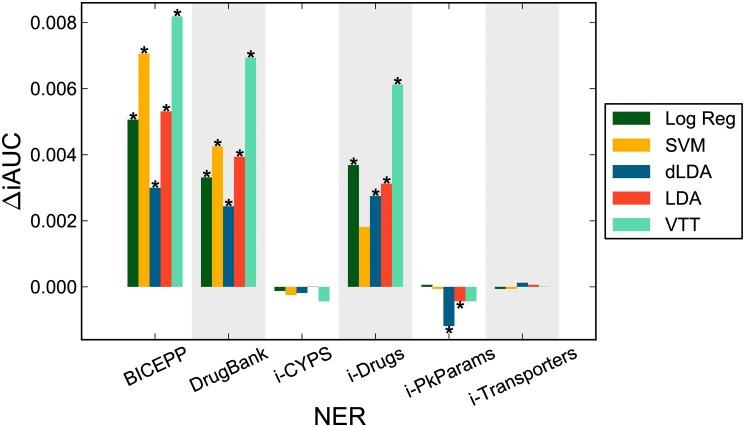
Drug-drug interaction (DDI) is a major cause of morbidity and mortality and a subject of intense scientific interest. Biomedical literature mining can aid DDI research by extracting evidence for large numbers of potential interactions from published literature and clinical databases. Though DDI is investigated in domains ranging in scale from intracellular biochemistry to human populations, literature mining has not been used to extract specific types of experimental evidence, which are reported differently for distinct experimental goals. We focus on pharmacokinetic evidence for DDI, essential for identifying causal mechanisms of putative interactions and as input for further pharmacological and pharmacoepidemiology investigations. We used manually curated corpora of PubMed abstracts and annotated sentences to evaluate the efficacy of literature mining on two tasks: first, identifying PubMed abstracts containing pharmacokinetic evidence of DDIs; second, extracting sentences containing such evidence from abstracts. We implemented a text mining pipeline and evaluated it using several linear classifiers and a variety of feature transforms. The most important textual features in the abstract and sentence classification tasks were analyzed. We also investigated the performance benefits of using features derived from PubMed metadata fields, various publicly available named entity recognizers, and pharmacokinetic dictionaries. Several classifiers performed very well in distinguishing relevant and irrelevant abstracts (reaching F1≈0.93, MCC≈0.74, iAUC≈0.99) and sentences (F1≈0.76, MCC≈0.65, iAUC≈0.83). We found that word bigram features were important for achieving optimal classifier performance and that features derived from Medical Subject Headings (MeSH) terms significantly improved abstract classification. We also found that some drug-related named entity recognition tools and dictionaries led to slight but significant improvements, especially in classification of evidence sentences. Based on our thorough analysis of classifiers and feature transforms and the high classification performance achieved, we demonstrate that literature mining can aid DDI discovery by supporting automatic extraction of specific types of experimental evidence.
药物相互作用(DDI)是发病和死亡的主要原因,也是科学界密切关注的课题。生物医学文献挖掘可以通过从已发表的文献和临床数据库中提取大量潜在相互作用的证据,来辅助DDI研究。尽管DDI在从细胞内生物化学到人群等不同规模的领域中都有研究,但文献挖掘尚未用于提取特定类型的实验证据,这些证据因不同的实验目的而有不同的报告方式。我们专注于DDI的药代动力学证据,这对于确定假定相互作用的因果机制以及作为进一步药理和药物流行病学研究的输入至关重要。我们使用人工整理的PubMed摘要语料库和带注释的句子来评估文献挖掘在两项任务上的效果:第一,识别包含DDI药代动力学证据的PubMed摘要;第二,从摘要中提取包含此类证据的句子。我们实现了一个文本挖掘流程,并使用几个线性分类器和各种特征变换对其进行评估。分析了摘要和句子分类任务中最重要的文本特征。我们还研究了使用从PubMed元数据字段、各种公开可用的命名实体识别器和药代动力学词典派生的特征所带来的性能提升。几个分类器在区分相关和不相关的摘要(F1≈0.93,MCC≈0.74,iAUC≈0.99)和句子(F1≈0.76,MCC≈0.65,iAUC≈0.83)方面表现出色。我们发现词二元语法特征对于实现最佳分类器性能很重要,并且从医学主题词(MeSH)术语派生的特征显著改善了摘要分类。我们还发现一些与药物相关的命名实体识别工具和词典带来了轻微但显著的改进,特别是在证据句子的分类方面。基于我们对分类器和特征变换的深入分析以及所实现的高分类性能,我们证明文献挖掘可以通过支持特定类型实验证据的自动提取来辅助DDI发现。


 Zotero 插件