Kerr Paul, Myers Candace L, Butler James, Alessa Mohamed, Lambert Pascal, Cooke Andrew L
Department of Otolaryngology, Winnipeg, Manitoba, Canada.
Cancer Care Manitoba, Winnipeg, Manitoba, Canada.
J Otolaryngol Head Neck Surg. 2015 May 13;44(1):17. doi: 10.1186/s40463-015-0068-4.
To compare early (3 and 6 month) and later (12 and 24 month) functional outcomes of stage III and IV (M0) oropharyngeal squamous cancer patients treated in sequential cohorts with 3D conformal (3DCRT) or intensity modulated radiotherapy (IMRT).
200 patients in sequential population based cohorts of 83 and 117 patients treated at a single institution with 3DCRT and then IMRT respectively were prospectively assessed at pre-treatment and 3, 6, 12 and 24 months post treatment. A standard functional outcomes protocol including performance status (KPS, ECOG), 3 Performance Status scales for Head and Neck (PSS-HN), the Royal Brisbane Hospital Outcome Measure for Swallowing (RBHOMS), Voice Handicap Index-10 (VHI-10) and self-rated xerostomia were applied.
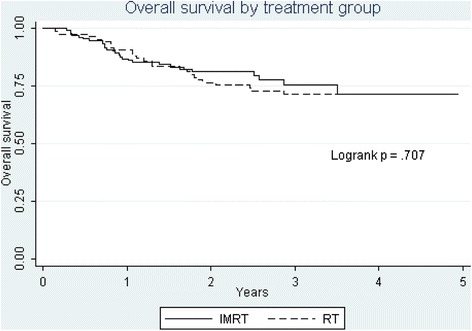
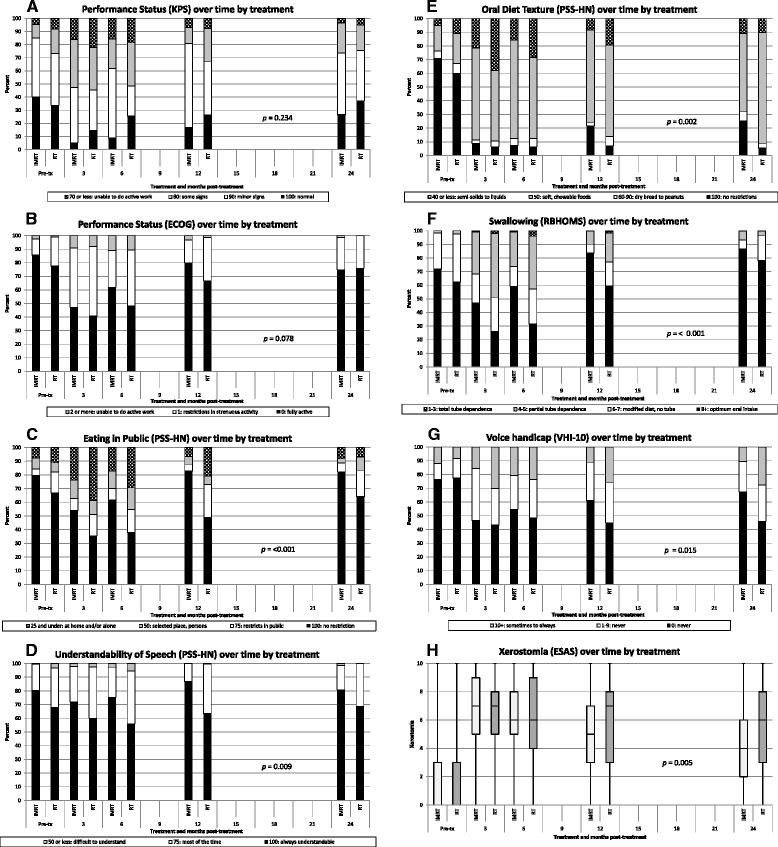
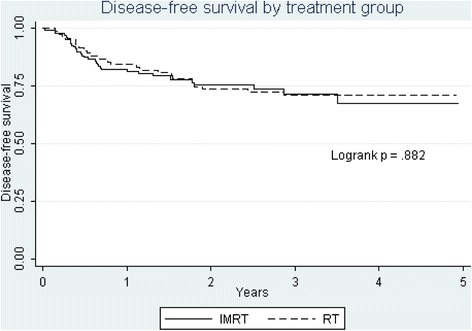
Mean age at diagnosis was 59 years. The primary site was base of tongue in 77 and tonsil or soft palate in 123 patients. Median follow up was 2.5 years for the second cohort. Concomitant therapy was used in 159 (79.5%). Overall survival at 3 years was 75.6% and 71.5% for IMRT and 3DCRT cohorts respectively (not significant). A multiple imputation technique was used to estimate missing values in order to avoid a healthy patient bias. KPS and ECOG reached nadirs at 3 to 6 months but approached baseline values at 12 to 24 months and did not differ by treatment. The 3 PSS-HN scales, Eating in Public (p < 0.001), Understandability of Speech (p = 0.009) and Oral Diet Texture (p = 0.002) and all showed significantly better outcomes in favor of IMRT. The RBHOMS showed a difference in favor of IMRT which appeared during 3 to 6 months (p < 0.001). The VHI-10 also showed a difference in favor of IMRT (p = 0.015). Self-rated xerostomia did not differ at 3 and 6 months but was significantly better in favor of IMRT after 12 months p = 0.005 CONCLUSIONS: A prospectively administered functional outcomes protocol showed meaningful differences in favor of IMRT over 3DCRT early (3-6 months) and later (12-24 months) in the treatment of oropharyngeal carcinoma with equivalent survival. These data support the adoption of IMRT as the standard radiation treatment method for patients with stage III and IV (M0) oropharyngeal squamous carcinoma. KPS and ECOG may not be sensitive to oropharyngeal cancer patients' functional outcomes by treatment.
比较采用三维适形放疗(3DCRT)或调强放疗(IMRT)序贯治疗的Ⅲ期和Ⅳ期(M0)口咽鳞状细胞癌患者早期(3个月和6个月)及晚期(12个月和24个月)的功能结局。
前瞻性评估了在单一机构分别接受3DCRT和IMRT治疗的连续人群队列中的200例患者,这两个队列分别有83例和117例患者。在治疗前以及治疗后3、6、12和24个月对患者进行评估。应用了标准的功能结局方案,包括体能状态(KPS、ECOG)、3种头颈部功能状态量表(PSS-HN)、皇家布里斯班医院吞咽结局测量量表(RBHOMS)、嗓音障碍指数-10(VHI-10)以及自我评估的口干情况。
诊断时的平均年龄为59岁。主要部位为舌根的有77例患者,扁桃体或软腭的有123例患者。第二个队列的中位随访时间为2.5年。159例(79.5%)患者接受了同步治疗。IMRT和3DCRT队列的3年总生存率分别为75.6%和71.5%(无显著差异)。采用多重填补技术估计缺失值,以避免健康患者偏差。KPS和ECOG在3至6个月时降至最低点,但在12至24个月时接近基线值,且不同治疗方式之间无差异。3种PSS-HN量表,即公共场合进食(p<0.001)、言语可理解性(p=0.009)和口腔饮食质地(p=0.002),均显示IMRT的结局明显更好。RBHOMS显示在3至6个月期间IMRT更具优势(p<0.001)。VHI-10也显示IMRT更具优势(p=0.015)。自我评估的口干情况在3个月和6个月时无差异,但在12个月后IMRT明显更好(p=0.005)。结论:一项前瞻性实施的功能结局方案显示,在口咽癌治疗中,IMRT在早期(3 - 6个月)和晚期(12 - 24个月)相对于3DCRT有显著差异,且生存率相当。这些数据支持将IMRT作为Ⅲ期和Ⅳ期(M0)口咽鳞状细胞癌患者的标准放射治疗方法。KPS和ECOG可能对不同治疗方式的口咽癌患者功能结局不敏感。