Gupta Rajeev, Sharma Krishna Kumar, Gupta Bal Kishan, Gupta Arvind, Saboo Banshi, Maheshwari Anuj, Mahanta Tulika, Deedwania Prakash C
Fortis Escorts Hospital, Jaipur, India.
SP Medical College and Associated Group of Hospitals, Bikaner, India.
J Glob Health. 2015 Jun;5(1):010411. doi: 10.7189/jogh.05.010411.
To determine epidemiology of cardiovascular risk factors according to geographic distribution and macrolevel social development index among urban middle class subjects in India.
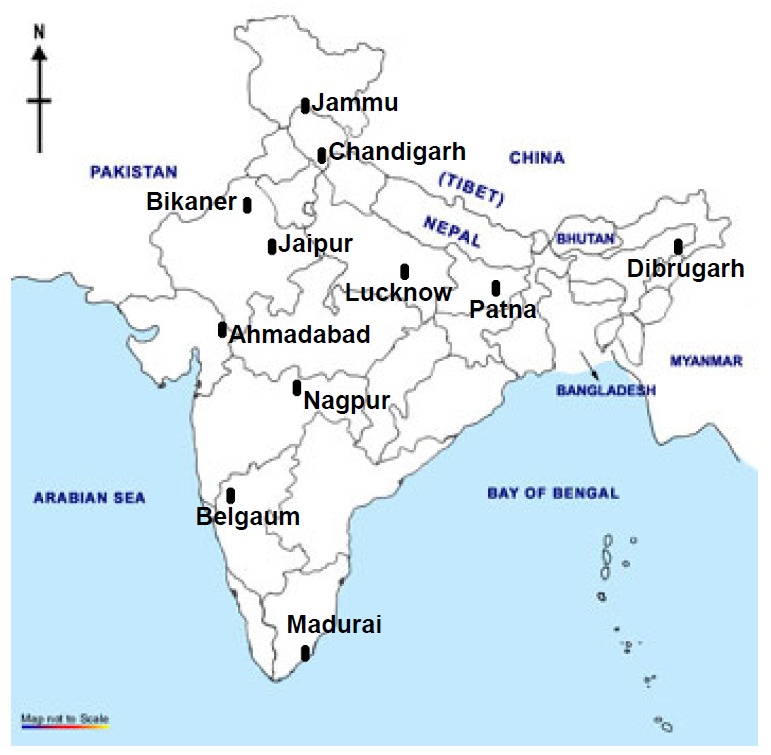
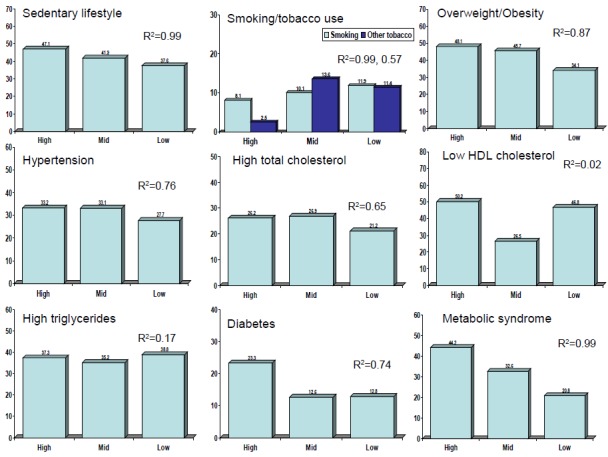
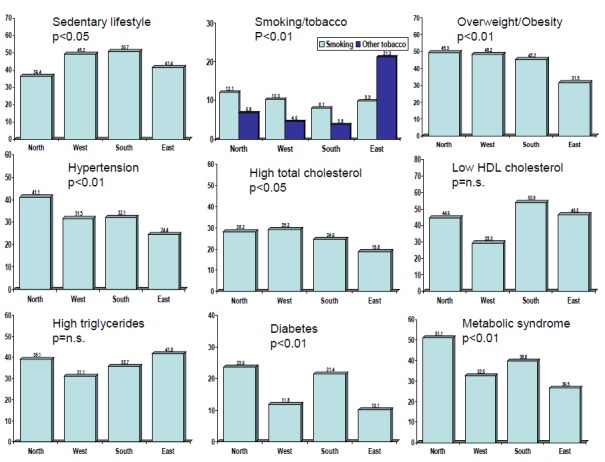
We performed cross-sectional surveys in 11 cities in India during years 2005-2009. 6198 subjects aged 20-75 years (men 3426, women 2772, response 62%) were evaluated for cardiovascular risk factors. Cities were grouped according to geographic distribution into northern (3 cities, n = 1321), western (2 cities, n = 1814), southern (3 cities, n = 1237) and eastern (3 cities, n = 1826). They were also grouped according to human social development index into low (3 cities, n = 1794), middle (5 cities, n = 2634) and high (3 cities, n = 1825). Standard definitions were used to determine risk factors. Differences in risk factors were evaluated using χ(2) test. Trends were examined by least squares regression.
Age-adjusted prevalence (95% confidence intervals) of various risk factors was: low physical activity 42.1% (40.9-43.3), high dietary fat 49.9% (47.8-52.0), low fruit/vegetables 26.9% (25.8-28.0), smoking 10.1% (9.1-11.1), smokeless tobacco use 9.8% (9.1-10.5), overweight 42.9% (41.7-44.1), obesity 11.6% (10.8-12.4), high waist circumference 45.5% (44.3-46.7), high waist-hip ratio 75.7% (74.7-76.8), hypertension 31.6% (30.4-32.8), hypercholesterolemia 25.0% (23.9-26.9), low HDL cholesterol 42.5% (41.3-43.7), hypertriglyceridemia 36.9% (35.7-38.1), diabetes 15.7% (14.8-16.6), and metabolic syndrome 35.7% (34.5-36.9). Compared with national average, prevalence of most risk factors was not significantly different in various geographic regions, however, cities in eastern region had significantly lower prevalence of overweight, hypertension, hypercholesterolemia, diabetes and metabolic syndrome compared with other regions (P < 0.05 for various comparisons). It was also observed that cities with low human social development index had lowest prevalence of these risk factors in both sexes (P < 0.05).
Urban middle-class men and women in eastern region of India have significantly lower cardiometabolic risk factors compared to northern, western and southern regions. Low human social development index cities have lower risk factor prevalence.
根据印度城市中产阶级人群的地理分布和宏观社会发展指数,确定心血管危险因素的流行病学特征。
2005年至2009年期间,我们在印度的11个城市进行了横断面调查。对6198名年龄在20 - 75岁之间的受试者(男性3426名,女性2772名,应答率62%)进行了心血管危险因素评估。城市根据地理分布分为北部(3个城市,n = 1321)、西部(2个城市,n = 1814)、南部(3个城市,n = 1237)和东部(3个城市,n = 1826)。它们还根据人类社会发展指数分为低(3个城市,n = 1794)、中(5个城市,n = 2634)和高(3个城市,n = 1825)。采用标准定义确定危险因素。使用χ(2)检验评估危险因素的差异。通过最小二乘法回归分析趋势。
各危险因素经年龄调整后的患病率(95%置信区间)为:体力活动不足42.1%(40.9 - 43.3)、膳食脂肪高49.9%(47.8 - 52.0)、水果/蔬菜摄入不足26.9%(25.8 - 28.0)、吸烟10.1%(9.1 - 11.1)、使用无烟烟草9.8%(9.1 - 10.5)、超重42.9%(41.7 - 44.1)、肥胖11.6%(10.8 - 12.4)、腰围高45.5%(44.3 - 46.7)、腰臀比高75.7%(74.7 - 76.8)、高血压31.6%(30.4 - 32.8)、高胆固醇血症25.0%(23.9 - 26.9)、高密度脂蛋白胆固醇低42.5%(41.3 - 43.7)、高甘油三酯血症36.9%(35.7 - 38.1)、糖尿病15.7%(14.8 - 16.6)、代谢综合征35.7%(34.5 - 36.9)。与全国平均水平相比,各地理区域大多数危险因素的患病率无显著差异,然而,东部地区城市的超重、高血压、高胆固醇血症、糖尿病和代谢综合征的患病率显著低于其他地区(各比较P < 0.05)。还观察到,人类社会发展指数低的城市中,这些危险因素在男女两性中的患病率最低(P < 0.05)。
与北部、西部和南部地区相比,印度东部地区的城市中产阶级男性和女性的心脏代谢危险因素显著更低。人类社会发展指数低的城市危险因素患病率更低。