Guan Junjie, Zhang Jieyuan, Li Haiyan, Zhu Zhenzhong, Guo Shangchun, Niu Xin, Wang Yang, Zhang Changqing
Department of Orthopedic Surgery, Shanghai Jiao Tong University Affiliated Sixth People's Hospital, Shanghai, People's Republic of China.
Med-X Research Institute, School of Biomedical Engineering, Shanghai Jiaotong University, Shanghai, People's Republic of China.
PLoS One. 2015 May 13;10(5):e0125253. doi: 10.1371/journal.pone.0125253. eCollection 2015.
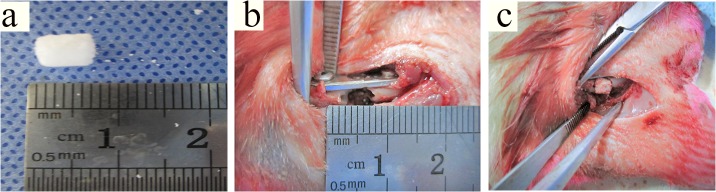
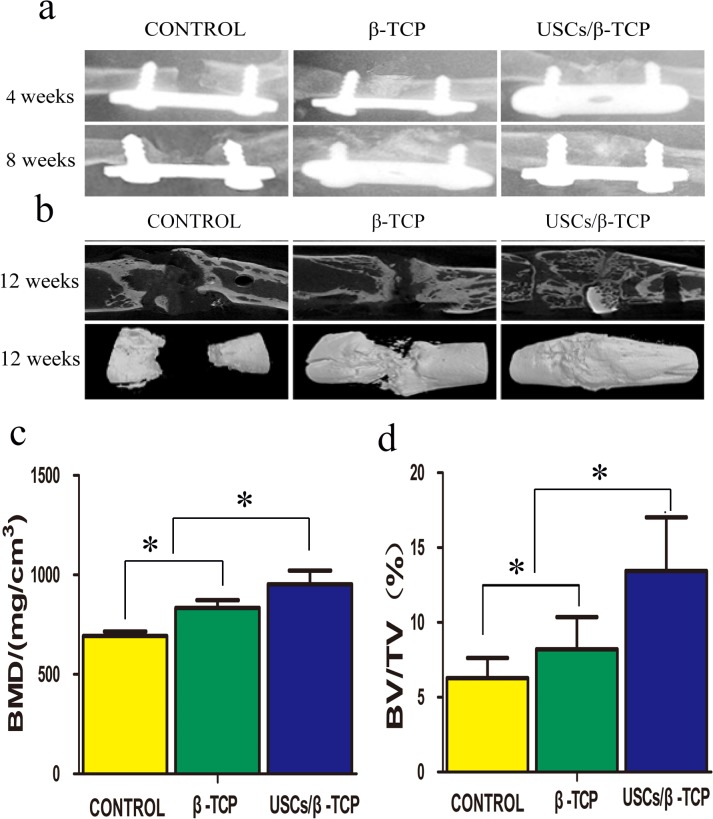
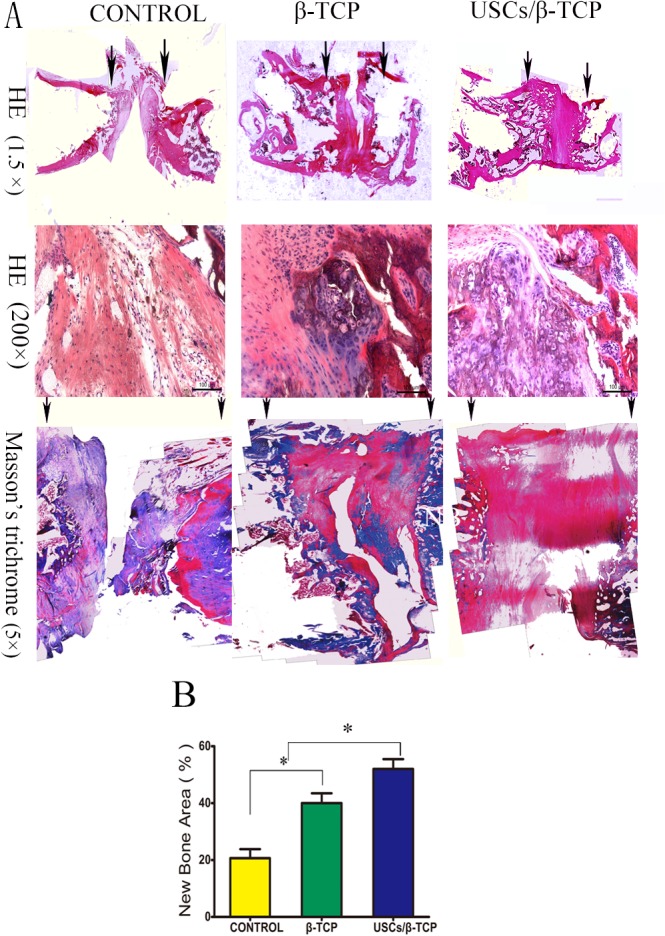
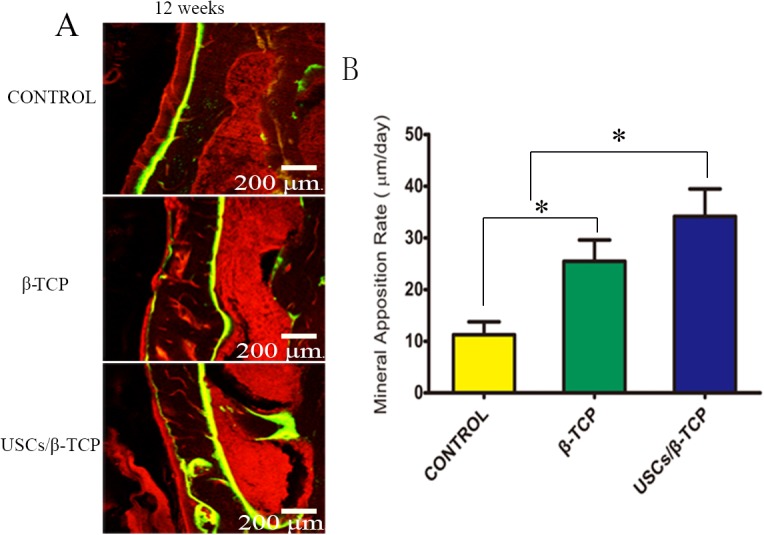
Bone tissue engineering requires highly proliferative stem cells that are easy to isolate. Human urine stem cells (USCs) are abundant and can be easily harvested without using an invasive procedure. In addition, in our previous studies, USCs have been proved to be able to differentiate into osteoblasts, chondrocytes, and adipocytes. Therefore, USCs may have great potential and advantages to be applied as a cell source for tissue engineering. However, there are no published studies that describe the interactions between USCs and biomaterials and applications of USCs for bone tissue engineering. Therefore, the objective of the present study was to evaluate the interactions between USCs with a typical bone tissue engineering scaffold, beta-Tricalcium Phosphate (β-TCP), and to determine whether the USCs seeded onto β-TCP scaffold can promote bone regeneration in a segmental femoral defect of rats. Primary USCs were isolated from urine and seeded on β-TCP scaffolds. Results showed that USCs remained viable and proliferated within β-TCP. The osteogenic differentiation of USCs within the scaffolds was demonstrated by increased alkaline phosphatase activity and calcium content. Furthermore, β-TCP with adherent USCs (USCs/β-TCP) were implanted in a 6-mm critical size femoral defect of rats for 12 weeks. Bone regeneration was determined using X-ray, micro-CT, and histologic analyses. Results further demonstrated that USCs in the scaffolds could enhance new bone formation, which spanned bone defects in 5 out of 11 rats while β-TCP scaffold alone induced modest bone formation. The current study indicated that the USCs can be used as a cell source for bone tissue engineering as they are compatible with bone tissue engineering scaffolds and can stimulate the regeneration of bone in a critical size bone defect.
骨组织工程需要易于分离的高增殖性干细胞。人尿干细胞(USCs)数量丰富,无需采用侵入性操作即可轻松获取。此外,在我们之前的研究中,已证明USCs能够分化为成骨细胞、软骨细胞和脂肪细胞。因此,USCs作为组织工程的细胞来源可能具有巨大的潜力和优势。然而,目前尚无已发表的研究描述USCs与生物材料之间的相互作用以及USCs在骨组织工程中的应用。因此,本研究的目的是评估USCs与一种典型的骨组织工程支架β-磷酸三钙(β-TCP)之间的相互作用,并确定接种到β-TCP支架上的USCs是否能促进大鼠股骨节段性缺损处的骨再生。从尿液中分离出原代USCs并接种到β-TCP支架上。结果显示,USCs在β-TCP内保持存活并增殖。支架内USCs的成骨分化通过碱性磷酸酶活性和钙含量的增加得以证明。此外,将带有黏附USCs的β-TCP(USCs/β-TCP)植入大鼠6毫米临界尺寸的股骨缺损处12周。使用X射线、微型计算机断层扫描(micro-CT)和组织学分析来确定骨再生情况。结果进一步表明,支架中的USCs能够增强新骨形成,在11只大鼠中有5只的骨缺损处有新骨跨越,而单独的β-TCP支架仅诱导了适度的骨形成。当前研究表明,USCs可作为骨组织工程的细胞来源,因为它们与骨组织工程支架相容,并且能够在临界尺寸的骨缺损处刺激骨再生。