Xu Menglong, Zhang Dong, Yang Yan, Liu Yu, Yuan Zhiyong, Qin Qianqing
School of Physics and Technology, Wuhan University, Wuhan, Hubei, China.
School of Computer, Wuhan University, Wuhan, Hubei, China.
PLoS One. 2015 May 14;10(5):e0125738. doi: 10.1371/journal.pone.0125738. eCollection 2015.
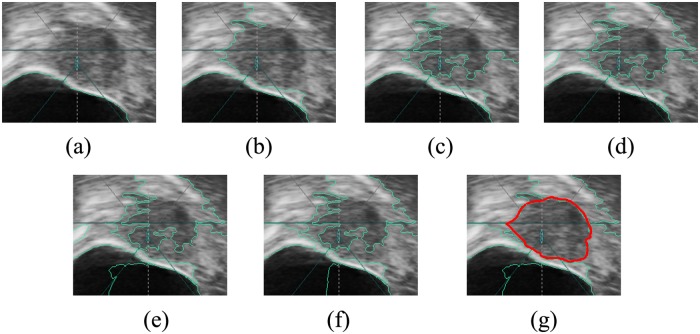
High-intensity focused ultrasound (HIFU) therapy has been used to treat uterine fibroids widely and successfully. Uterine fibroid segmentation plays an important role in positioning the target region for HIFU therapy. Presently, it is completed by physicians manually, reducing the efficiency of therapy. Thus, computer-aided segmentation of uterine fibroids benefits the improvement of therapy efficiency. Recently, most computer-aided ultrasound segmentation methods have been based on the framework of contour evolution, such as snakes and level sets. These methods can achieve good performance, although they need an initial contour that influences segmentation results. It is difficult to obtain the initial contour automatically; thus, the initial contour is always obtained manually in many segmentation methods. A split-and-merge-based uterine fibroid segmentation method, which needs no initial contour to ensure less manual intervention, is proposed in this paper. The method first splits the image into many small homogeneous regions called superpixels. A new feature representation method based on texture histogram is employed to characterize each superpixel. Next, the superpixels are merged according to their similarities, which are measured by integrating their Quadratic-Chi texture histogram distances with their space adjacency. Multi-way Ncut is used as the merging criterion, and an adaptive scheme is incorporated to decrease manual intervention further. The method is implemented using Matlab on a personal computer (PC) platform with Intel Pentium Dual-Core CPU E5700. The method is validated on forty-two ultrasound images acquired from HIFU therapy. The average running time is 9.54 s. Statistical results showed that SI reaches a value as high as 87.58%, and normHD is 5.18% on average. It has been demonstrated that the proposed method is appropriate for segmentation of uterine fibroids in HIFU pre-treatment imaging and planning.
高强度聚焦超声(HIFU)治疗已被广泛且成功地用于治疗子宫肌瘤。子宫肌瘤分割在HIFU治疗的目标区域定位中起着重要作用。目前,它由医生手动完成,降低了治疗效率。因此,子宫肌瘤的计算机辅助分割有助于提高治疗效率。最近,大多数计算机辅助超声分割方法都基于轮廓演化框架,如蛇形模型和水平集。这些方法可以取得良好的效果,尽管它们需要一个初始轮廓,而该轮廓会影响分割结果。自动获取初始轮廓很困难;因此,在许多分割方法中,初始轮廓总是手动获取的。本文提出了一种基于分裂合并的子宫肌瘤分割方法,该方法无需初始轮廓以确保较少的人工干预。该方法首先将图像分割成许多称为超像素的小均匀区域。采用一种基于纹理直方图的新特征表示方法来表征每个超像素。接下来,根据超像素的相似性进行合并,相似性通过将它们的二次卡方纹理直方图距离与空间邻接性相结合来衡量。采用多路Ncut作为合并准则,并引入一种自适应方案以进一步减少人工干预。该方法在配备英特尔奔腾双核CPU E5700的个人计算机(PC)平台上使用Matlab实现。该方法在从HIFU治疗获取的42幅超声图像上进行了验证。平均运行时间为9.54秒。统计结果表明,SI高达87.58%,平均normHD为5.18%。已经证明所提出的方法适用于HIFU治疗前成像和规划中的子宫肌瘤分割。