Dong Xiaoxi, Yambartsev Anatoly, Ramsey Stephen A, Thomas Lina D, Shulzhenko Natalia, Morgun Andrey
College of Pharmacy, Oregon State University, Corvallis, OR, USA.
Department of Statistics, Institute of Mathematics and Statistics, University of Sao Paulo, Sao Paulo, SP, Brazil.
Bioinform Biol Insights. 2015 Apr 29;9:61-74. doi: 10.4137/BBI.S12467. eCollection 2015.
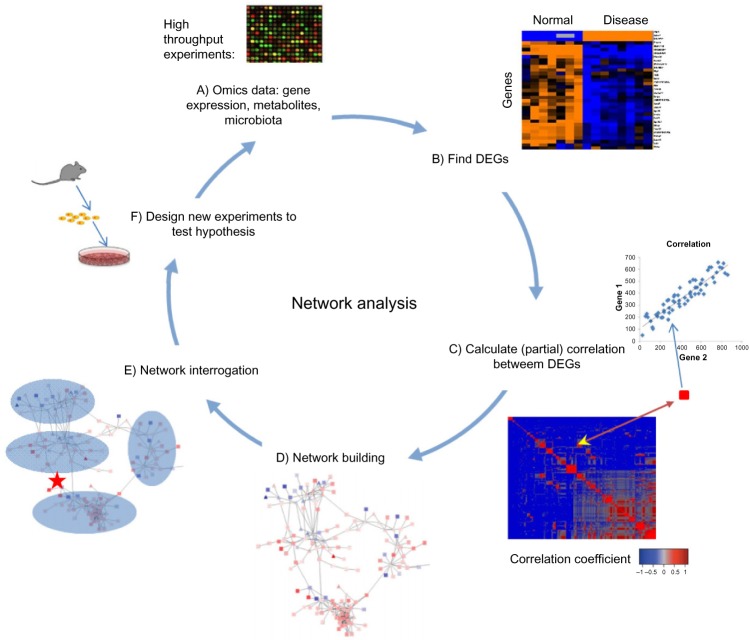
Omics technologies enable unbiased investigation of biological systems through massively parallel sequence acquisition or molecular measurements, bringing the life sciences into the era of Big Data. A central challenge posed by such omics datasets is how to transform these data into biological knowledge, for example, how to use these data to answer questions such as: Which functional pathways are involved in cell differentiation? Which genes should we target to stop cancer? Network analysis is a powerful and general approach to solve this problem consisting of two fundamental stages, network reconstruction, and network interrogation. Here we provide an overview of network analysis including a step-by-step guide on how to perform and use this approach to investigate a biological question. In this guide, we also include the software packages that we and others employ for each of the steps of a network analysis workflow.
组学技术能够通过大规模平行序列采集或分子测量对生物系统进行无偏见研究,将生命科学带入大数据时代。此类组学数据集带来的一个核心挑战是如何将这些数据转化为生物知识,例如,如何利用这些数据回答以下问题:细胞分化涉及哪些功能通路?我们应该靶向哪些基因来阻止癌症?网络分析是解决这一问题的一种强大且通用的方法,它由两个基本阶段组成,即网络重建和网络查询。在此,我们提供网络分析概述,包括关于如何执行和使用此方法来研究生物学问题的分步指南。在本指南中,我们还列出了我们自己以及其他人在网络分析工作流程的每个步骤中使用的软件包。