Ibrahimi Pranvera, Jashari Fisnik, Bajraktari Gani, Wester Per, Henein Michael Y
Department of Public Health and Clinical Medicine, Umeå University, Umeå 901 87, Sweden.
Int J Mol Sci. 2015 May 12;16(5):10734-47. doi: 10.3390/ijms160510734.
To evaluate in a systematic review and meta-analysis model the effect of statin therapy on carotid plaque echogenicity assessed by ultrasound.
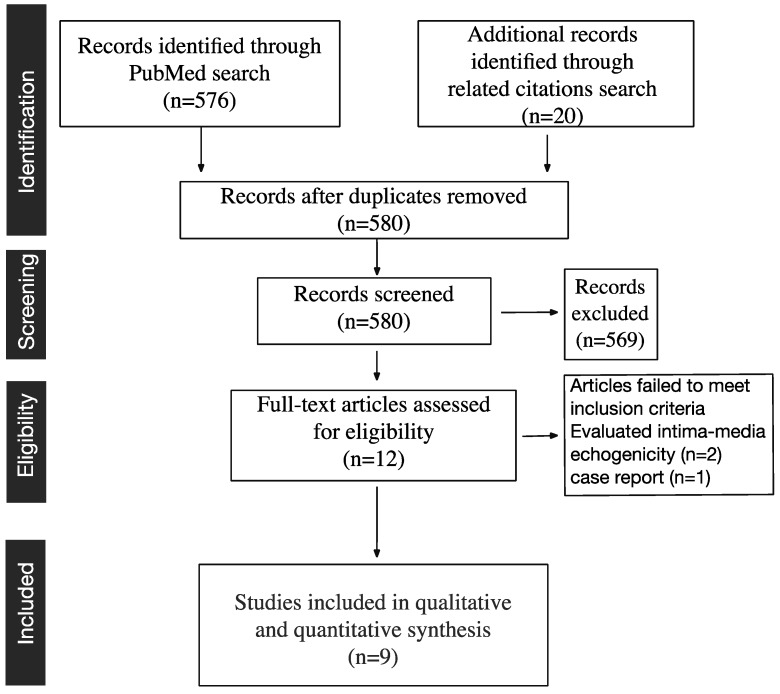
We have systematically searched electronic databases (PubMed, MEDLINE, EMBASE and Cochrane Center Register) up to April, 2015, for studies evaluating the effect of statins on plaque echogenicity. Two researchers independently determined the eligibility of studies evaluating the effect of statin therapy on carotid plaque echogenicity that used ultrasound and grey scale median (GSM) or integrated back scatter (IBS).
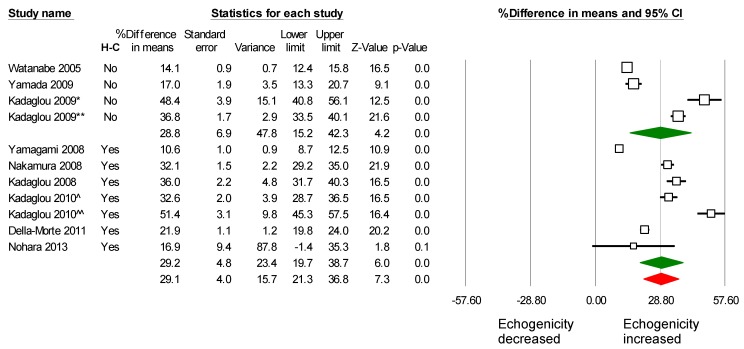
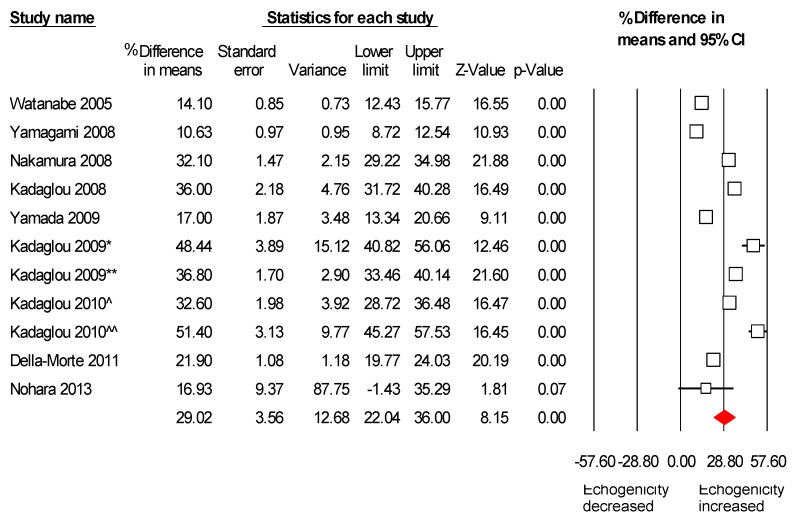
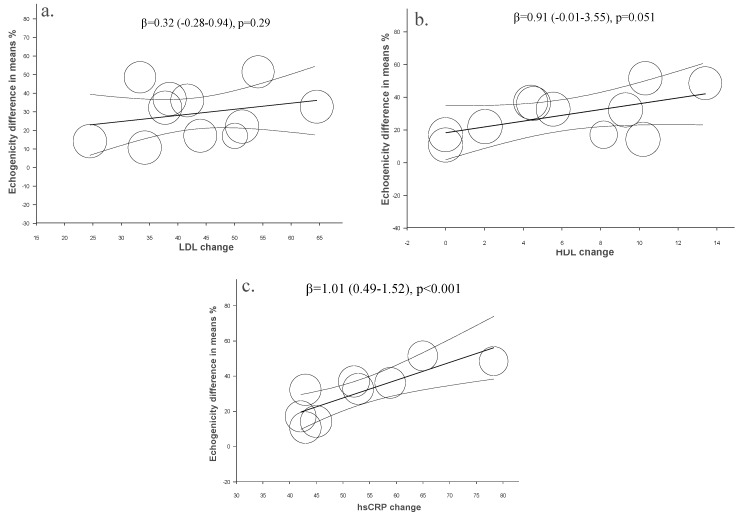
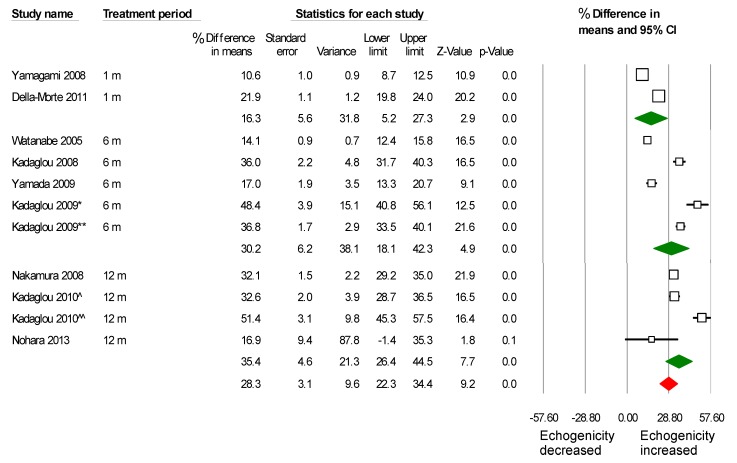
Nine out of 580 identified studies including 566 patients' carotid artery data were meta-analyzed for a mean follow up of 7.2 months. A consistent increase in the echogenicity of carotid artery plaques, after statin therapy, was reported. Pooled weighted mean difference % (WMD) on plaque echogenicity after statin therapy was 29% (95% CI 22%-36%), p<0.001, I2=92.1%. In a meta-regression analysis using % mean changes of LDL, HDL and hsCRP as moderators, it was shown that the effects of statins on plaque echogenicity were related to changes in hsCRP, but not to LDL and HDL changes from the baseline. The effect of statins on the plaque was progressive; it showed significance after the first month of treatment, and the echogenicity continued to increase in the following six and 12 months.
Statin therapy is associated with a favorable increase of carotid plaque echogenicity. This effect seems to be dependent on the period of treatment and hsCRP change from the baseline, independent of changes in LDL and HDL.
采用系统评价和荟萃分析模型评估他汀类药物治疗对超声评估的颈动脉斑块回声性的影响。
我们系统检索了截至2015年4月的电子数据库(PubMed、MEDLINE、EMBASE和Cochrane中心注册库),以查找评估他汀类药物对斑块回声性影响的研究。两名研究人员独立确定了评估他汀类药物治疗对使用超声和灰阶中位数(GSM)或背向散射积分(IBS)的颈动脉斑块回声性影响的研究的纳入资格。
对580项已识别研究中的9项进行了荟萃分析,这些研究包含566例患者的颈动脉数据,平均随访7.2个月。结果显示,他汀类药物治疗后颈动脉斑块回声性持续增加。他汀类药物治疗后斑块回声性的合并加权平均差百分比(WMD)为29%(95%CI 22%-36%),p<0.001,I²=92.1%。在一项以低密度脂蛋白(LDL)、高密度脂蛋白(HDL)和高敏C反应蛋白(hsCRP)的平均变化百分比作为调节因素的荟萃回归分析中,结果表明,他汀类药物对斑块回声性的影响与hsCRP的变化有关,而与基线时LDL和HDL的变化无关。他汀类药物对斑块的作用是渐进性的;在治疗的第一个月后显示出显著性,并且在随后的6个月和12个月内回声性持续增加。
他汀类药物治疗与颈动脉斑块回声性的有利增加相关。这种效应似乎取决于治疗时间和基线时hsCRP的变化,与LDL和HDL的变化无关。