Sasayama Kensaku, Ochi Eisuke, Adachi Minoru
Joint Graduate School in Science of School Education, Hyogo University of Teacher Education, Kato, Hyogo prefecture, Japan.
Graduate School of Education, Okayama University, Okayama, Japan.
PLoS One. 2015 May 20;10(5):e0127400. doi: 10.1371/journal.pone.0127400. eCollection 2015.
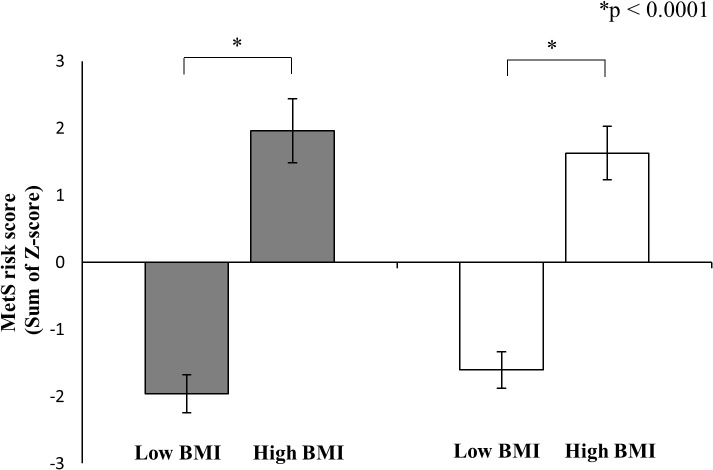
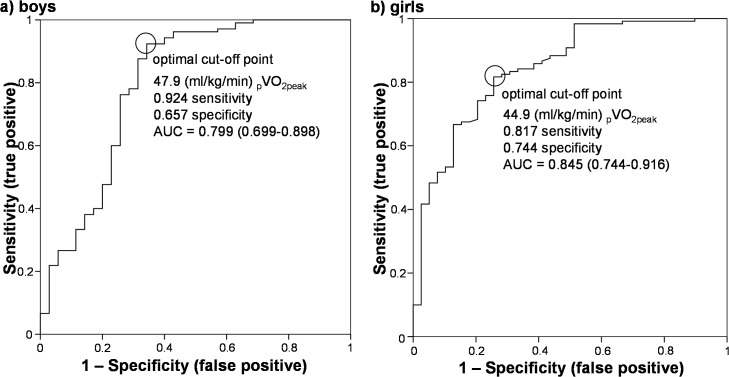
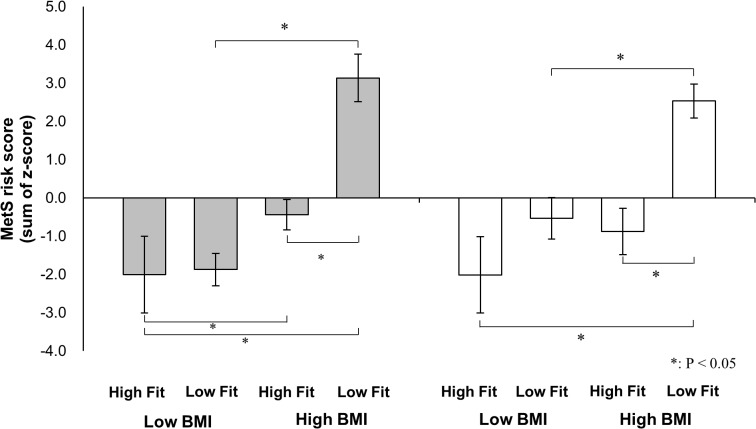
Associations between body mass index (BMI), peak oxygen consumption (VO(2peak)), and metabolic syndrome (MetS) risk factors have not been adequately studied in Japanese children. Here the relationships between these parameters and the threshold aerobic fitness level necessary for low MetS risk were determined. The participants (299 children; 140 boys and 159 girls, aged 9.1 ± 0.3 years) were divided into four groups using the medians of predicted VO(2peak) (pVO(2peak)) and BMI. MetS risk scores were calculated using z-scores. Receiver Operating Characteristic analysis was used to determine the threshold aerobic fitness level necessary for low MetS risk. The MetS risk score of the High BMI group was significantly higher than that of the Low BMI group for both sexes (p < 0.0001). However, the High BMI/High Fitness group had a significantly lower MetS risk score than the High BMI/Low Fitness group for both sexes. The (p)VO(2peak )cut-off values for low MetS risk were 47.9 and 44.9 ml/kg/min for boys and girls, respectively. Our results suggest that improvements in both fatness and aerobic fitness are important for decreasing MetS risk. We also confirmed the (p)VO(2peak) of cut-off values necessary for low MetS risk in Japanese children.
在日本儿童中,体重指数(BMI)、峰值耗氧量(VO₂peak)与代谢综合征(MetS)风险因素之间的关联尚未得到充分研究。在此,我们确定了这些参数之间的关系以及低MetS风险所需的有氧适能水平阈值。参与者(299名儿童;140名男孩和159名女孩,年龄9.1±0.3岁)根据预测的VO₂peak(pVO₂peak)和BMI的中位数分为四组。使用z分数计算MetS风险评分。采用受试者工作特征分析来确定低MetS风险所需的有氧适能水平阈值。高BMI组的MetS风险评分在两性中均显著高于低BMI组(p<0.0001)。然而,高BMI/高适能组的MetS风险评分在两性中均显著低于高BMI/低适能组。低MetS风险的(p)VO₂peak临界值在男孩和女孩中分别为47.9和44.9 ml/kg/min。我们的结果表明,肥胖和有氧适能的改善对于降低MetS风险都很重要。我们还确定了日本儿童低MetS风险所需的(p)VO₂peak临界值。